
JWST has detected an ultrahot super‑Earth, TOI‑561 b, that surprisingly retains a thick, volatile‑rich atmosphere despite extreme irradiation. NIRSpec measurements show the planet's dayside is markedly cooler (about 3,200°F / 1,800°C) than expected for a bare rock, implying heat redistribution, water‑vapor absorption, and reflective silicate clouds. The planet orbits every 11 hours at roughly 1/40th Mercury's distance and is tidally locked. The findings, published Dec. 11 in The Astrophysical Journal Letters, challenge current models of atmospheric loss and formation.
James Webb Finds a 'Hell Planet': Ultrabright Super‑Earth Keeps an Atmosphere It Shouldn't

An artist's illustration of "hell" planet TOI 601-b, located 280 light-years from Earth. | Credit: Illustration: NASA, ESA, CSA, Ralf Crawford (STScI)
The James Webb Space Telescope (JWST) has revealed an unexpected world: an ultrahot super‑Earth, TOI‑561 b, that appears to retain a thick, volatile‑rich atmosphere above a likely magma ocean. The discovery challenges prevailing ideas about how close‑in planets lose their gaseous envelopes and offers a new laboratory for studying extreme atmospheres.
Key Observations
TOI‑561 b lies about 280 light‑years away in the constellation Sextans and has a radius roughly 1.4 times that of Earth. The planet completes an orbit in just 11 hours, placing it among the rare class of ultra‑short‑period exoplanets. It orbits at roughly 1/40th the distance between Mercury and the Sun and is likely tidally locked, with a permanent dayside and nightside.
Surprising Temperature—and Atmosphere
Using JWST's Near‑Infrared Spectrograph (NIRSpec), researchers measured the planet's dayside temperature from the depth of the secondary eclipse (the drop in combined light when the planet moves behind its star). A bare‑rock surface at this proximity should heat to about 4,900°F (2,700°C), yet JWST measured a dayside temperature near 3,200°F (1,800°C). The only model that fits the observations is one with a substantial, volatile‑rich atmosphere.
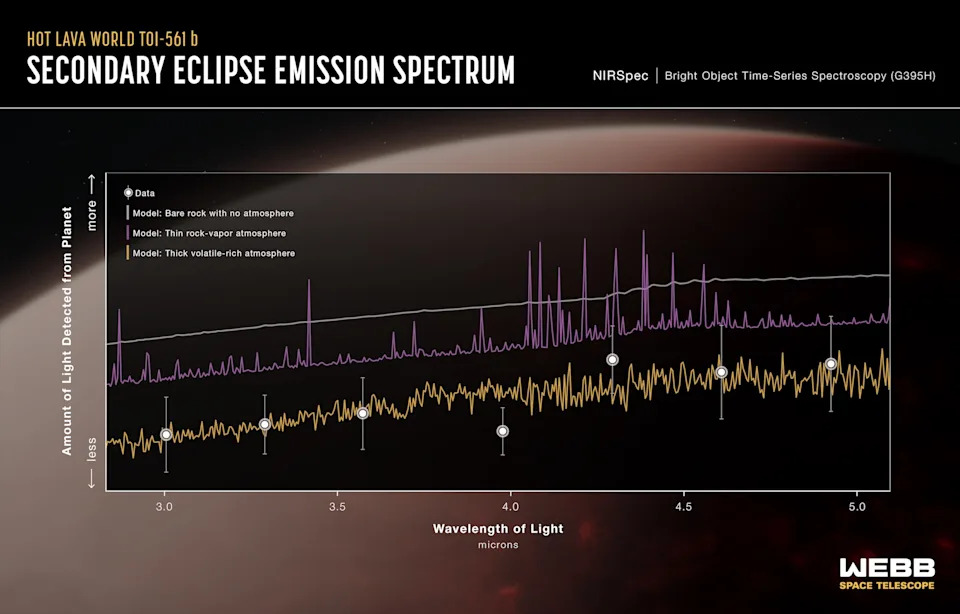
Light from JWST shows the brightness of the planet in near-infrared light as it passes behind its star. It is much cooler than expected, which suggests it has a thick, volatile, chemical-rich atmosphere. | Credit: Illustration: NASA, ESA, CSA, Ralf Crawford (STScI); Science: Johanna Teske (Carnegie Science Earth and Planets Laboratory), Anjali Piette (University of Birmingham), Tim Lichtenberg (Groningen), Nicole Wallack (Carnegie Science Earth and Planets Laboratory)
"What's really exciting is that this new data set is opening up even more questions than it's answering," said Johanna Teske, lead author and staff scientist at Carnegie Science's Earth and Planets Laboratory.
How an Atmosphere Explains the Puzzle
An atmosphere with abundant volatile species can transport heat from the permanent dayside to the nightside via strong winds, lowering the dayside temperature. It could also contain water vapor that absorbs near‑infrared light before it reaches JWST's detectors, and bright silicate clouds (rock‑forming minerals) that reflect incoming starlight—both effects that reduce the measured dayside flux.
These conclusions are surprising because TOI‑561 b orbits an old, iron‑poor star (about twice the Sun's age) in the Milky Way's thick disk. Over long timescales, intense stellar radiation is expected to strip atmospheres from planets so close to their stars, yet this world appears to have retained or re‑formed a substantial envelope.
Implications and Publication
The team's results were published on Dec. 11 in The Astrophysical Journal Letters. Although TOI‑561 b's extreme heat makes it inhospitable to life, studying its atmosphere with JWST will help refine models of atmospheric formation and loss and improve strategies for detecting atmospheres (and potential biosignatures) on cooler, more Earth‑like exoplanets.
Study Authors (Selected): Johanna Teske, Tim Lichtenberg, Anjali Piette.


