U.S. Navy Secretary John Phelan will personally review and approve any design change orders for the new Medium Landing Ship, holding weekly meetings he has reserved on Fridays at 5 p.m.. The Navy selected the Dutch-designed Damen LST 100 (≈4,000 tons, helicopter-capable) as a mature, non-developmental hull to reduce acquisition risk. The move responds to failures in the Constellation-class frigate program, where building began before requirements were finalized; experts say Phelan's oversight helps but institutional reforms are still required.
Navy Secretary Institutes Friday Change-Order Hours to Avoid Another Frigate Fiasco

Renderings of the LST 100 Medium Landing ShipNAVSEA
U.S. Navy Secretary John Phelan has stepped into the shipbuilding process for the Navy's new Medium Landing Ship (LSM), personally requiring that any design change orders go through him during a weekly Friday review slot. The move aims to avoid repeating the cost overruns, schedule slips and program instability that plagued the Constellation-class frigate effort.
What Phelan announced
At the Reagan National Defense Forum, Phelan said the Navy has selected a mature, Dutch-designed hull — Damen's LST 100 — for the LSM program and will lock requirements before construction begins. He told attendees that "any change order will have to be put through me," and that he has "reserved Fridays at 5 p.m." for change-order decisions.

Renderings of the LST 100 Medium Landing ShipNAVSEA
Why this matters
The LST 100 displaces roughly 4,000 tons, can carry cargo and operate helicopters, and represents a non-developmental (off-the-shelf) design the Navy hopes will shorten acquisition timelines and reduce risk. Naval Sea Systems Command said choosing a mature design and applying strategic engineering will help ensure littoral mobility is delivered more quickly and predictably.
Lessons from the Constellation frigates
Phelan and other leaders cited the Constellation-class frigate program as a cautionary example: the Navy proceeded to build the first hull before finalizing requirements, and the program later suffered escalating costs and delays. The original contract with Fincantieri Marinette Marine was reportedly about $22 billion for 20 ships; the effort was curtailed and now continues with just two vessels under construction.
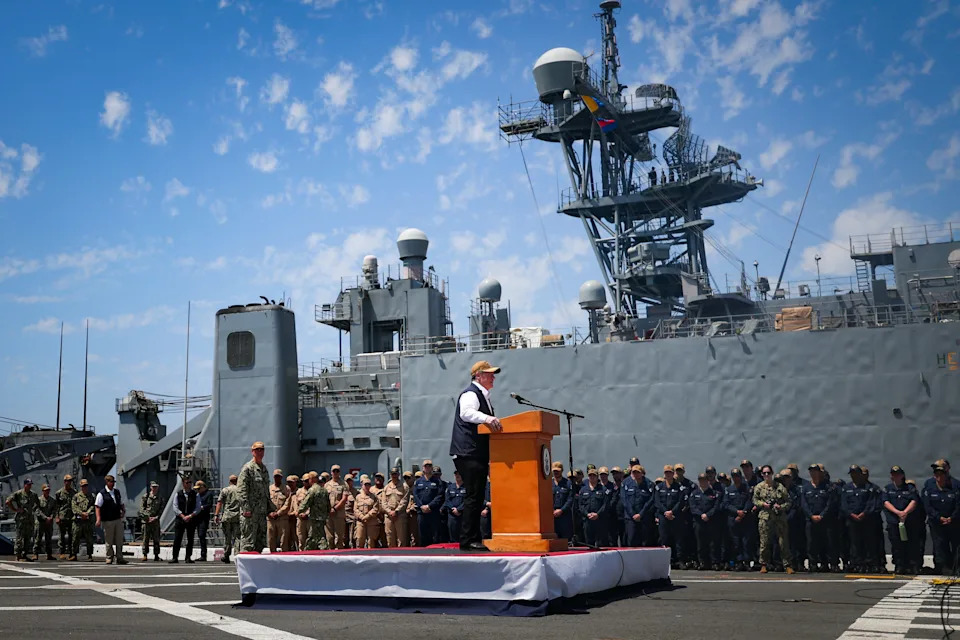
During the Reagan forum last week, Phelan placed equal blame for the Constellation frigate problem on the Navy and shipbuilder FMM.The San Diego Union-Tribune/The San Diego Union-Tribune via Getty Images
"We are going to take our warfighters' requirements, translate them into stable, producible designs, and stick with them once they're set. If anyone wants to tinker, I've reserved Fridays at 5pm in my office for change order decisions — no drift, no delay," Phelan said.
Scope and limits of the secretary's role
Traditionally, the secretary of the Navy sets budgets, procurement policy and acquisition priorities, while technical ship configuration and fleet tactics are handled by the chief of naval operations and NAVSEA. Phelan's direct involvement — especially in approving post-start change orders — narrows the gap between acquisition decisions and program execution, but observers warn that a personal intervention is no substitute for lasting institutional reform.
Former Navy Secretary Thomas Modly told reporters that Phelan's move is a "necessary first step" but not a full institutional solution. Modly emphasized the need for cultural change across programs: acceptance of minimally altered foreign designs when appropriate, long-tenured program managers, and processes that outlast any single secretary's term.

Renderings of the LST 100 Medium Landing ShipNAVSEA
Broader shipbuilding context
Senior Navy leaders have prioritized clearer requirements, tighter cost control and faster delivery timelines amid long-term challenges such as a shrinking skilled workforce, stagnant wages, and aging shipyard infrastructure. Other modernization efforts include uncrewed surface vessels and exploratory concepts like hypersonic-missile-capable platforms — often discussed in reports under labels such as a potential "Golden Fleet." How these assets fit into overall fleet architecture remains an open question.
Phelan has also signaled that the Navy aims to be a smarter and more collaborative customer for industry — working with traditional defense contractors and new partners alike. His weekly change-order reviews are a practical, visible measure intended to keep the LSM program tightly constrained and on schedule.
Help us improve.