
Archaeologists have exposed the most complete continuous Hasmonean wall foundation yet found in Jerusalem — a nearly 50-meter-long, 5-meter-wide section that appears to have been uniformly dismantled rather than destroyed in battle. Researchers link the controlled razing to a ceasefire recorded by Flavius Josephus in 132–133 B.C. between John Hyrcanus I and Antiochus VII. The foundation was uncovered beneath an abandoned wing of the 1830 Kishleh building and will be displayed under a floating glass floor in a future Tower of David Museum gallery.
2,100-Year-Old Ceasefire? Archaeologists Uncover Longest Hasmonean Wall Foundation in Jerusalem
06:56 PM, 12/10/2025

The Jerusalem Regional Archaeologist for the Israel Antiquities Authority, Dr. Amit Re'im, walks in a section of an excavation site where, according to the institution, a city wall from the Hasmonean period, dating to the late 2nd century BCE, was uncovered under the Tower of David Citadel Museum, in the Old City of Jerusalem, Dec. 8, 2025. / Credit: Leo Correa / AP
Archaeologists have completed excavation of the most extensive continuous stretch yet found of a foundation that once supported walls encircling ancient Jerusalem, and say it may offer physical evidence of a ceasefire dating back about 2,100 years.
A Major Hasmonean Discovery
The dig, concluded last week, exposed the most intact portion discovered so far of fortifications built during the Hasmonean Kingdom — the dynasty associated with the historical events that inspired Hanukkah. The revealed foundation measures nearly 50 meters (164 feet) long and about 5 meters (16 feet) wide. Archaeologists believe it once supported walls taller than the present ramparts surrounding Jerusalem's Old City, most of which date to the Ottoman period centuries later.
Signs of Deliberate Dismantling
One striking feature of the uncovered foundation is evidence that the superstructure above it was uniformly lowered to a consistent height, rather than having been toppled chaotically by warfare or erosion. Dr. Amit Re'em of the Israel Antiquities Authority notes this controlled dismantling could reflect a deliberate policy rather than accidental destruction.
Historical Context: Ancient historian Flavius Josephus records that in 132–133 B.C., Seleucid King Antiochus VII (Sidetes) besieged Jerusalem. Facing pressure, Hasmonean ruler John Hyrcanus I negotiated terms that included tearing down the city's fortifications to secure the withdrawal of Antiochus's army — an account that aligns with the archaeological pattern seen at this site.
Why Only This Section?
Not all exposed sections of Hasmonean defenses show the same deliberate leveling, so researchers caution that the dismantling may have applied only to this segment of the wall. Some archaeologists suggest the cleared stretch might later have served as a foundation for subsequent construction, such as parts of Herod’s complex. It is considered unlikely Jerusalem was left entirely undefended for extended periods.
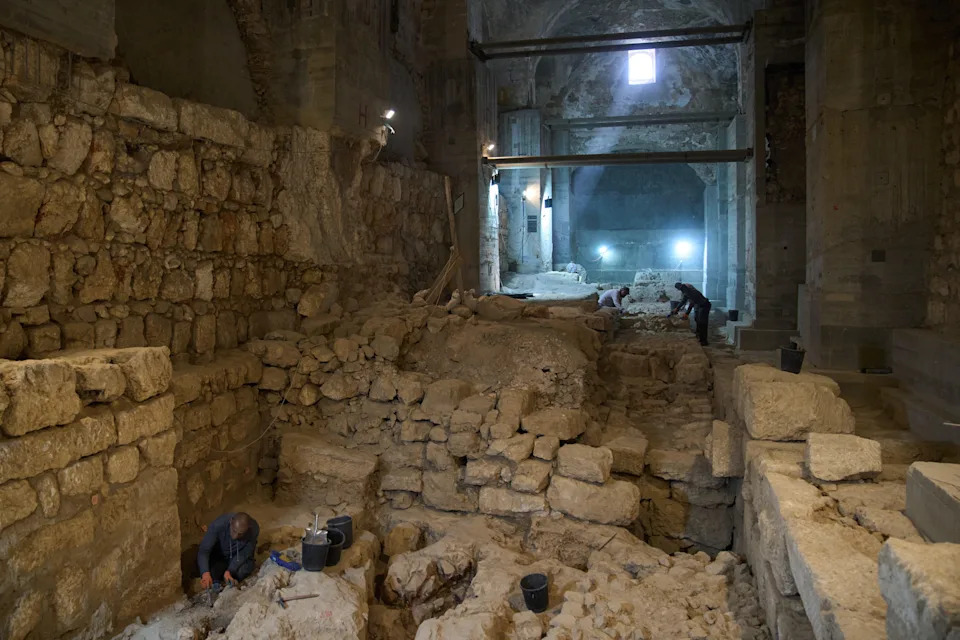
Workers from the Israel Antiquities Authority clean a section of an excavation site where, according to the institution, a city wall from the Hasmonean period, dating to the late 2nd century BCE, was uncovered under the Tower of David Citadel Museum, in the Old City of Jerusalem, Dec. 8, 2025. / Credit: Leo Correa / AP
Found Under an Old Prison Wing
The foundation was discovered beneath an abandoned wing of the Kishleh, a building erected in 1830 as a military compound. That wing later served as a prison, including during the British Mandate; graffiti in English, Hebrew and Arabic and remnants of iron cell bars remain. Most of the Kishleh still houses Israeli police functions, but the disused wing has been transferred to the Tower of David Museum.
Excavation and Museum Plans
Excavations at the site began in 1999 but were interrupted during the Second Intifada around 2000 and resumed recently. Archaeologists removed, by hand over the past two years, the equivalent of about two Olympic-size swimming pools of soil and debris. The dig also uncovered medieval dye pits, likely used for textile coloring. The Tower of David Museum plans to install a floating glass floor above the ruins and convert the hall into a gallery within its Schulich Wing of Archaeology, Art and Innovation; those renovations are expected to take at least two years.
Related Finds
Nearly a year ago, in December 2024, Israeli archaeologists announced the discovery of a hoard of roughly 160 coins attributed to King Alexander Jannaeus, the Hasmonean dynasty’s second ruler. Found in the Jordan Valley on the third day of Hanukkah, researchers described that timing as symbolically meaningful because of Alexander Jannaeus’s dynastic link to the leaders of the revolt traditionally associated with Hanukkah. More recently, teams in northern Israel reported evidence of an ancient religious practice and uncovered a wine press dated to about 5,000 years ago.
What This Means: While definitive proof linking the dismantling to the specific ceasefire described by Josephus cannot be established from a single site, the uniform lowering of the wall corroborates historical accounts and adds an important physical dimension to our understanding of Jerusalem’s turbulent Hellenistic-era history.
Similar Articles

Massive Hasmonean Wall Unearthed: Over 40 Metres of Maccabean-Era Fortification Revealed at Jerusalem’s Tower of David
The Israel Antiquities Authority has exposed a more than 40-metre segment of a Hasmonean (Maccabean-period) city wall at Jeru...

Archaeologists Uncover Royal Palace Remains on Alexandrium, Revealing Herodian Architecture
The Alexandrium fortress, perched about 650 metres above the Jordan Valley, has yielded remains of a newly identified royal p...

Beneath the Stone: 39 Ancient Quarries Mapped Under Modern Jerusalem
The study mapped 39 ancient quarry sites inside modern Jerusalem after analyzing 117 IAA excavation reports from 2012–July 20...

Dozens of Looted Antiquities Recovered at Burj Lasana After Villa Damaged Site
The Civil Administration seized dozens of antiquities during an enforcement operation at Burj Lasana in Area B after a privat...

Mesolithic Flints and a 12th‑Century Hall Found Beneath Parliament — New Finds Reframe Central London’s Early History
A three‑year archaeological dig beneath the Palace of Westminster has uncovered artefacts dating from the Mesolithic (around ...

6,000 Years Beneath Westminster: Stone‑Age Tools, Roman Relic and Medieval Walls Unearthed
Archaeological investigations at the Palace of Westminster have revealed artefacts spanning about 6,000 years, from Stone Age...

Israel Moves to Seize Vast Sebastia Archaeological Site as New West Bank Outpost Appears
Israel issued a Nov. 12 order to appropriate parcels of the Sebastia archaeological site in the northern West Bank, a move ri...

16 Massive Pits Near Stonehenge Confirmed as Neolithic — A 1.25‑Mile Monumental Circle
Researchers have confirmed that 16 large pits around Durrington Walls, just north of Stonehenge, were intentionally dug durin...

Israel Plans to Expropriate Major Roman‑Era Site in West Bank, Drawing International Concern
Israeli authorities issued an order on November 12 to expropriate parcels of land at Sebastia, a Roman‑era site in the occupi...

New Vindolanda Discoveries Rewrite Life on Hadrian’s Wall: A Bustling, Multicultural Frontier
New excavations at Vindolanda and other sites along Hadrian’s Wall reveal the frontier as a lively, multicultural society rat...

Inside Rafah’s Underground: Israeli Troops Escort Journalists Through a 7 km Tunnel Network
Israeli forces led journalists through a major tunnel complex beneath Rafah — a city captured and largely flattened last year...

Gaza's Pasha Palace: Hand‑led Restoration Begins After Two Years of War
The Pasha Palace Museum in Gaza City, a medieval fortress‑turned‑museum, is being slowly cleared and stabilised by Palestinia...

483 Bronze‑Age Settlements in Western Turkey Reveal a Lost Luwian Cultural Sphere
Fieldwork and geodata analysis across western Anatolia have documented 483 Middle–Late Bronze Age settlements (c. 2000–1300 B...

Five Roman-Era Theatrical Masks Unearthed Near a 5,000-Seat Theater in Kastabala, Turkey
Archaeologists at Kastabala in southern Turkey have unearthed five carved stone theatrical masks dated to the first century C...

Roman 'Piggy Banks' Filled With Tens Of Thousands Of Coins Unearthed In French Village
Archaeologists excavating in Senon, northeastern France, uncovered three amphorae buried beneath a house floor that may conta...