
Hayli Gubbi, a volcano in Ethiopia's Afar Region, erupted on November 23, 2025, marking its first recorded activity in an estimated 10,000–12,000 years. The blast produced an ash and SO₂ plume that reached about 45,000 ft and created a new ~650‑ft crater. The cloud traveled roughly 2,566 miles to Delhi within ~35 hours, prompting flight cancellations and public‑health responses after ashfall blanketed nearby villages.
Hayli Gubbi Volcano in Ethiopia Erupts After ~10,000 Years — 45,000 ft Ash Plume Disrupts Flights
07:26 AM, 12/11/2025

A satellite image of the East African Rift Valley - NASA
On Sunday, November 23, 2025, Hayli Gubbi — a volcano in Ethiopia's Afar Region — erupted for the first time in recorded history. Scientists estimate its previous eruption occurred roughly 10,000 to 12,000 years ago, underscoring that long dormancy does not guarantee ongoing inactivity.
What Happened
The explosive phase began around 11:30 a.m. local time and had largely subsided by about 11 p.m. the same day. The eruption blasted an ash and gas column to roughly 45,000 feet (13,700 meters), well into the cruising altitudes of many commercial airliners. Satellite analyses estimate the plume carried about 220,000 tons of sulfur dioxide (SO₂) mixed with volcanic ash and pulverized rock.
Local Impact and Damage
The blast ripped open Hayli Gubbi's summit, creating a new crater approximately 650 feet (200 meters) across and a smaller third crater nearby. Residents in Semera, about 120 miles (190 kilometers) south, reported hearing a powerful detonation and feeling a shock wave. The nearby village of Afdera, roughly 17 miles (28 kilometers) west of the volcano, was blanketed in ash; local residents reported breathing difficulties and heavy coughing, prompting deployment of emergency medical teams.
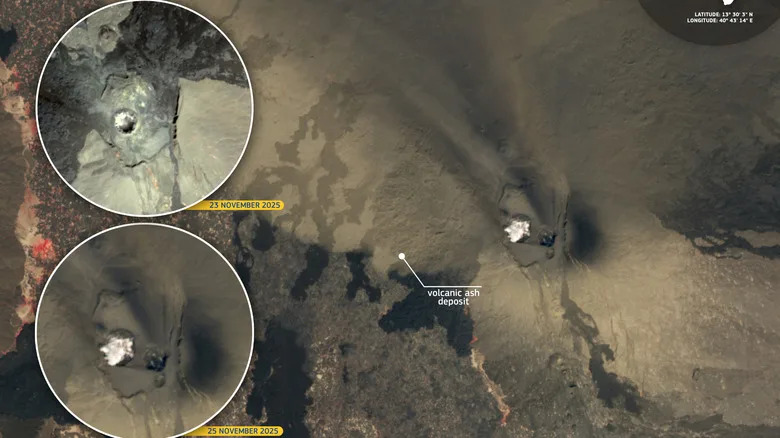
Two closeup images showing the change in crater shape before and after the Hayli Gubbi eruption - European Union/Copernicus Sentinel-2
Regional Effects and Aviation Disruption
The ash cloud traveled across the Red Sea and the Arabian Peninsula, affecting Yemen and Oman before moving into southern Pakistan and northern India. By 11 p.m. on November 24 the plume had reached Delhi — approximately 2,566 miles (4,130 kilometers) from Hayli Gubbi — covering that distance in about 35 hours.
Volcanic ash is a serious hazard to aircraft: fine particles can clog engine intakes and, at high temperatures, silica in ash can melt into glassy deposits that cause engine failure. In response to the eruption, Air India canceled 11 flights and Akasa Air suspended its Middle Eastern services. India's Directorate General of Civil Aviation (DGCA) issued advisories asking pilots to report any ash encounters and to exercise caution when routing flights through affected airspace.
Why This Eruption Was Unusual
Hayli Gubbi is typically a shield volcano, which usually produces runny lava and relatively gentle eruptions. This event was unusually explosive and has been classified as sub‑Plinian — characterized by powerful vertical columns and widespread ash dispersal. The eruption highlights the variability and unpredictability of volcanism in the East African Rift System.
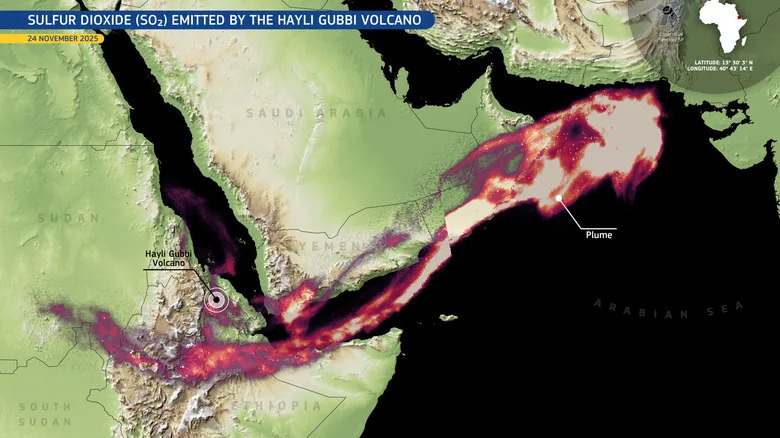
A map showing the spread of the eruption plume from Hayli Gubbi across the world - European Union/Copernicus Sentinel-5P
Warning Signs Before the Eruption
Although the eruption seemed sudden, several precursor signals were observed in the months leading up to it. Nearby Erta Ale experienced explosive activity on July 15, and scientists recorded a magma intrusion that traveled southeast along a dike toward Hayli Gubbi. Fissure vents appeared along the rift, with the closest cluster about 1.2 miles (2 kilometers) from Hayli Gubbi's crater. Satellite measurements also showed ground uplift earlier in the year, and observers noted an unusual white cloud inside Hayli Gubbi's crater between July 25 and November 18 — all consistent with magma movement that may have primed the system for eruption.
Health and Environmental Concerns
The roughly 220,000 tons of sulfur dioxide injected into the atmosphere can worsen local and regional air quality and may contribute to acid rain and respiratory problems downwind. Ashfall can contaminate water supplies, damage crops, and create long-term cleanup challenges for affected communities.
What Comes Next: Authorities and volcanologists will continue monitoring seismicity, gas emissions, ground deformation, and satellite imagery to assess ongoing hazards. The event underscores the importance of continuous monitoring in rift zones and of issuing timely aviation and public-health advisories when large eruptions occur.
Similar Articles

Hayli Gubbi Volcano in Ethiopia Erupts After ~12,000 Years, Sending Ash Plume Nine Miles High
The Hayli Gubbi volcano in Ethiopia's Afar region erupted for the first time in roughly 12,000 years, sending ash and smoke u...

Ethiopia’s Hayli Gubbi Volcano Erupts for First Time in ~12,000 Years, Sends Ash Plumes Nine Miles High
The Hayli Gubbi volcano in Ethiopia's Afar region erupted for several hours, launching ash plumes up to nine miles (≈14.5 km)...

Hayli Gubbi Erupts After Nearly 12,000 Years — Ash Plumes Reach South Asia, Villages Coated in Ash
Hayli Gubbi in northern Ethiopia erupted on Nov. 23 — its first recorded eruption in nearly 12,000 years — sending ash plumes...

Hayli Gubbi Eruption Subsides as Ash Buries Ethiopian Villages and Disrupts Flights
The Hayli Gubbi volcano in northern Ethiopia quieted after a weekend eruption that coated villages in ash and disrupted fligh...

Long‑Dormant Hayli Gubbi Volcano Erupts in Northern Ethiopia; Ash Plumes Drift Toward Yemen and Oman
The Hayli Gubbi volcano in Ethiopia's Afar region erupted Sunday, sending ash across the Red Sea toward Yemen and Oman and bl...

Mount Semeru Erupts, Sends 6,500‑ft Ash Plume; 300+ Evacuated as Red Aviation Alert Issued
Mount Semeru erupted on Nov. 19, producing an ash plume reaching about 6,500 feet (2,000 m) and prompting the evacuation of o...

Magma-Driven Quakes in Ethiopia: Why Fentale and Dofen Are Being Closely Watched
Since early 2025, seismic swarms in Ethiopia’s Afar and Oromia regions—including a magnitude-5.7 quake on 4 January—have prom...

Over 170 Climbers Rescued After Sudden Eruption of Indonesia’s Mount Semeru
Indonesian authorities rescued and assisted more than 170 people stranded after Mount Semeru erupted suddenly in East Java. P...

Six Volcanoes Scientists Are Watching — From Local Hazards to Global Risks
Six volcanic systems — Campi Flegrei, Merapi, Cumbre Vieja, Mount St. Helens, Popocatépetl and Yellowstone — are closely moni...

Sakurajima Erupts Near Kagoshima — Ash Plumes Reach 4,400m; Dozens of Flights Cancelled
The Sakurajima volcano near Kagoshima erupted early Sunday, producing multiple ash plumes that rose to about 4,400 metres and...

Massive Lava Fountains at Kīlauea Destroy USGS Camera; Rare Triple Fountain Recorded
Over the weekend, towering lava fountains at Kīlauea engulfed and destroyed a USGS monitoring camera inside the closed Halema...

13 American Volcanoes Closely Monitored for Sudden Eruptions
The U.S. contains numerous active volcanic systems—from the Yellowstone Caldera to frequently erupting Aleutian peaks—that ar...

Mount Semeru Erupts in East Java: Ash, Lava Flows and Mass Evacuations
Mount Semeru in East Java erupted Wednesday, sending hot ash, pyroclastic flows and lava down its slopes and prompting author...

Rare X5.1 Solar Super-Flare Sent Atmospheric Radiation to Highest Levels in Nearly 20 Years
On Nov. 11 an X5.1 flare from sunspot AR4274 produced a rare Ground Level Event that briefly drove atmospheric radiation to i...

Bezymianny Volcano Is Nearly Rebuilt — Eruptions Are Restoring Its Lost Summit
Bezymianny on Russia's Kamchatka Peninsula erupted in late November, sending ash about 32,800 ft (10 km) into the air — a sig...