
The movement of a Chinese-made PHL-03 multiple-launch rocket system toward the Thailand–Cambodia frontier sparked Thai pre-emptive air strikes on military depots amid fears the launcher’s 81-mile range could threaten civilian and military infrastructure. Intelligence points to Chinese arms deliveries to Cambodia earlier in the year, while analysts note Beijing arms both sides but seeks to avoid escalation. Rising nationalism and domestic politics have hardened rhetoric on both sides, raising the risk of further clashes and humanitarian fallout.
Chinese PHL-03 Rocket Spurs Fresh Thailand–Cambodia Clash as Bangkok Strikes Pre-emptively
03:14 PM, 12/10/2025

Beijing has become the biggest military supplier to Cambodia, which has six Chinese-made PHL-03 MLRS
Tensions along the Thailand–Cambodia frontier flared after Cambodia moved a Chinese-made PHL-03 multiple-launch rocket system (MLRS) closer to the disputed border, prompting Thailand to launch pre-emptive air strikes on military depots. The PHL-03’s roughly 81-mile range raised concerns that airfields, hospitals and other deep targets in Thailand could be vulnerable if the system were deployed.
What Happened
Bangkok says it struck facilities after intelligence indicated attempts to "lock on the co-ordinates" of Thai infrastructure. Thai defence ministry spokesman Rear-Adml Surasant Kongsiri told Reuters the strikes were aimed at degrading Cambodia’s ability to target civilian and military sites and that they had been successful.
"Based on our intelligence as well, there have been attempts to lock on the co-ordinates of these facilities," Rear-Adml Surasant Kongsiri said.
Why the PHL-03 Matters
The Chinese PHL-03 fires large-calibre 300mm rockets to a maximum range of about 81 miles (approximately 130 km), far beyond the reach of older BM-21 systems Cambodia previously used. The International Institute for Strategic Studies estimates Cambodia’s armed forces possess six PHL-03 launchers, making the system the heaviest and longest-range artillery in Phnom Penh’s inventory.
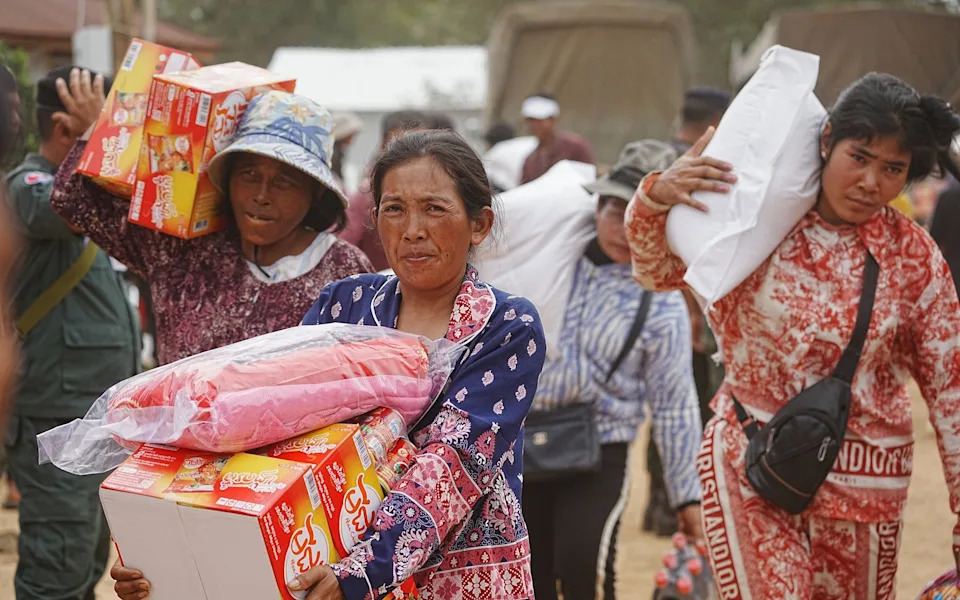
Evacuees have taken refuge in Oddar Meanchey province - Heng Sinith/AP Photo
Anthony Davis, a Bangkok-based security analyst, described the system’s significance: "You’re talking large-calibre, 300mm munitions, that can be delivered up to a range of 81 miles … so able to reach targets deep inside Thai territory." The prospect of such strikes prompted Thai officials to act pre-emptively to limit the perceived threat.
Supply Lines and Regional Dynamics
Thai intelligence documents cited by The New York Times reported that in June Chinese Y-20 transport aircraft made multiple flights to Cambodia carrying rockets, artillery shells and mortars loaded into 42 containers. Human rights groups later concluded that most of the rockets used by Cambodia in earlier strikes originated from China.
China has become Cambodia’s largest military supplier since the United States curtailed arms sales to Phnom Penh in 2010. Beijing’s support includes weapons deliveries and major infrastructure projects, notably upgrades at the Ream Naval Base, which have alarmed neighbours that fear expanded Chinese military access in the Gulf of Thailand.
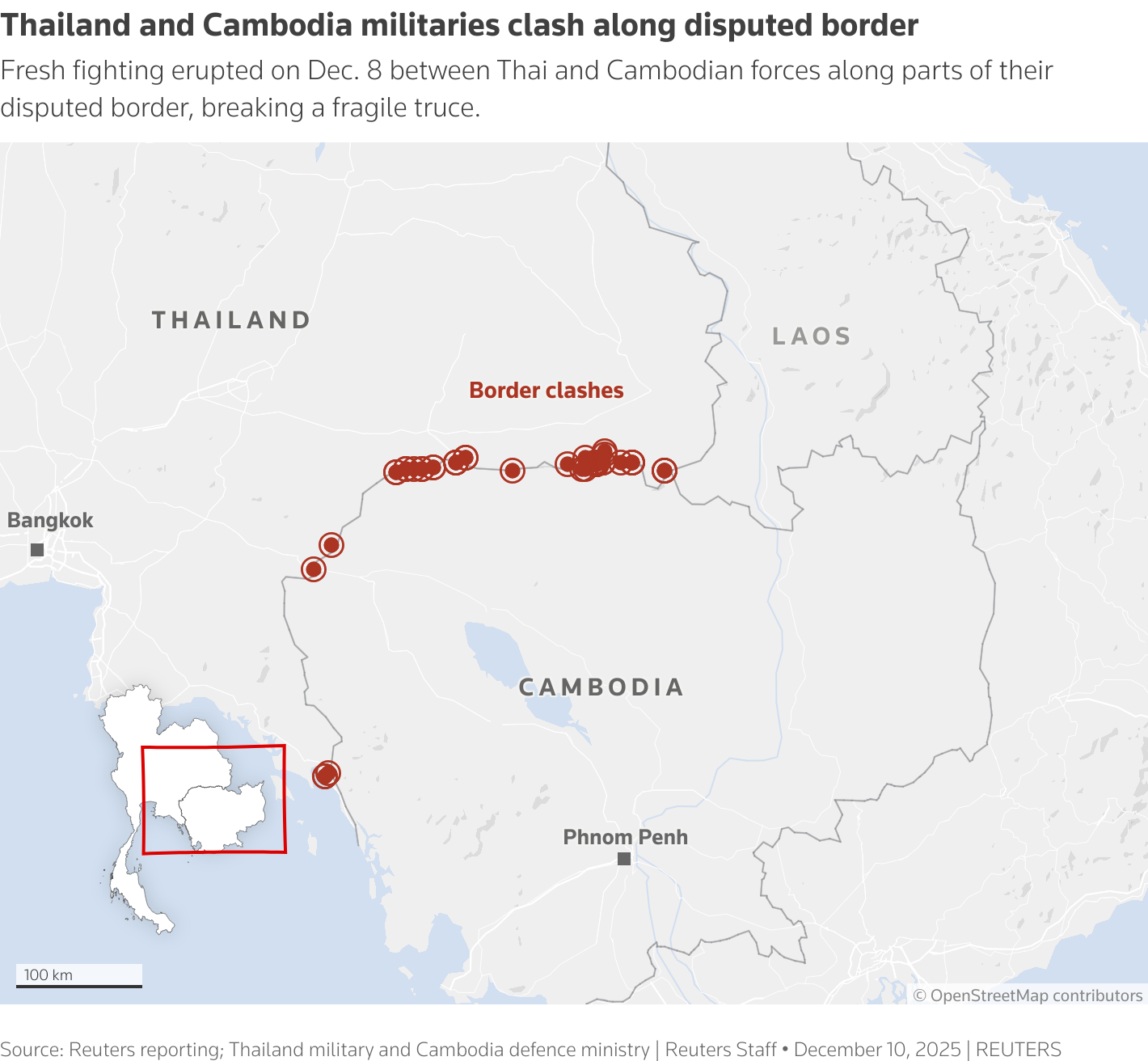
Locations of military clashes along the disputed border between Thailand and Cambodia via Reuters
China’s Position
Analysts stress that supplying arms does not necessarily mean Beijing wants an escalation. Dr Rahman Yaacob of the Australian National University said Chinese officials reportedly asked Cambodia not to fire the PHL-03 in July, fearing that use of the system would dangerously escalate the conflict.
Human Cost and Political Drivers
Violence in late July left 48 people dead and displaced some 300,000 during a five-day stand-off reportedly triggered by competing interpretations of a colonial-era map. Since the latest breach of the fragile ceasefire, at least 10 people have been killed, nearly two dozen wounded and hundreds of thousands evacuated as new clashes unfold. Observers say domestic politics and rising nationalist sentiment in both capitals have hardened rhetoric and limited room for compromise.
Gen Chaiyapruek Duangprapat, the Thai army chief of staff, has warned of efforts to degrade Cambodia’s military capability — an approach analysts interpret as a signal from Bangkok that it can and will target advanced systems such as the PHL-03 if necessary.
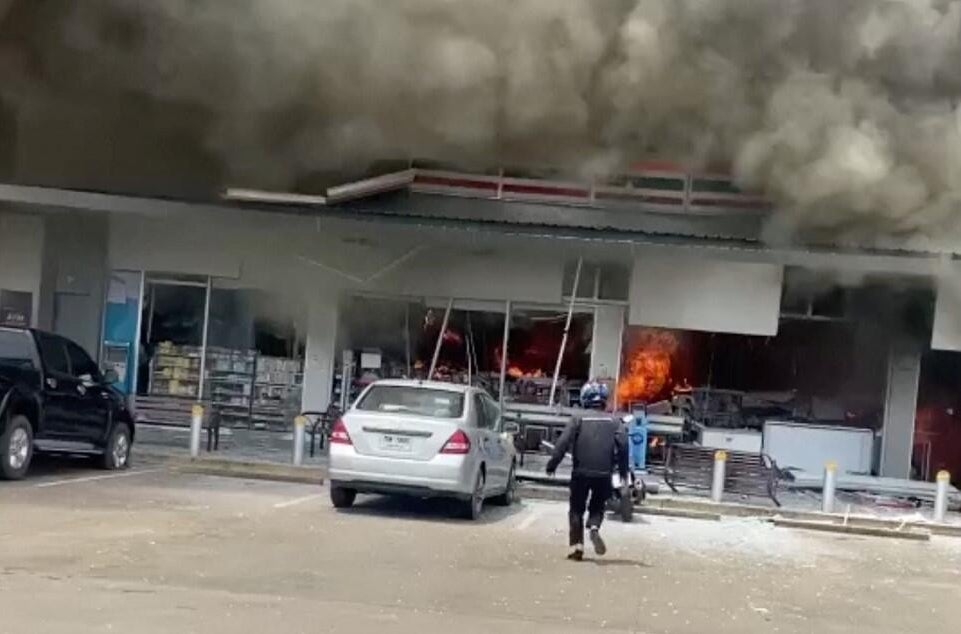
Army Region 2 via Facebook/Handout via Reuters
Arms Trade Context
While China has supplied Cambodia with advanced rockets, it has also sold arms to Thailand: Stockholm International Peace Research Institute data show Thailand spent nearly £375 million on Chinese weaponry between 2019 and 2023, compared with just over £75 million from the United States during the same period. This dual relationship complicates Beijing’s ability to manage the dispute without appearing to favour one side.
Outlook: The presence of long-range Chinese-made systems on a contested frontier increases the risk of miscalculation. Analysts warn that, unless diplomatic pressure or confidence-building measures are quickly restored, the conflict could escalate further with significant humanitarian consequences.
Sources: Reporting by Reuters, The New York Times and The Telegraph; analysis from IISS, SIPRI and regional security experts.
Similar Articles

Thailand Conducts Airstrikes Against Cambodia as Border Clashes Escalate
Thai forces launched airstrikes on Cambodian positions Dec. 8 after Bangkok said Cambodian fire hit the Anupong base and kill...

Renewed Clashes on Thailand–Cambodia Border Kill Civilian, Undermine US-Backed Truce
Cambodia and Thailand accused each other after renewed border gunfire, with Phnom Penh reporting one civilian killed and thre...

Renewed Thailand–Cambodia Border Clashes Kill One Civilian, Wound Three as Truce Falters
What happened: Fighting along the Thailand–Cambodia border on Nov. 13 left one civilian dead and three wounded as both milita...

Deadly Clashes Spread Along Thailand–Cambodia Border, Forcing 140,000+ to Flee
Fighting between Thailand and Cambodia has spread into new border areas, killing at least 10 people and displacing more than ...

Trump-Backed Thailand–Cambodia Peace Deal Unravels After Villager Killed in New Border Clash
Trump’s peace declaration between Thailand and Cambodia is under strain after a fresh border clash that killed one Cambodian ...

Renewed Clashes on Thai–Cambodian Border Force Thousands Back Into Makeshift Shelters
Renewed clashes along the Thailand–Cambodia border have forced thousands back into makeshift shelters, including hundreds hou...

Landmine Blast Injures Chinese National on Cambodia–Thailand Border, Reigniting Mine-Clearance Dispute
The Thai army says a 26-year-old Chinese man was injured by a land mine on the Cambodia–Thailand border while allegedly tryin...

Cambodia Evacuates Border Village After Deadly Shooting as Thailand-Cambodia Tensions Flare
Cambodia evacuated about 250 families from Prey Chan after gunfire during a border exchange left one Cambodian dead and three...

Renewed Cambodia–Thailand Clashes Force Over 500,000 Into Shelters as Leaders Face International Pressure
Renewed fighting along the Cambodia–Thailand border has displaced more than 500,000 people and left at least 15 dead as jets,...

Thailand Pauses U.S.-Brokered Ceasefire, Demands Cambodian Apology After Border Landmine Injures Four Soldiers
Thailand has indefinitely suspended implementation of a U.S.-brokered ceasefire after a land mine injured four soldiers along...

China-Tokyo Showdown After Reported Radar 'Lock' Near Okinawa — Tensions Fueled by Taiwan Remarks
Japan says Chinese J-15 fighters twice illuminated Japanese F-15s with fire-control radar near Okinawa on Dec. 6, an action T...

Satellite Images Expose Massive Chinese Naval Build-Up Across Disputed Waters
Satellite images show a concentrated Chinese naval force operating across disputed waters from the Yellow Sea to the Philippi...

Japan and Australia Urge Restraint After Chinese Fighter Locks Radar on Japanese Jets
Japan formally protested after a Chinese J-15 fighter intermittently locked its radar on Japanese F-15s near Okinawa, calling...

Myanmar Inducts Russian Mi-38T Helicopters and Chinese Y-8 Transport Planes Amid Escalating Conflict
The Myanmar military formally inducted three Russian Mi-38T helicopters and two Chinese Y-8 transport planes on Nov. 7, highl...

Skies at Stake: How the U.S. and China Are Racing for Air Dominance in the Pacific
Quick summary: The United States and China are racing to control the skies over the Pacific by taking different approaches: t...