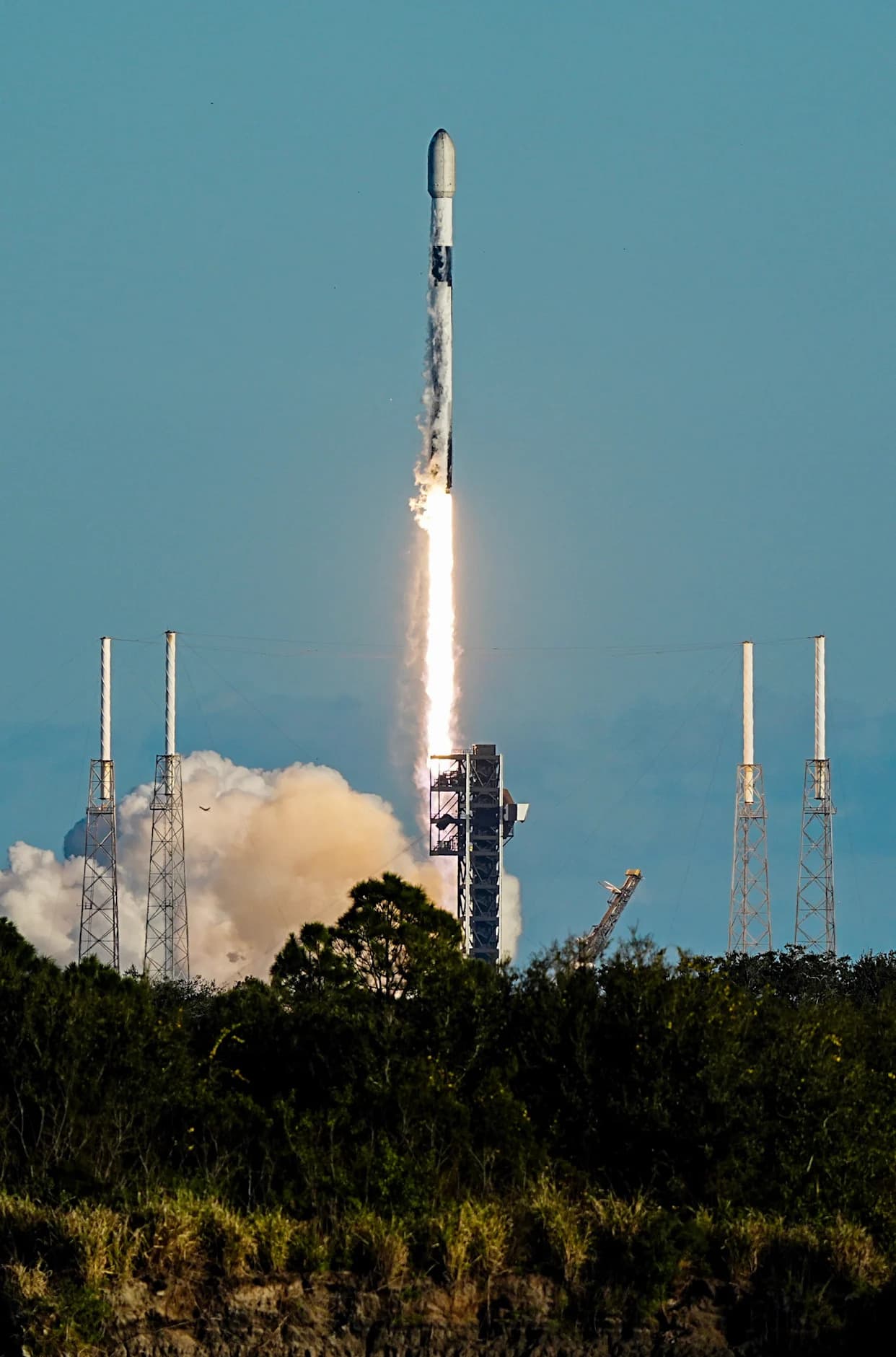
Space Coast in 2025: As of Dec. 2 the region recorded 103 orbital launches (plus one hypersonic test), led by SpaceX’s 96 Falcon 9 flights. ULA and Blue Origin contributed key Atlas V, Vulcan and New Glenn missions. Near-term items to watch are the Dec. 7 Starlink launch, the classified NROL-77 land-recovery attempt on Dec. 9 (which could produce sonic booms), and ULA’s Atlas V Kuiper flight on Dec. 15. Multiple lunar CLPS missions and Artemis crewed flights remain on the multi-year manifest.
Space Coast Rockets Past 100 Launches in 2025 — What’s Left on the Year-End Manifest
As of Dec. 2, 2025, the Space Coast had recorded 103 orbital launches (plus one hypersonic missile test), maintaining a record-setting cadence driven largely by SpaceX. Of those 103 flights, 79 launched from Cape Canaveral Space Force Station and 24 from Kennedy Space Center. SpaceX accounted for 96 missions (all Falcon 9), United Launch Alliance (ULA) flew five missions (four Atlas V, one Vulcan) and Blue Origin completed two New Glenn flights (NG-1 and NG-2). The year also included four commercial human spaceflights: Crew-10, Fram2, Axiom Ax-4 and Crew-11.
Short-term schedule (selected)
Dec. 2 (completed) — SpaceX Falcon 9 launched 29 Starlink satellites from SLC-40 at 5:18 p.m.; the booster completed its 25th flight and landed on the droneship A Shortfall of Gravitas.
Dec. 7 (planned) — Starlink 6-92 from Launch Pad 39A using a booster on its ~32nd flight; droneship recovery expected on Just Read the Instructions.
Dec. 9 (planned) — SpaceX NROL-77 (classified NRO payload) from SLC-40 at 2:16 p.m., backup Dec. 10. The booster is expected to attempt a land recovery at Landing Zone 2, which could cause sonic booms for central Florida.
Dec. 15 (planned) — ULA Atlas V 551 on the Amazon Kuiper (Leo 4) mission, carrying 27 Project Kuiper satellites; launch window opens at 3:52 a.m.
Key TBD and multi-year missions
- Vulcan Centaur — USSF-87 (delayed from 2024): Department of Defense mission carrying GSSAP spacecraft; vehicle staged at CCSFS and expected to use four solid boosters.
- Vulcan — Vulcan Leo 1: Six-booster Vulcan configuration to deploy 44 operational Kuiper satellites.
- Intuitive Machines IM-3 (PRISM): Nova-C lander to Reiner Gamma carrying NASA science payloads, a rover and a relay satellite.
- Blue Origin New Glenn — Blue Moon MK1: Single-launch lunar cargo lander carrying at least one NASA CLPS instrument.
- NASA Artemis II: Four-person Orion lunar orbital test no earlier than Feb–Apr 2026 (TBD).
- Boeing Starliner-1 (Atlas V): Contract updated to make this an uncrewed Atlas V flight (no earlier than April 2026).
- Multiple commercial lunar CLPS missions (Blue Ghost, Draper, Astrobotic Griffin on Falcon Heavy, follow-on Intuitive Machines and Firefly flights) spanning 2025–2027.
- Vast space-station missions: Vast Haven-1 (uncrewed) and a later crewed commercial mission targeted for mid-2026 and beyond.
- Dream Chaser to ISS and Starliner-2 (Atlas V) remain planned in later 2026 schedules as hardware and certification work progress.
- Artemis III (Summer 2027): NASA’s planned crewed lunar landing mission from Launch Pad 39B.
Highlights and milestones in 2025
2025 produced numerous operational landmarks: SpaceX reached its 500th Falcon 9 launch milestone and recorded its 500th successful booster recovery; multiple boosters reached 20+ flights; SpaceX set several pad-turnaround records at SLC-40; ULA returned to operational Atlas V and began introducing Vulcan Centaur; and Blue Origin conducted New Glenn debut flights. National-security launches (including several classified NRO missions) and hypersonic test activity also featured prominently.
What to watch next
Short-term schedule items that could shape the final year-end tally and public impacts include the Dec. 7 Starlink flight, the Dec. 9 NROL-77 mission (possible land recovery and sonic booms), and the Dec. 15 Atlas V Kuiper launch. As always, launch dates remain subject to weather, range availability, and vehicle readiness.
How launches are counted
This tally counts orbital launches from the Space Coast (Cape Canaveral SFS and KSC). It includes government, commercial and national-security missions. The tempo reflects a mix of high-rate commercial rideshares, strategic government launches, and the introduction of new heavy-lift vehicles, producing a historic annual total for the region.
If you follow launch activity, expect frequent schedule updates: windows shift, backup opportunities appear, and recovery plans (droneship vs. land) can affect local communities.
Help us improve.