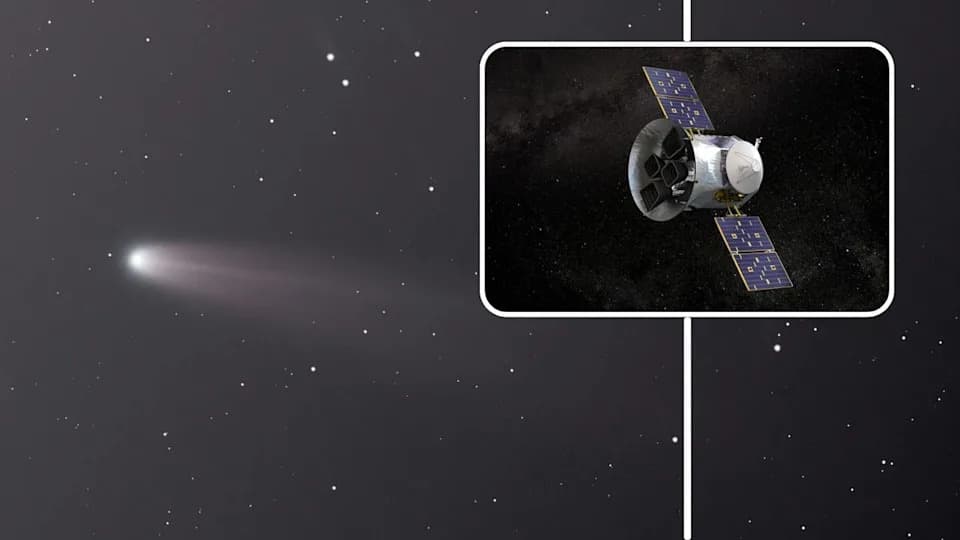
3I/ATLAS, an interstellar object, is expected to pass about 170 million miles from Earth on December 19. An October study reports a repeating 16.16‑hour brightening; researchers say this behavior is consistent with a weakly active comet rotating and exposing sunlit ice patches. Avi Loeb highlights the signal and suggests time‑lapse imaging could determine whether the jets are sun‑driven or point in arbitrary directions — a distinction that would separate a natural cometary origin from a potential engineered source.
Interstellar Visitor 3I/ATLAS Shows a 16.16‑Hour 'Heartbeat' — Cometary Spin or Something More?

The interstellar object 3I/ATLAS is approaching a relatively close pass to Earth, expected to sweep within roughly 170 million miles on December 19. Recent ground-based observations reported in October suggest the object produces a repeating pulse of light every 16.16 hours — a pattern some researchers describe as a 'heartbeat.'
What the observations show
An October paper in Astronomy & Astrophysics by a team of European and African astronomers found a periodic brightening with a 16.16‑hour cadence. The authors note that, despite its interstellar origin, 3I/ATLAS 'shows characteristics typical of weakly active outer Solar System comets' and call for continued monitoring around perihelion to track changes in activity and color.
Natural explanation: rotation and sunlit ice
The simplest and most widely accepted interpretation is that 3I/ATLAS is a natural, weakly active comet whose rotation exposes pockets of volatile ice. When a sunlit patch of ice rotates into sunlight, it can drive a focused jet of gas and dust. If that jet points toward the Sun, it can create an 'anti‑tail' and periodically puff up the coma, producing the observed heartbeat‑like brightening every rotation.
"As a result, the coma will get pumped up every time the ice pocket is facing the Sun," writes astrophysicist Avi Loeb, describing how a sunward jet tied to rotation could produce repeated brightening.
Alternative considered: engineered jets?
Harvard astrophysicist Avi Loeb has highlighted the heartbeat signal in a recent blog post and notes that while a natural explanation is most likely, an artificial origin cannot be conclusively ruled out by current data. He points out that for a technological object, the direction of any pulsed jet could be arbitrary and would not necessarily align with the Sun — a signature that would distinguish it from sun‑driven cometary activity.
What would settle it?
To discriminate between these hypotheses observers need well‑calibrated time‑series imaging of the coma spanning several rotation cycles. A time‑lapse 'movie' showing the periodic brightening and the orientation of jets relative to the Sun can reveal whether the pulses track the Sun (supporting a natural, rotation‑driven jet) or point in arbitrary directions (which would be unexpected for a simple cometary model).
Because 3I/ATLAS passed perihelion in late October, its spin state or jet activity may already have evolved. Continued monitoring through and after the December close approach will provide the best chance to understand the phenomenon.
Why it matters
Whether natural or not, the heartbeat signal offers a rare opportunity: 3I/ATLAS is an interstellar sample whose response to solar heating can teach astronomers about materials from another star system. Prompt, coordinated observations across wavelengths will help scientists determine the cause of the periodic brightening and improve our understanding of interstellar visitors.
Help us improve.