Quebec's Parti Québécois is favored to win the provincial election, a result that could test Ottawa's message of national unity. Polls put both PQ support and backing for independence at about 30 percent — a level that could translate to a legislative majority under Quebec's first-past-the-post system if federalist votes are divided. PQ leader Paul Saint-Pierre Plamondon says he would pursue a referendum but has pledged not to hold one while Donald Trump remains in office, and he proposes reallocating lieutenant governor funds to social programs.
Quebec Separatists Poised To Win Provincial Vote, Testing Federal Unity Message From Mark Carney

The separatist Parti Quebecois (PQ) Paul St-Pierre Plamondon, is favored to win Monday's provincial election in Quebec (Alexis Aubin)
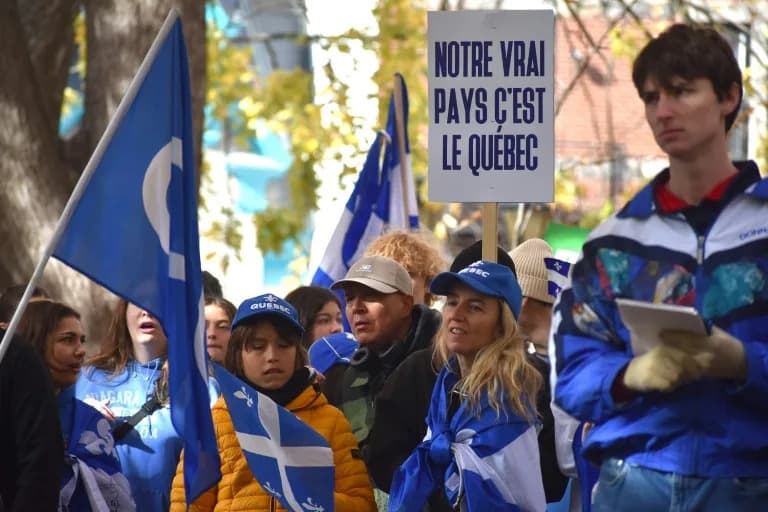
Quebec separatists are widely expected to win Monday's provincial election in Canada's largely French-speaking province, creating a fresh test of the federal unity message advanced by Ottawa's leader, Mark Carney.
Why The PQ Is Resurgent
Analysts say the likely comeback of the Parti Québécois (PQ) after 12 years in opposition is driven mainly by voter frustration over affordability and declining public services rather than a sudden surge in appetite for independence. Recent polls put support for an independent Quebec at roughly 30 percent, and polling for the PQ itself hovers near the same level.
How 30 Percent Could Mean Power
Under Quebec's first-past-the-post system, about 30 percent popular support can still translate into a legislative majority in the 127-seat National Assembly if federalist votes are split among several parties. That electoral math is central to forecasts that the PQ could secure a governing mandate despite not commanding majority popular support.
Leader's Referendum Pledge — With A Delay
PQ leader Paul Saint-Pierre Plamondon (often referred to by his initials, PSPP), a 49-year-old lawyer, has publicly pledged to pursue a referendum on independence if elected premier. However, he has said he will not hold such a referendum while Donald Trump remains in the White House, arguing in August that the question requires 'conditions that allow for an informed and calm debate' and should not be 'hijacked by the theatrics of an unpredictable president.' He has indicated no referendum would be sought before at least 2029.
Electoral Day And Immediate Stakes
Polling stations across the province of roughly 9 million people open at 9:30 a.m. (1330 GMT) and close at 8:00 p.m.; results are expected a few hours after voting ends. PSPP has attacked the federal government and says a PQ administration would seek a new 'balance of power' with Ottawa. 'There will be dialogue, but the condition for cooperation is that Quebec be respected,' he told broadcaster Radio-Canada.
Implications For Ottawa And Beyond
Carney faces competing pressures: his federal administration retains broad support nationally, and many credit him with leading domestic — and at times international — opposition to U.S. policies perceived as hostile. At the same time, rising separatist strength in Quebec coincides with a non-binding consultation on independence taking place in Alberta later this month, intensifying national unity debates.
The Monarchy Question
While PSPP may lack majority backing for outright independence today, some of his proposals enjoy strong public support — notably plans to trim the provincial role tied to the British monarchy. Canada is a Commonwealth realm: King Charles III is the head of state, represented federally by the governor general and provincially by lieutenant governors. A 2025 Leger poll found 87 percent of Quebecers felt no attachment to the monarchy, and only 31 percent had a favourable view of King Charles.
There is nothing preventing the National Assembly from acting as a sovereign parliament and reallocating the lieutenant governor's budget, PSPP said, proposing that those funds be redirected to homelessness programs.
Historical Context
Quebec has held two referendums on separation: federalists won decisively in 1980, while the 1995 vote was narrowly lost by separatists, with 50.58 percent voting to remain in Canada — a result that remains a pivotal memory in Canadian federal politics.
Note: This report focuses on the political dynamics and implications of the provincial vote; it maintains the original article's references to key actors and public opinion while tightening language and clarifying electoral mechanics.
Help us improve.