On Oct. 4, 1957, the Soviet Union launched Sputnik 1, a 184-pound satellite about the size of a beach ball that orbited Earth roughly every 98 minutes and broadcast radio signals. The launch produced a "Pearl Harbor"-style shock in the United States, prompting President Eisenhower to acknowledge Soviet progress in satellite technology. The public and political reaction led to the 1958 National Defense Education Act and accelerated federal investment in aerospace research, helping to pave the way for NASA's founding.
69 Years Ago Today: How Sputnik 1 Stunned the U.S. and Launched the Space Age
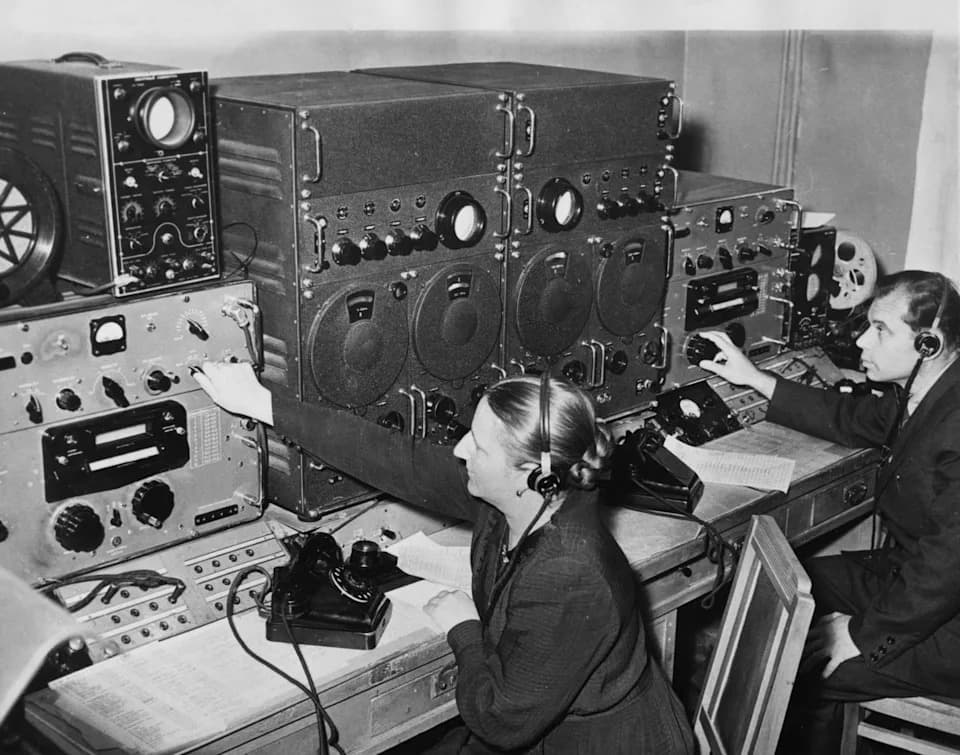
The frequency of the radio signals from Sputnik 1 being measured at a radio control post near Moscow Observatory, 1957. Photo by Getty Images
Sixty-nine years ago a 184-pound metal sphere did something the United States had not expected: it reached orbit before America. On Oct. 4, 1957, the Soviet Union launched Sputnik 1, the world’s first artificial satellite. About the size of a beach ball, Sputnik completed an orbit of Earth roughly every 98 minutes and transmitted steady radio signals that were recorded at a control post near the Moscow Observatory.
The Satellite and the Signal
Sputnik 1 carried no weapons, but its successful launch proved reliable long-range rocket capability. Observers around the world could hear its beeps on amateur radio equipment, and the measurement of those transmissions confirmed that the Soviet Union could place objects into stable orbit—a technological demonstration with unmistakable Cold War implications.
Immediate Reaction in the United States
"Pearl Harbor" Effect
NASA historian Roger Launius later described the launch as having a "Pearl Harbor" effect on American public opinion, calling it a shock that introduced many Americans to the space age amid a crisis atmosphere.
President Dwight D. Eisenhower at first resisted claims that the launch meant immediate U.S. military inferiority. Still, about a month after Sputnik’s flight he acknowledged the uncomfortable fact: "The Soviets are obviously ahead of us in satellite development," while also insisting that "the overall military strength of the free world is distinctly greater."
Policy and Educational Consequences
The public alarm and political pressure that followed Sputnik prompted rapid policy responses. In 1958 Congress passed the National Defense Education Act (NDEA), which expanded federal support for education—including low-cost student loans and stronger emphasis on science, mathematics and foreign languages. The U.S. Senate Historical Office later noted that Sputnik helped break long-standing resistance to federal aid for education.
At the same time, Sputnik accelerated federal investment in aerospace research and development and spurred the creation and expansion of institutions to oversee science and technology. That momentum helped lead to the establishment of the National Aeronautics and Space Administration (NASA) in 1958 and a larger, sustained federal role in space exploration.
Why It Still Matters
Sputnik 1 was small and simple, but its launch exposed the strategic importance of rocket and space technology, reshaped U.S. education priorities, and changed how governments funded and organized scientific research. Its legacy is the modern space age—from satellites that enable global communications to the agencies and programs that pursue exploration today.
This article was adapted from a piece originally published by Men’s Journal on Oct. 4, 2026.
Help us improve.