Republicans prevailed in 2024 by addressing voters' immediate economic concerns, especially the rising cost of living and job insecurity, while Democrats emphasized macroeconomic achievements. Academy of Management scholar Tim Pollock says GOP candidates acknowledged grievances and promised action, which resonated with voters living paycheck to paycheck. Economists warn that some proposed GOP policies—such as high tariffs and strict immigration enforcement—could worsen inflation or create labor shortages. The campaign highlights the power of empathetic, concrete messaging and offers lessons for both parties ahead of the 2026 midterms.
How the GOP Won the 2024 U.S. Election — Messaging, Economic Anxiety, and Lessons for 2026
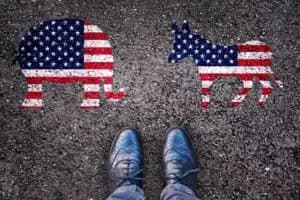
Man stands near Republican and Democrat party symbols painted on ground
By Daniel Butcher
The Republican Party capitalized on a set of political and economic dynamics in the run-up to the 2024 U.S. election. A late-stage change in presidential candidates for the Democrats, persistent concerns about the rising cost of living, and messaging that directly addressed voters' everyday struggles gave GOP candidates an advantage at the ballot box. While questions remain about the likely effectiveness of some proposed Republican policies, their campaign rhetoric connected with many voters in a way that Democratic messaging did not.
Listening to Economic Worries
Tim Pollock, an Academy of Management scholar at the University of Tennessee, Knoxville, argues that the GOP succeeded in large part because Republican candidates acknowledged voters’ anxieties rather than emphasizing macroeconomic indicators. Pollock contrasted the two strategies: Democrats highlighted the accomplishments of the Biden-Harris administration and favorable statistics, while Republicans more directly engaged with grievances about prices and jobs.
"Republican candidates were willing to say, 'Yeah, we hear you. We are going to deal with this. We're going to bring inflation down,' even though inflation was already coming down, and even though many of the factors across the supply chain that might have been responsible for inflation are not actually under government control," Pollock said. "Whatever the actual reasons are, they said, 'We hear you, and we're going to do something about it.' And the Dems are citing data and saying, 'No, things are great—unemployment is low, and the stock markets are hitting record highs.'"
Pollock added: "If I'm living paycheck to paycheck, I don't care what the S&P 500 is doing. I care about the prices of eggs, meat, and gas." That focus on tangible expenses helped Republican messages resonate with voters who felt disconnected from national-level economic narratives.
Policy Promises vs. Economic Reality
Many professional economists expressed skepticism that some of the policy remedies proposed by certain GOP candidates would achieve their stated goals. Measures discussed on the campaign trail—including steep tariffs and aggressive immigration enforcement—are widely expected by analysts to carry risks that could raise prices or reduce labor supply.
"Every economist I've seen, heard, or read says that they'll do the opposite—those policies would increase inflation," Pollock said. "Increasing tariffs would only increase costs, because they're going to get passed on to U.S. consumers, and cracking down in immigration will cause labor shortages, etc."
Despite these warnings, the promise of decisive action and empathy with voters' daily struggles often mattered more in voters' decision-making than technical debates about macroeconomic causality.
Lessons for 2026
The 2024 result underscores a strategic lesson for candidates of both parties ahead of the November 2026 midterms: messaging that connects with voters' lived experiences can be decisive. Evidence-based rebuttals about national metrics are unlikely to persuade those whose primary concerns are neighborhood grocery bills and job security. Parties that combine credible policy proposals with empathetic, concrete messaging about everyday costs will be better positioned to win voter trust.
Originally published on Academy of Management Today.
Help us improve.