On Nov. 20, 1980, a Texaco drill punctured the Diamond Crystal salt mine beneath Lake Peigneur, triggering a massive whirlpool that drained a shallow freshwater lake into the mine and transformed it into a nearly 200-foot-deep saltwater basin. Eleven barges, a tugboat, docks and about 70 acres of shoreline were sucked in; nine barges later resurfaced and two were never recovered. Remarkably, there were no fatalities, and the ensuing legal battle was settled in 1983 with payments to Diamond Crystal and Live Oak Gardens. The lake remains Louisiana's deepest and is now brackish due to Gulf water influx.
When a Drill Punctured a Salt Mine: How Lake Peigneur Became a 200-Foot Saltwater Sinkhole (1980)
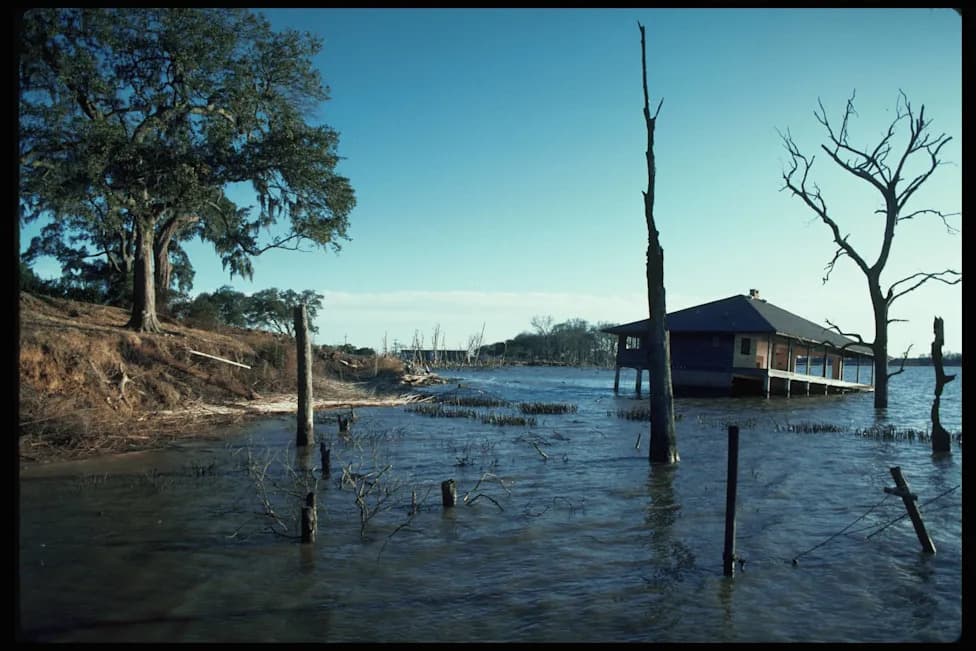
How a 1980 Drilling Accident Transformed Louisiana's Lake Peigneur into a 200-Foot Deep Saltwater Hole
On the morning of Nov. 20, 1980, a Texaco drilling crew working on Lake Peigneur, near Jefferson Island, struck the roof of the Diamond Crystal salt mine beneath the lake. The breach created a violent whirlpool as surface water poured into the mine void, transforming a shallow freshwater lake into a deep saltwater basin within hours.
What Happened
The drill bit punctured the mine roof and water rushed downward, undermining underground workings. Contemporary reporting in The Washington Post described how the drilling rig and nearby boats disappeared within roughly three hours. The rig's derrick—about 150 feet tall—was swept away as the lake drained into the mine.
Fisherman Leonce Viator Jr., who was on the lake when it began to drain, later recalled: "You'd better get out of here. The end of the world is coming. That water was roaring. I ain't kidding you a bit."
Damage and Unusual Effects
The suction pulled in eleven barges, a tugboat, a loading dock, trees and roughly 70 acres of shoreline, according to the University of Louisiana at Lafayette's archives. Nine of the barges later "popped up like iron corks," reported Mother Jones; two were never recovered. The Delcambre Canal, which normally carries lake outflow to the Gulf of Mexico, briefly reversed as water rushed toward the mine, allowing salty Gulf water to enter and turning the formerly fresh lake brackish.
Human Toll and Legal Fallout
Astonishingly, there were no fatalities. Miners underground were safely evacuated, and surface witnesses and crews escaped without serious injury, according to Atlas Obscura and contemporary news accounts. The inundation destroyed much of the Diamond Crystal mine's operations. Diamond Crystal sued Texaco for $260 million; the dispute was settled in July 1983 with Diamond Crystal accepting $32 million (mostly paid by Texaco) and Live Oak Gardens awarded $12.8 million, per United Press International.
Legacy
Today, Lake Peigneur measures roughly 200 feet deep, making it the deepest lake in Louisiana, and its waters are brackish due to the influx of saltwater. The dramatic event remains a widely cited example of the hazards of drilling above abandoned or active underground mine workings and a striking case study in geology, engineering, and environmental consequence.
Sources: The Washington Post, United Press International, Atlas Obscura, University of Louisiana at Lafayette, Mother Jones, The Shreveport Times, Parade.
Help us improve.