A new paper reconstructs nearly 240,000 years of the Great Salt Lake basin using a 120‑meter sediment core and microbial chemical signals. Two intervals—Lake Bonneville (~30,000–16,000 years ago) and Little Valley (~140,000–135,000 years ago)—filled the basin with much larger, fresher water bodies, with Bonneville recorded as essentially freshwater and Little Valley as brackish. Salinity rose rapidly as the lakes retreated, and researchers warn modern, human‑driven warming combined with water withdrawals threatens today’s lake in similar but faster ways.
Great Salt Lake Was Once a Freshwater Basin 10× Larger, Study Finds
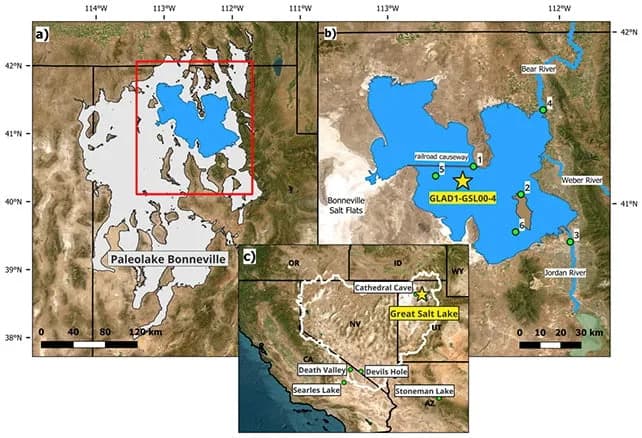
Maps showing the comparative size of Lake Bonneville, the drilling location (the yellow star), and other sites in the wider region. (So et al.,Paleoceanogr. Paleoclimatol., 2026)
Looking back hundreds of thousands of years can sharpen our view of the future. A new study published in Paleoceanography and Paleoclimatology reconstructs nearly 240,000 years of the Great Salt Lake basin in Utah, revealing two intervals when the lake expanded dramatically and became far less salty than it is today.
How Researchers Rebuilt the Lake's Past
Scientists recovered a 120‑meter (394‑foot) sediment core from the lake bed and used radiometric dating of minerals in the layers to establish an age model. They also analyzed tiny chemical signatures left by microorganisms preserved in the sediments to estimate past salinity: different microbes thrive at different salt concentrations, so changes in the biological signal record freshening or salinization over time.
What They Found
The core reveals two prominent highstands when the basin filled with much larger and fresher water bodies. The younger episode corresponds to Lake Bonneville (roughly 30,000–16,000 years ago) and appears to have been essentially freshwater. An older phase, called Little Valley (about 140,000–135,000 years ago), was broader than the modern lake but recorded as brackish rather than fully fresh.

Researcher Rachel So, working with part of the sediment core. (Rachel So)
Field evidence supports these reconstructions: terraced, step‑like ledges cut into surrounding mountains mark former shorelines and imply these ancient lakes may have reached depths on the order of ~300 meters at their highstands.
Fast Shifts and Modern Parallels
The record also shows that salinity rose rapidly as these lakes retreated—abrupt changes in geological terms, occurring over millennia. "The fact that the core spans two and a half glacial cycles allows us to see two fresh‑to‑salty transitions," says USC earth scientist Sarah Feakins. "It allows us to compare the two fresh lake events for their duration and freshness, to see how fragile and fleeting these moments are."
Authors suggest differences in river inflow likely explain why Lake Bonneville remained fresher and lasted longer than Little Valley: stronger freshwater input would have buffered salinity as the basin expanded. Regional lake records from Nevada, California, and Arizona show matching wet‑to‑dry patterns during these intervals, indicating broad climatic drivers.
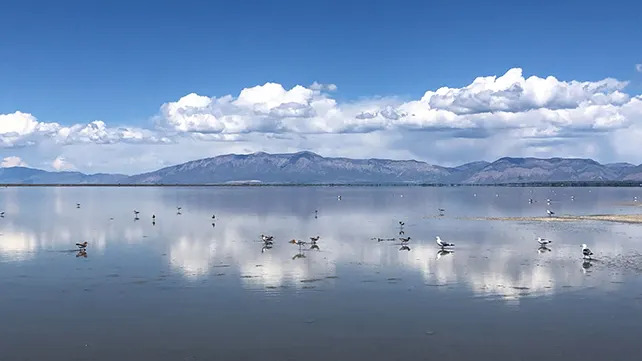
Waterfowl in the South Farmington Bay region of the lake. (Rachel So)
Why This Matters Today
Because the Great Salt Lake basin loses most water through evaporation rather than an outlet, it is especially sensitive to changes in temperature and precipitation. The researchers draw parallels between the natural warming that drove past lake shrinkage at the ends of ice ages and the rapid, human‑driven warming we are causing now. "Today we're warming the climate at an unprecedented rate," says Rachel So of USC. "That warming makes the atmosphere thirstier, increasing the rate of evaporative drying from the soil and lakes across the region."
They also stress that contemporary water withdrawals and land use must be considered alongside climate drivers. Past natural variability does not justify today’s human‑driven declines in lake levels and ecosystem health.
Study: Paleoceanography and Paleoclimatology.
Help us improve.