The Milwaukee Art Museum returned two 19th-century stoneware vessels by enslaved South Carolina potter David "Dave the Potter" Drake to his descendants on Sept. 9. One vessel was purchased from the Dave the Potter Legacy Trust and the other will remain on long-term loan; both were set to return to public view on Sept. 30. The moves follow similar restitutions by museums in Boston and Georgia as Drake’s family works to preserve his artistic legacy and reconnect relatives after generations of disruption.
Milwaukee Art Museum Returns Two 19th-Century David Drake Vessels to His Descendants
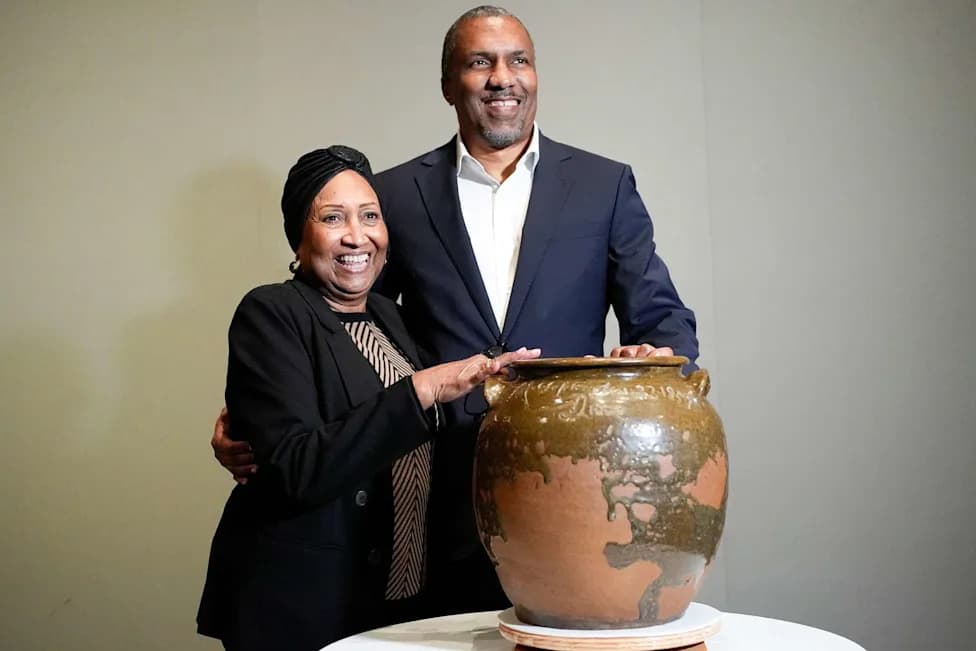
Pauline Baker and son Yaba Baker with pot made by their enslaved ancestor, David Drake, at the Museum of Fine Arts in Boston in November 2025Credit: AP Photo/Robert F. Bukaty
The Milwaukee Art Museum has returned two 19th-century stoneware vessels made by the enslaved South Carolina potter David "Dave the Potter" Drake to his descendants, continuing a recent wave of restitutions aimed at reuniting family members with culturally and historically significant objects.
Born around 1800 and believed to have died circa 1865, Drake became renowned for inscribing his pots with his name, dates and sometimes brief poems at a time when laws and custom forbade enslaved people from learning to read or write. The Dave the Potter Legacy Trust, managed by Drake’s relatives, notes that these inscriptions add unique historical and artistic value to his work.
How the Return Happened
On Sept. 9 the museum transferred the two stoneware vessels back to Drake’s family, the Milwaukee Journal Sentinel reported. One vessel was purchased by the museum from the Dave the Potter Legacy Trust; the second will remain on display as a long-term loan. Both were scheduled to return to public view on Sept. 30.
According to Kantara Souffrant, the museum’s senior director of community dialogue and adult programs, returning works like these helps families reconnect and reclaim lost histories. "These objects are a way of really, truly gathering your family — family you didn't know," she told the Journal Sentinel.
Broader Context And Family Efforts
The return follows similar agreements: the Museum of Fine Arts, Boston reached a deal with the Dave the Potter Legacy Trust in 2025, and the Georgia Museum of Art returned works in July. Drake’s descendants say they only learned about his historical significance roughly a decade ago and have since organized to preserve his legacy and connect with other relatives.
"Because of slavery, so many African Americans don't even know where to start," said Daisy Whitner, a descendant. "We don't know who our people are."
Family members emphasize that Drake’s pieces are not only culturally meaningful but also financially valuable. In 2021, a 25-gallon, four-handled stoneware "poem jar" attributed to Drake sold for $1.56 million, setting a record for American pottery. Descendants say they have not previously benefited from proceeds tied to the market for his work and view repatriation as a step toward building generational wealth and educational opportunities.
Provenance And Public Access
Drake’s work first appeared in the Milwaukee Art Museum’s orbit when the Chipstone Foundation exhibited his pieces in 2010. Chipstone purchased the two vessels from an art dealer in 2013 and donated them to the museum earlier this year. After the family expressed interest in reuniting with Drake’s work, the museum developed an ethical, legal process to transfer the vessels to the descendants.
The family says returned jars that carry signatures or poems are being placed on public display so the public can learn about Drake’s life and contributions. "Our goal is to make sure that the public gets a chance to get to know Dave," said Yaba Baker, Drake’s great-great-great-great-grandson. "We think he is an unsung hero in Black history."
What’s Next: The Dave the Potter Legacy Trust continues outreach to identify more relatives and locate additional works, while museums are increasingly engaging with descendants to address provenance, ethical stewardship and potential restitution.
Help us improve.