Vietnamese leaders publicly acknowledged dissent over a major Hanoi redevelopment after a consultation showed more than a quarter of respondents opposed the Red River element. The 100-year master plan approved in May would demolish thousands of homes to make way for parks, infrastructure and luxury housing, and a separate $30 billion, 11,000-hectare scheme could displace about 250,000 people. Officials reported 92% support for the Hoan Kiem lake proposal and 71.8% for the Red River plan, but residents and analysts say those figures may understate local opposition.
Rare Admission: Hanoi Redevelopment Sparks Public Dissent as Over a Quarter Oppose Red River Plan
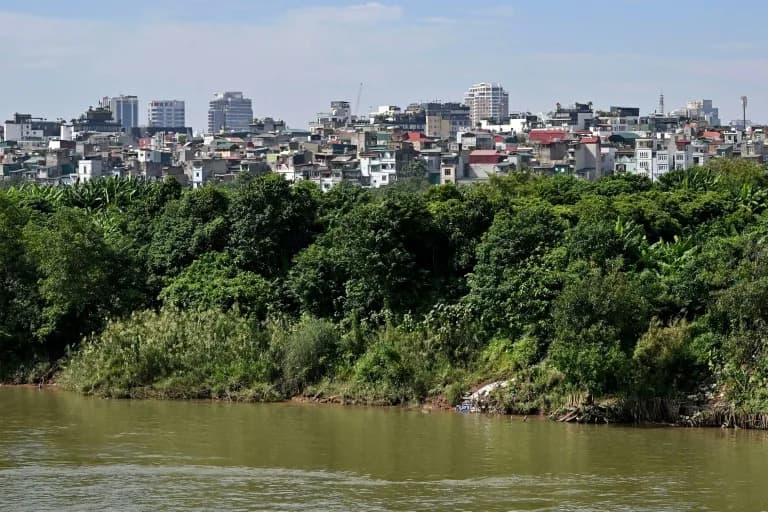
The Red River flows against the backdrop of a residential area in Hanoi (STR)
Vietnam's leadership has made a rare public acknowledgment that not all citizens support its flagship Hanoi redevelopment, revealing divisions after a government consultation found more than a quarter of respondents opposed parts of the plan.
The 100-year master plan, approved in May, proposes major upgrades along the Red River and around Hoan Kiem (Sword) Lake in central Hanoi. Officials say the multi-billion-dollar initiative will deliver new infrastructure, parks and high-end residential projects. But the scheme would also require the demolition of thousands of homes and the relocation of large numbers of residents.
Consultation Results And Official Response
President To Lam announced consultation results that state media reported as showing 92 percent support for the Hoan Kiem lake project and 71.8 percent support for the Red River redevelopment. By that measure, more than a quarter of respondents opposed the Red River plans. To Lam acknowledged those divergent views and urged authorities to engage more with citizens, saying it is "normal" and "necessary" that there are differing opinions on initiatives with long-term impact.
“While the majority of citizens are in consensus, there are differing opinions on certain specific aspects,” To Lam told Hanoi residents.
Local Backlash And Symbolic Controversy
Public unease has surfaced in subtle ways in recent months: prayer vigils, banners pleading to spare neighbourhoods and social media posts critical of specific design elements. A detailed map published as part of the consultation identified which homes could be demolished, prompting personal outcry.
One particular flashpoint is a proposed ceremonial arch near Hoan Kiem lake, modelled after Paris's Arc de Triomphe. Many residents said a towering modernist arch would jar with the lake's tree-lined streets, French-era buildings and traditional temples. Resident Tran Thi Sanh likened the design to a "guillotine or a gallows" in a Facebook post that received thousands of reactions.
Scale, Displacement And Doubts About The Numbers
Authorities also unveiled a $30 billion mega-project across the Red River. Plans for an 11,000-hectare zone—roughly the size of Paris—envision parks and luxury housing that would require relocating an estimated 250,000 residents.
Many locals doubt the consultation figures capture the true depth of opposition. Resident Giang told reporters she was "angry and sad" at the prospect of losing her land and said people in her community opposed the plan. Neighbours who asked to remain anonymous for fear of reprisals echoed those concerns.
“If they want to do it, they will do it, regardless of what people’s opinions are,” Giang said.
US-based analyst Tuong Vu of the University of Oregon described the public release of numerical results as unusual, noting that such survey data were typically shown only to officials. He suggested that an independent survey might reveal higher levels of opposition.
Implications
The episode offers a rare window into the dynamics between Vietnamese authorities and the public on urban planning and heritage preservation. Officials have signalled a willingness to listen, at least rhetorically, but residents remain sceptical about whether dissent will influence final decisions. The debate raises broader questions about governance, compensation, and how to balance modernization with community rights and cultural heritage.
What to watch next: whether Hanoi authorities revise designs, adjust relocation and compensation plans, or press ahead with the current timeline.
Help us improve.