The University of Tartu-led team used ancient Yersinia pestis genomes, radiocarbon dates and historical records to trace repeated plague reintroductions across Europe from the late 14th century through the 18th century. They reconstructed 26 new genomes and improved dating for 75 genomes in total, linking lineages to specific outbreaks. A major diversification around 1450–1500 suggests new rodent reservoirs, possibly influenced by the Great Renaissance Drought, and later spread is associated with wartime movements such as the Thirty Years' War and the Great Northern War.
New Study Maps How the Black Death Reappeared Across Europe for Centuries — Using Ancient Genomes and Historical Records
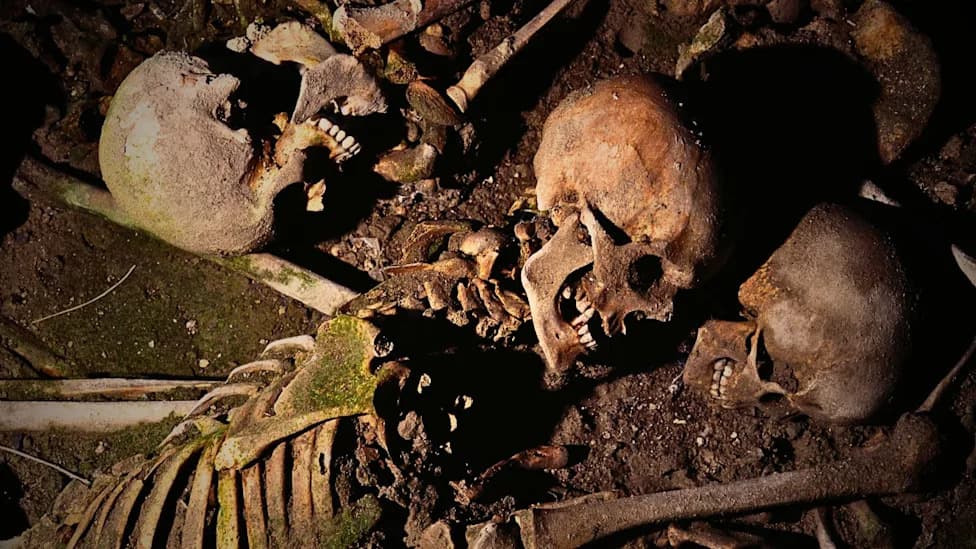
(Richard T. Nowitz/The Image Bank/Getty Images)
Textbooks often describe the Black Death as a single catastrophic wave that swept Europe between 1347 and 1353. A new paper in PNAS, led by researchers at the University of Tartu (Keller et al., 2026), shows a much more complex picture: the plague returned repeatedly across the continent for centuries, and can now be tracked with far greater temporal and geographic precision.
Combining Genetics, Radiocarbon Dating and Archives
The team reconstructed and analyzed 26 new Yersinia pestis genomes recovered from 11 archaeological sites in Estonia, Russia, England, the Netherlands and Switzerland. To improve chronological resolution, they combined traditional radiocarbon dating with bacterial genetic timelines, and cross-checked results against historical archives and local fatality records.
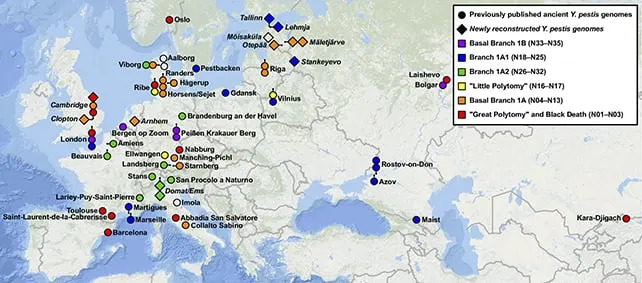
The researchers tracked the plague across 400 years in Europe. (Keller et al.,PNAS, 2026)
Applying this multilayered method allowed the researchers to more accurately date a total of 75 plague genomes: 11 high-quality samples from the newly sequenced material plus 64 genomes from earlier studies. Those improved dates made it possible to link genetic lineages to specific recorded outbreaks and waves of disease.
Key Findings
One striking discovery is a pronounced diversification of Y. pestis lineages around 1450–1500. The authors suggest this branching may reflect the bacterium establishing new animal reservoirs—most likely in rodents—at the same time as climatic stresses such as the so-called Great Renaissance Drought, which could have altered rodent populations and their contact with humans.
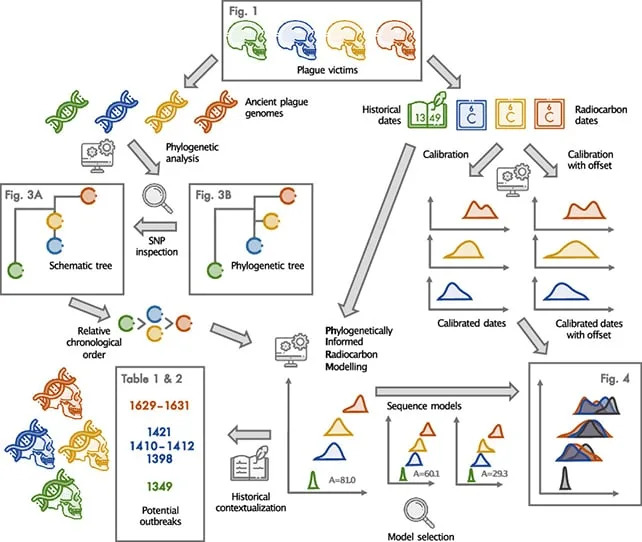
The researchers connected bacteria lineages with specific outbreaks. (Keller et al.,PNAS, 2026)
The study also connects genetic lineages to later plague surges during major conflicts: notably the Thirty Years' War (1618–1648) and the Great Northern War (1700–1721). The findings support the idea that troop movements, refugees and trade networks helped carry the disease along travel routes.
“We found evidence for repeated introductions of plague into Estonia starting already in the late 14th century and identified several previously unknown genetic lineages, both in urban and rural settings,”
Why This Matters Today
Although Yersinia pestis persists in animal reservoirs today and human cases are now rare and treatable with modern antibiotics, the study illustrates how zoonotic diseases can evolve and spread over long timescales. Improved genomic dating and linkage to historical records provide a richer framework for modeling the long-term dynamics of diseases that jump from animals to humans—knowledge that can inform responses to future pandemic threats.
As genetic sampling of ancient remains grows, the authors note, timelines will become even sharper and connections to historical events more secure. The study demonstrates the power of integrating genetics, archaeology and archival research to illuminate centuries-long patterns of infectious disease.
Reference: Keller et al., PNAS, 2026.
Help us improve.