The Pacific's subsurface "age" — how long water has been isolated from the surface — is projected to shift in contrasting ways as the planet warms. Idealized century-long model runs by a UC San Diego team show the upper Pacific thermocline (200–1,000 m) will see young subsurface water become older in the subtropical North Pacific, while older water appears to get younger in the tropical Pacific. The authors link this meridional contrast to weakened vertical exchange driven both locally and remotely by Southern Ocean warming, and warn the North Pacific may face the largest habitat decline.
Pacific Warming Reshuffles Ocean 'Ages': Young Water Gets Older, Old Water Gets Younger

(Ken Kiefer 2/Connect Images/Getty Images)
Water in the open ocean has an effective "age" — a measure of how long it has been isolated from the surface and unable to reclaim oxygen from the air. As water ages it loses dissolved oxygen to marine life, microbes and chemical reactions, and warmer water also holds less oxygen, so climate warming is expected to accelerate ocean "aging" and worsen low-oxygen conditions in many marine habitats.
To clarify how these changes will play out across the Pacific, researchers at the University of California, San Diego ran idealized ocean circulation model experiments projecting 100 years of warming. Their results, published in AGU Advances, reveal a striking and seemingly paradoxical pattern: in some regions the relatively "young" thermocline waters become older, while in other regions older waters appear to get younger.
Where the Change Is Strongest
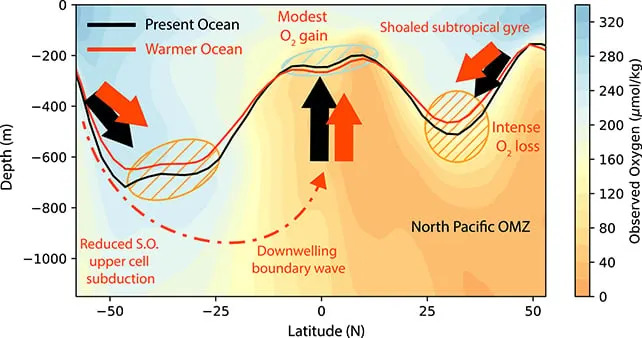
The study modeled ocean warming impacts on oxygenation. (Taylor et al.,AGU Adv., 2026)
The effect is most pronounced in the upper Pacific thermocline — the transition layer between roughly 200 and 1,000 meters depth that separates the warm, well-mixed surface layer from the colder deep ocean. Warming increases the temperature-driven density contrast between surface and subsurface layers, which reduces vertical exchange. But regional differences in circulation and wind forcing mean the consequences vary across the basin.
"We use idealized model simulations to isolate and illustrate the warming-induced circulation changes that drive the 'young get older, but old get younger' pattern in the Pacific thermocline under projected climate change," the researchers write.
In the subtropical North Pacific, the thermocline is strongly influenced by relatively young, fresher water mixed down from the surface. As downward mixing weakens with warming, those subsurface waters become more isolated and thus older and lower in oxygen. By contrast, the tropical Pacific thermocline is more affected by older, saltier water upwelling from depth. The model indicates that slowed mixing there leads to a relative rejuvenation of subsurface waters — effectively making them younger in the projections.
The team attributes part of the tropical response to a remote influence from warming in the Southern Ocean around Antarctica. Changes in heat forcing there can alter large-scale meridional circulation patterns across the Pacific, producing contrasting age and oxygen trends between northern and tropical sectors.
YouTube Thumbnail
Implications and Next Steps
Although the study focuses on physical and circulation-driven changes rather than a detailed ecological impact assessment, the authors flag the North Pacific as potentially facing the greatest deterioration in conditions for marine life. Existing low-oxygen zones are unlikely to see catastrophic additional oxygen loss over the next century in these idealized runs, but they already start from an ecologically stressed baseline.
The researchers recommend follow-up studies using higher-resolution, more comprehensive climate models that explicitly incorporate changing wind patterns and other processes to capture the full picture of Pacific oxygenation. They conclude that warming-induced changes in vertical circulation will play a key role in shaping the Pacific Ocean's physical, biogeochemical, and ecosystem response to human-driven climate change.
Publication: The study is published in AGU Advances and was led by scientists at the University of California, San Diego.
Help us improve.