An Italian court convicted three Egyptian security officers in absentia for the 2016 abduction of Giulio Regeni and sentenced each to 10 years, while acquitting a fourth defendant and dismissing a related murder charge. Regeni, a 28-year-old Cambridge postgraduate, was found dead days after his disappearance; post-mortem results showed extensive torture. Italian prosecutors said the trial proceeded despite limited cooperation from Egyptian authorities and noted extradition is unlikely. The court ordered damages to Regeni's family; Rome may still consider an appeal.
Italian Court Convicts Three Egyptian Security Officers In Giulio Regeni Abduction; Fourth Acquitted
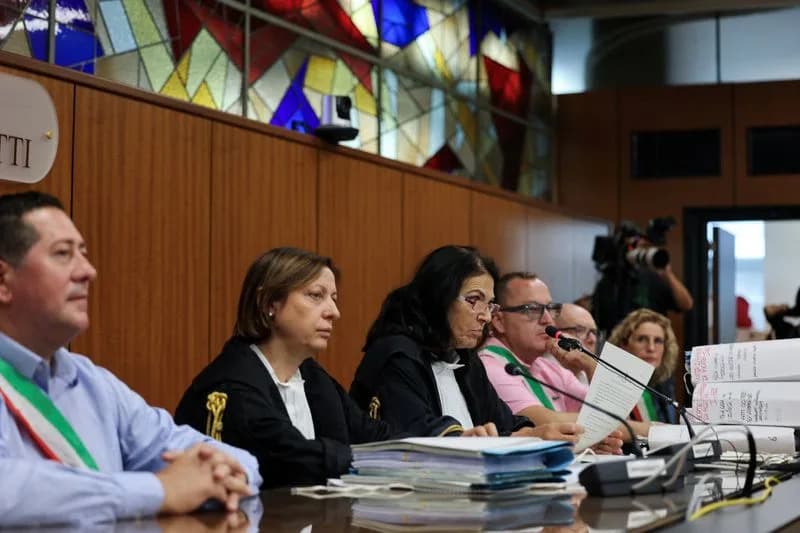
The presiding judge of the court, Paola Roja, speaks on the day of the verdict in the trial of four Egyptian security officers accused of the kidnapping, torture and murder of Giulio Regeni in Cairo in 2016, in Rome, Italy, September 28, 2026. REUTERS/Yara Nardi
An Italian court on Monday found three Egyptian security officers guilty in absentia of the 2016 abduction of Giulio Regeni, the Cambridge University postgraduate whose tortured body was discovered days after he disappeared in Cairo. Each convicted man was sentenced to 10 years in prison, while a fourth defendant was acquitted and a murder-related accusation against one defendant was dismissed.
Verdict and Sentences
The court identified the convicted men as Major Magdi Sharif of Egypt's General Intelligence Service, Colonel Ather Kamal, head of Cairo police investigations, and Colonel Hisham Helmy. Major General Tarek Sabir, the former head of state security, was acquitted of the aggravated kidnapping charge. The judge also rejected an allegation of conspiracy to commit aggravated murder against Sharif.
Background

Italian student Giulio Regeni's parents, Claudio and Paola Regeni speak to lawyer Alessandra Ballerini on the day of the verdict in the trial of four Egyptian security officers accused of the kidnapping, torture and murder of Giulio Regeni in Cairo in 2016, in Rome, Italy, September 28, 2026. REUTERS/Yara Nardi
Regeni, a 28-year-old Cambridge postgraduate, disappeared in Cairo on January 25, 2016. His body was recovered nearly a week later; a post-mortem examination showed he had been subjected to extensive torture. Italian prosecutors have argued that Regeni was targeted because his academic research touched on the politically sensitive topic of independent trade unions. Egyptian authorities have consistently blamed criminal gangs for his death.
Investigation, Cooperation And Legal Basis
Italian and Egyptian prosecutors initially worked together but later reached different conclusions and fell into conflict. Rome's chief prosecutor, Francesco Lo Voi, said the verdict was reached "despite what can be described as less than wholehearted cooperation from the Egyptian authorities." Italy attempted about 30 times through diplomatic and government channels to obtain the suspects' addresses but received no response. Under Italian law, courts can prosecute crimes committed abroad against Italian citizens, which allowed the trial to proceed in absentia.
Practical Implications And Reactions

Italian student Giulio Regeni's mother, Paola Regeni, speaks to lawyer Alessandra Ballerini before the verdict in the trial of four Egyptian security officers accused of the kidnapping, torture and murder of Giulio Regeni in Cairo in 2016, in Rome, Italy, September 28, 2026. REUTERS/Yara Nardi
It is considered unlikely the convicted men will be extradited to serve their sentences. Prosecutors had initially sought life imprisonment for Major Magdi Sharif and 17 years and six months for the other defendants. The court ordered the convicted men to pay damages to Regeni's family and to the Italian state. Alessandra Ballerini, the family's lawyer, described the ruling as a victory against impunity and urged the Italian government to press for damages and reconsider relations with Egypt.
"Impunity can be defeated and democracies can place limits on arbitrary power," Ballerini said after the verdict.
Next Steps
Rome's chief prosecutor said he would review the judgment before deciding whether to appeal. Italy's top court previously ruled that a foreign state's refusal to assist an investigation cannot block domestic proceedings, a decision that allowed the case to continue despite limited cooperation from Egypt.
This verdict renews attention on the diplomatic strain between Italy and Egypt and the broader questions of accountability when alleged crimes involve foreign security services.
Help us improve.