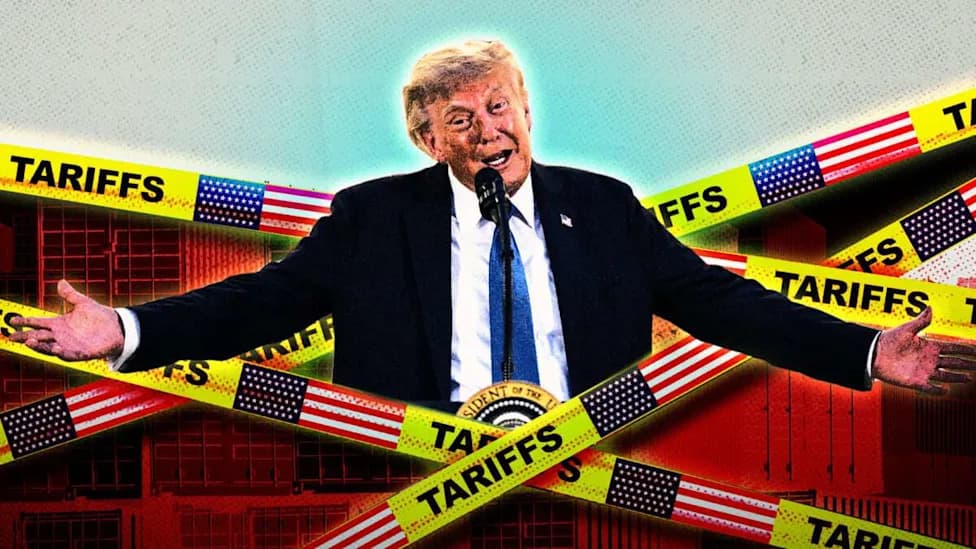
Alan Wolff, the drafter of Section 301 of the 1974 Trade Act, says President Trump’s broad use of that statute to impose tariffs on dozens of countries exceeds the authority Congress intended. The Liberty Justice Center has filed a legal challenge, arguing the administration’s forced-labor findings are a pretext for generalized tariffs. Three former senior trade officials filed an amici brief backing the challenge, calling the investigations inadequate and the tariffs arbitrary. The Court of International Trade will hear the case on September 30, a decision with broad implications for U.S. trade authority.
Architect of Section 301: Alan Wolff Says Trump’s Broad Tariffs Exceed Congressional Authority

Shipping cranes stand near the Vincent Thomas Bridge at the Port of Los Angeles on August 19, 2026 in Los Angeles. - Mario Tama/Getty Images
Alan Wolff, the trade lawyer who drafted what became Section 301 of the 1974 Trade Act, says President Trump’s sweeping use of that statute to impose tariffs on dozens of countries exceeds the authority Congress intended and may be unlawful.
Court Challenge and What's at Stake
On September 30 the U.S. Court of International Trade will hear a lawsuit from the Liberty Justice Center challenging the administration’s latest tariff strategy. The center previously prevailed in a Supreme Court decision earlier this year that found the president lacked authority to invoke emergency powers to impose tariffs. The current suit argues the administration is misusing Section 301 and acting on a pretext tied to forced-labor findings.
Why Section 301 Was Drafted
Wolff, who served as the Nixon administration’s lead international trade lawyer, says Section 301 was crafted as a narrow, targeted tool to address specific anticompetitive actions by a single foreign government. Frustrated by surging competition from Japan in the 1960s and early 1970s, policymakers sought an authority that would allow focused investigations and retaliatory measures to force negotiations. In practice, that tool once helped secure a bilateral agreement after steep tariffs on Japanese electronics.
"The notion that you can write your own tariff against anyone and anybody is offensive," Wolff said. "This isn't what we intended."
Administration's Current Approach
The Trump administration has argued Section 301 — which lacks explicit statutory time limits or tariff caps — grants broad discretion to impose duties on any country it determines harms U.S. commerce. In June, the U.S. Trade Representative’s office, led by Jamieson Greer, published a 98-page report following a months-long probe of foreign policies related to goods made with forced labor. After public comment, the USTR in July declared that dozens of countries directly or indirectly supported forced labor and announced punitive duties of roughly 10% to 12.5% on more than 60 countries.
Wolff and other critics say the USTR effectively "bundled" disparate countries under a single standard, created a novel enforcement approach, and deployed tariffs not as a negotiating tool but as a broad, unilateral trade policy.
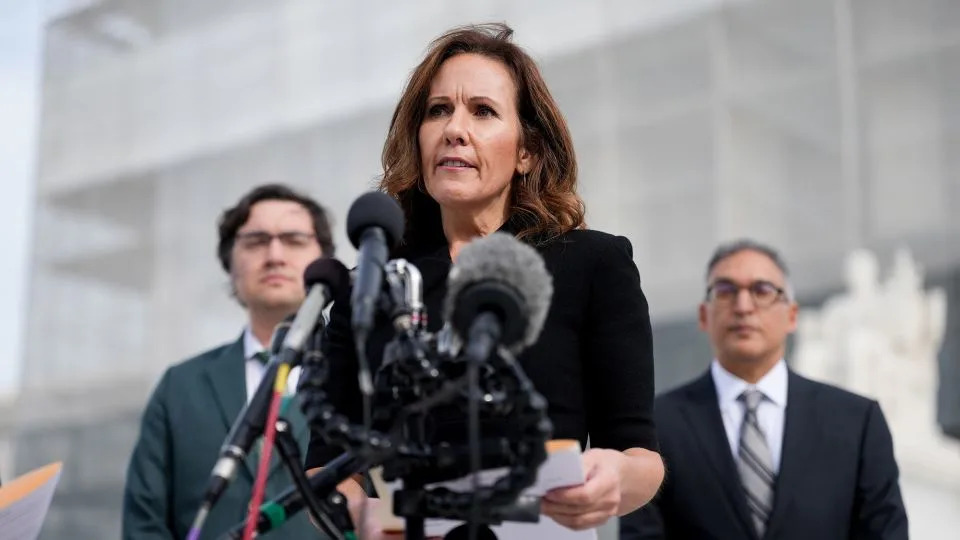
Sara Albrecht, chair of the Liberty Justice Center. - Eric Lee/Bloomberg/Getty Images
Legal Challenge and Amici Support
The Liberty Justice Center contends the administration’s actions are pretextual: public statements and earlier moves indicate an effort to restore near-universal tariffs after the Supreme Court curtailed prior emergency-based measures. After that decision, the administration briefly used Section 122 of the 1974 Trade Act to impose a universal 10% tariff; when those measures expired, it turned to Section 301.
Three former senior trade officials — Wolff; Carla Hills, U.S. Trade Representative under President George H.W. Bush; and Warren Maruyama, USTR general counsel under President Ronald Reagan — filed an amici brief supporting the Liberty Justice Center. They argue the forced-labor allegations are weak or inadequately investigated, the tariffs were not designed to induce corrective action, and therefore the tariffs are "contrary to law and arbitrary and capricious."
Broader Implications
Wolff warns the administration has shown willingness to use other statutory authorities when one route is blocked: the White House has already used Section 301 to raise some Brazilian tariffs to 37.5% and invoked Section 338 of the Tariff Act of 1930 to impose duties of up to 50% on selected Canadian items. The USTR is also investigating more than a dozen countries over excess manufacturing capacity.
"If courts bar this approach, the administration may simply seek another statutory path," Wolff said. "The only response available to opponents is to keep fighting in court."
What to watch: The Court of International Trade’s September 30 hearing could set important limits on how broadly the executive branch may use Section 301 and related authorities to impose tariffs on multiple trading partners.
Help us improve.