New research in Animal Cognition reports that when dogs suppress actions after hearing "no," their frontal EEG shows increased theta-band activity similar to the human neural signature of self-control. The team recorded 226 EEG segments from 14 awake dogs during commands and quiet sitting and found enhanced frontal-theta activity during behavioural inhibition. Authors propose that canine EEG markers could help model human conditions linked to frontal-lobe function, such as ADHD and obesity.
When Dogs Hear “No,” Their Brains Show Human-Like Self-Control

Self-control can be seen in the brain's frontal lobes.
Common commands — sit, stay, roll over, come, fetch — and the curt “no” are everyday tools owners use to shape their dogs’ behaviour. New research published in Animal Cognition finds that when dogs restrain themselves after hearing a prohibitive cue, their brain activity shows a pattern resembling the frontal-theta signature linked to human self-control.
Study Details
Researchers led by Márta Gácsi and colleagues recorded non-invasive electroencephalography (EEG) from awake pet dogs to investigate neural activity during moments of behavioural inhibition. The team collected 226 EEG segments, each about 30 seconds long, from 14 dogs while the animals either followed a command or sat quietly. They specifically examined theta-band activity measured over frontal regions — the same oscillatory pattern often associated with self-control in humans.
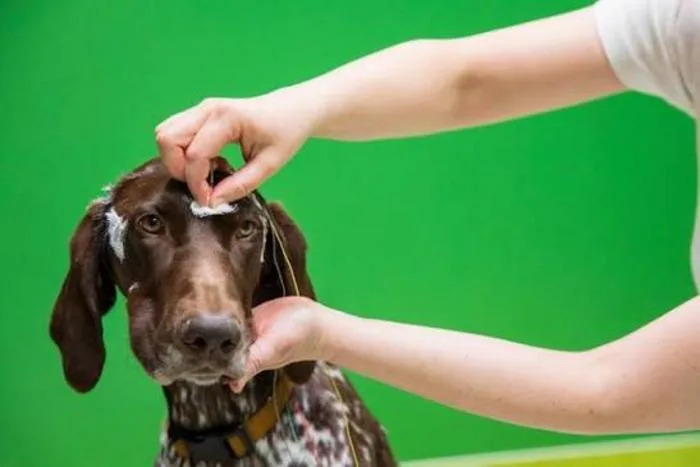
The team took 226 EEG recordings of awake dogs.Image: Gáti Oszkár Dániel.
"During self-control situations, we observed EEG activity that resembles human theta in both frequency and localization," said co-author Ivaylo Borislavov Iotchev.
Why It Matters
The frontal lobes are a relatively recent evolutionary addition to the mammalian brain and are important for deliberate, goal-directed control. In humans, frontal-lobe processes and frontal-theta oscillations are linked to self-control and are implicated in conditions such as attention-deficit/hyperactivity disorder (ADHD) and abnormal weight gain. The authors — including Anna Kis of the Hungarian Academy of Sciences — suggest that canine EEG markers of frontal engagement could provide a useful, time-efficient model to study developmental and pathological conditions that also affect humans.
While the findings do not prove dogs experience self-control in exactly the same subjective way humans do, the similarity in EEG patterns suggests comparable neural mechanisms may be engaged when dogs inhibit actions on command. The study opens a path for comparative neuroscience using non-invasive recordings in companion animals.
Study Reference: Animal Cognition (authors: Márta Gácsi, Ivaylo Borislavov Iotchev, Anna Kis, et al.).
Help us improve.