The Broca Living Lab in Paris and a care home in southern France are piloting robots and AI systems to support people with Alzheimer’s. Devices such as NAO, Paro and Miroki are being tested for conversation, comfort and cognitive stimulation, while the Livana AI uses residents’ biographies to personalise calming phone interactions. Researchers view these technologies as potential facilitators for therapy and staff—not replacements for essential human relationships.
How Robots and AI Are Being Tested to Support People With Alzheimer’s in France
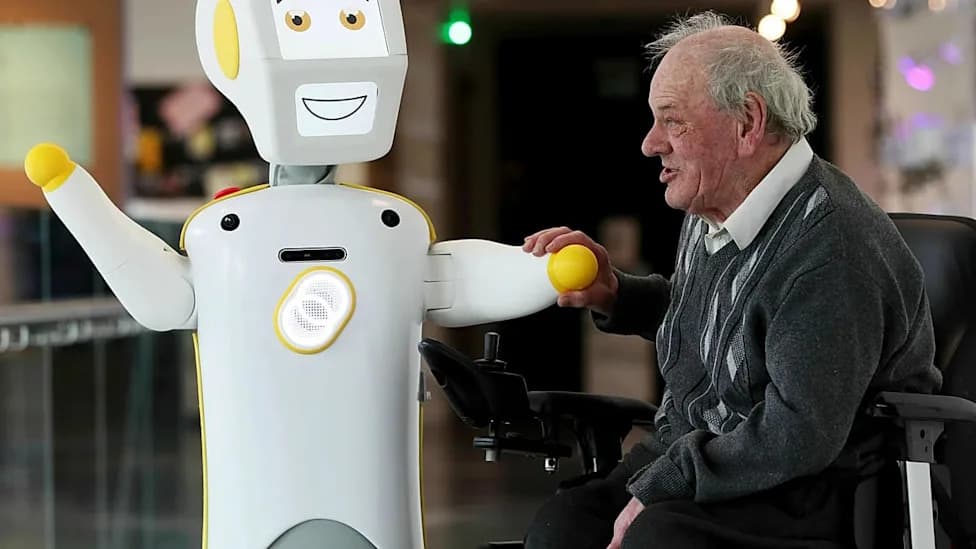
How AI and robots provide companionship for people with Alzheimer’s
At Paris’s Broca Hospital and at a care home in southern France, researchers are trialling robots and artificial intelligence systems to support people living with Alzheimer’s and other cognitive disorders. The experiments explore whether these technologies can encourage conversation, provide comfort and help deliver or facilitate therapy—while keeping human care at the centre.
Robots That Talk, Play and Soothe
Several devices are in use at Broca Living Lab. The NAO robot leads simple exercises and asks conversational prompts to stimulate memory and language—for example, asking patients to finish familiar proverbs. Paro, a robotic seal, is designed to offer therapeutic comfort and reacts to a patient’s movements and sounds through embedded sensors. Miroki is another conversational robot used to engage patients through dialogue and interaction.
“I’m going to give you the beginning of a proverb, and you can try to tell me how it ends,” the NAO robot tells participants during sessions.
Reactions vary. Some participants are fascinated and delighted to see robotic technologies in person; others are uncomfortable or clearly reject the interactions. “There are all sorts of reactions,” says Lea Vecchioni, psychologist and research engineer at the Broca Living Lab. “Some patients are almost amazed… others clearly reject the technology and the robots.”
AI For Personalised, Soothing Conversations
In Tarn-et-Garonne, the La Septfontoise care home is piloting Livana, an AI-driven system that delivers personalised conversations by phone to calm residents who become agitated. Staff collected biographical information about consenting residents—details such as interests and life stories—to shape the system’s voice and the content of its interactions. Psychologist Elodie Jammes says, “The voice can have elements that help soothe the resident, based on their interests and life story.”
Managers view the tool as a potential non-drug approach to support wellbeing and provide extra help for care teams. “The aim of the trial is to explore non-drug approaches that can improve residents’ wellbeing, while also providing additional support for care staff,” says La Septfontoise director Ghislaine Verines.
What Researchers Are Looking For
Investigators are studying how these machines might act as facilitators in a range of therapies, including cognitive stimulation, speech and language therapy, physiotherapy and psychomotor rehabilitation. Maribel Pino, a cognitive psychology researcher and research director at the Broca Living Lab, emphasises the potential role: “The robot can act as a facilitator that helps engage patients in therapy sessions.”
At the same time, researchers are careful to set boundaries. Pino stresses robotics should not be treated as a replacement for human relationships: “They are still tools, however sophisticated their conversational abilities or presence may become… They will never replace the essential human relationships people need.”
Context And Related Developments
The trials in France come as other advances in Alzheimer’s care are emerging: for example, Roche recently gained European approval for a blood test intended to flag Alzheimer’s risk earlier, though questions about reliability remain. The French experiments demonstrate a range of possible applications—from prompting conversation to providing comfort or personalised support—and aim to assess what technology can add to traditional care while keeping human contact central.
Help us improve.