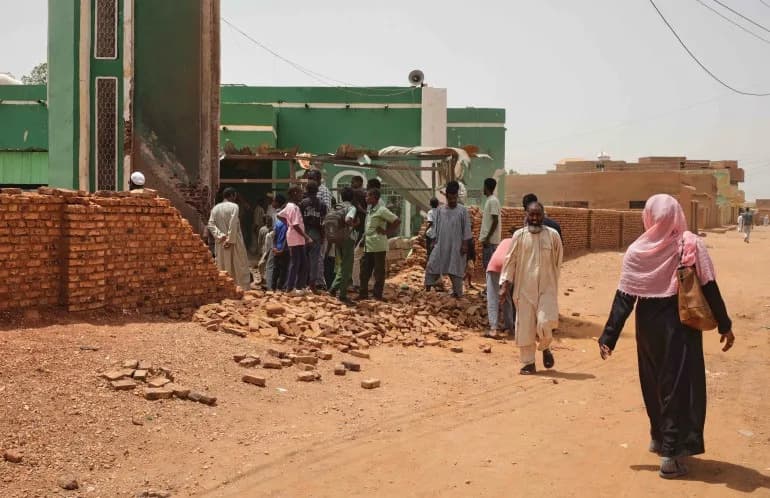
The war between Sudan’s army and the Rapid Support Forces, which began in April 2023, has precipitated a largely man-made food crisis that produced famines in 2024 and 2025 and now threatens people across the country. Historical famines—from 1684 through the catastrophic 1888–1889 episode—offer grim parallels, but the current emergency is distinguished by the deliberate disruption of agriculture, markets and infrastructure. Humanitarian access and international funding are inadequate for the scale of need, even as Sudan’s vast agricultural potential remains untapped.
Sudan’s Past Famines Resurface as War Drives a Nationwide Hunger Crisis
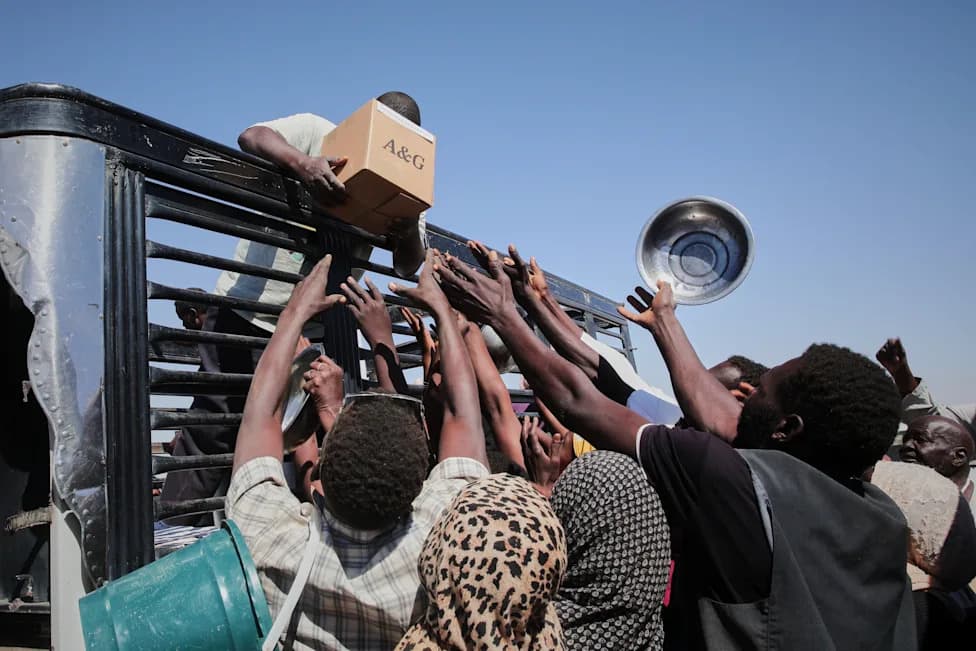
Sudanese families reach out as aid workers distribute food supplies at a camp in al-Dabba, in Sudan's Northern State, November 16, 2025 [File: Marwan Ali/AP]
Sudan, a country long haunted by episodes of famine, has again descended into a catastrophic food emergency as fighting between the Sudanese army and the Rapid Support Forces intensifies. What began in April 2023 has, according to observers, escalated into a largely man-made crisis that produced declared famines in 2024 and 2025 and now threatens millions across urban and rural areas alike.
Historical Context
Severe food shortages are not new to the region. One of the earliest recorded crises took place in 1684 under the Funj Sultanate, producing prolonged grain scarcity, mass displacement and a concurrent smallpox outbreak. Similar drought-driven crises followed in 1750 and between 1835 and 1838 during Ottoman-Egyptian rule, when low Nile levels and drought devastated harvests.
The famine of 1888–1889 under Khalifa Abdullahi al-Taashi remains the most searing in public memory: drought, locusts and conflict combined to create widespread hunger. Contemporary accounts and later estimates suggest the death toll may have exceeded one million, though precise figures are hard to confirm. Throughout the 20th century, periodic shortages persisted, including the severe 1984 drought that displaced hundreds of thousands into Khartoum.
The Current Crisis: Largely Man-Made
Unlike many earlier famines driven chiefly by weather, the present emergency is driven primarily by conflict. War has disrupted planting and harvests, forced farmers from their land, and impeded transport routes and markets. Reports point to the deliberate targeting and disruption of key infrastructure — markets, bakeries, agricultural projects, banking and communications — intensifying scarcity and isolating communities.
Abdullah al-Tijani, a social historian and humanitarian activist, warned that ‘most previous famines were often confined to particular regions, while this time hunger and the collapse of basic services have spread across major urban and agricultural centres, including Khartoum, Gezira, Sennar, Darfur and Kordofan.’
Access for humanitarian organizations has been severely constrained by restrictions, delays in transit permits and frontline insecurity, reducing lifesaving relief deliveries. Observers also report that control over food supplies is increasingly being used as a tool of war, exacerbating civilian suffering.
Mohammed Abdul Rahman, an economic researcher, said the crisis reveals deeper development gaps: ‘Wars and armed conflicts are among the most influential factors on food production, compounded by displacement of farmers, political instability, weak agricultural policy and underinvestment in modern farming.’
Potential and Urgent Needs
The scale of the catastrophe is particularly stark given Sudan’s agricultural potential: roughly 200 million acres (81 million hectares) of arable land, abundant Nile water and large livestock resources. Those assets have been undercut by conflict, years of underdevelopment and now the direct disruption of agricultural systems.
Humanitarian agencies warn that international funding remains insufficient for the scale of need, and they call for safe humanitarian corridors, unimpeded access for relief workers, and urgent political efforts to protect civilians and rebuild food systems.
What’s at stake: Without immediate, large-scale humanitarian response and steps to restore agricultural production — including protecting farmers and markets and re-establishing supply chains — millions of Sudanese may face prolonged hunger and displacement.
Help us improve.