Surveyed Starbucks employees say health insurance premiums will rise sharply starting 1 October, with some per-paycheck costs nearly doubling. More than 130 partners responded to the union-backed survey, and many report being pushed toward dropping coverage or taking second jobs. The increases coincide with a union-led boycott and growing union representation at Starbucks, which now claims over 12,000 members.
Starbucks Baristas Reel As Health Insurance Premiums Soar — Some Consider Second Jobs
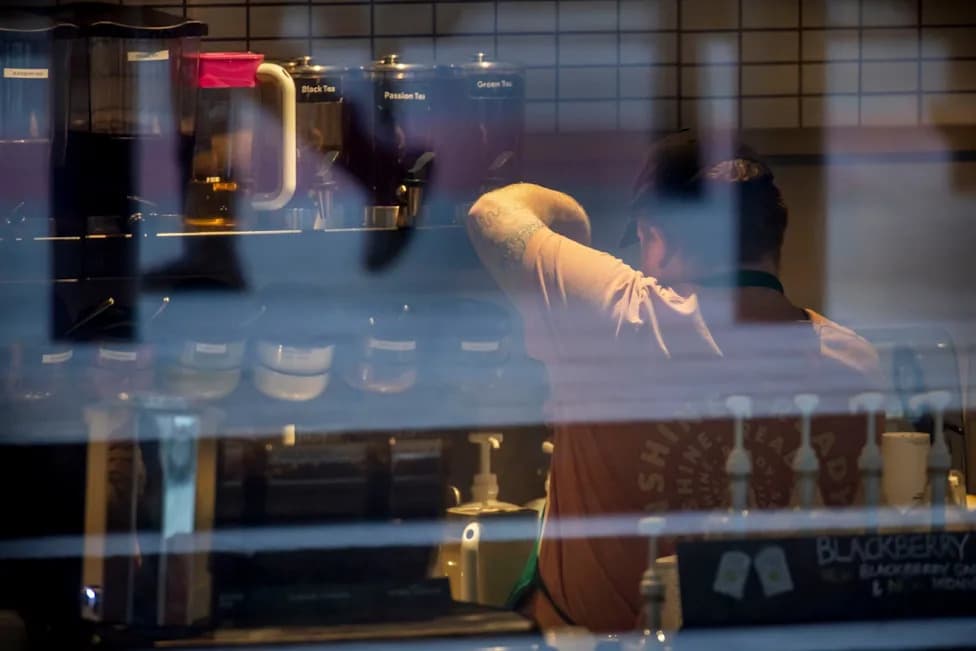
A barista prepares a drink inside a Starbucks in New York on 24 February 2025.Photograph: Bloomberg/Getty Images
Baristas at Starbucks say their health insurance premiums have surged sharply this year, with some workers reporting increases that nearly double their per-paycheck costs. The findings come from a survey of more than 130 Starbucks employees — from both unionized and non-unionized stores — shared exclusively with the Guardian and conducted by Starbucks Workers United.
The survey found many partners facing higher premiums effective 1 October, even though they are scheduled for enough hours to qualify for benefits. Several workers said the increases are forcing them to contemplate dropping coverage or seeking a second job to make ends meet.
Workers Describe Steep Increases
Longtime employees provided detailed examples of how the hikes are affecting household budgets. Kaye-Lani Story, a nine-year barista in Edina, Minnesota, said she recently visited a doctor for herself and her son because her company coverage is set to lapse on 1 October. Her weekly premium was due to rise from $130 to $170 — roughly a 30% increase.
“That is another $40 each week that I am not going to have in my income, if I choose to go with it, and that's just not something that financially I can afford,” Story said. “I have to drop my insurance because the company will not cover those costs when it's clear that they're definitely making enough.”
Story said she had been eligible for Minnesota's state health plan in the past but moved onto Starbucks' plan after her income exceeded the state threshold. Now she finds herself ineligible for state help yet unable to absorb the higher employer-plan costs alongside fluctuating household expenses.
In Woods Cross, Utah, partner Cory Wagner — who depends on a heart medication — said his biweekly premium jumped from $70 to $122, a rise that has forced him to weigh paying for medicine against groceries, utilities and fuel.
“This is the first year that [premiums] nearly doubled,” Wagner said. “Now I'm kind of left at a point where I am choosing between paying for this medication and paying for my utility bills, paying for my groceries, paying for the gas that I need to get to work.”
Union Response and Company Statement
Starbucks Workers United has launched a boycott and filed an unfair labor practice charge after the company did not provide requested information about what prompted the premium increases and how Starbucks' contribution to healthcare costs changed. The union represents more than 12,000 workers and says over 700 Starbucks stores have won union elections since unionizing began in December 2021.
A Starbucks spokesperson declined to comment on the unfair labor practice charge but said by email that, “like employers across the country, we continue to face rising healthcare costs while remaining committed to providing quality, affordable healthcare coverage for full and part-time partners at Starbucks, beginning at just 20 hours per week.”
What This Means
Employees report that the premium hikes are not only straining monthly budgets but also affecting access to essential medications and care. For some baristas, the cost increases are prompting difficult trade-offs — dropping insurance, seeking outside coverage, or taking a second job — and are adding momentum to the union's organizing and bargaining efforts.
Help us improve.