Summary: The Suriname toad (Pipa pipa) is nearly blind and tongueless yet captures fish by powerful suction triggered by ultra‑sensitive, multi‑lobed fingertips. Each finger exhibits a four‑by‑four lobed pattern (16 lobes per finger, 128 total) covered in papillae that make the tips nearly as sensitive as human fingertips. These fingertip sensors account for over 60% of the limb’s nerve connections while covering only ~8% of its surface, and their signals are routed to an unexpectedly large optic tectum region. High‑speed video shows suction begins at ~0.5 cm from prey and the capture takes <0.1 s, even when the lateral line is disabled.
Blind, Tongueless Suriname Toad Hunts Using Human‑Like Sensitive Fingertips
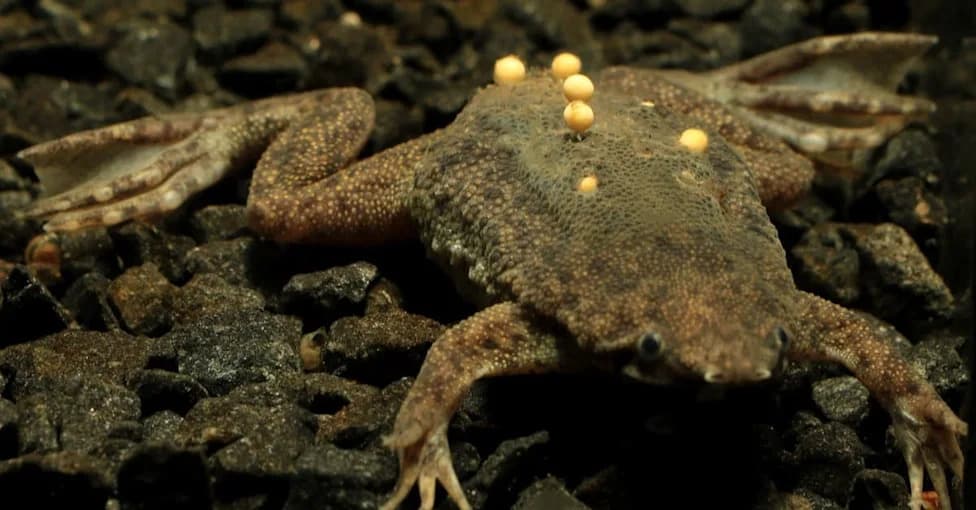
Semi-aquatic Frog - Surinam Toad© Dan Olsen/Shutterstock.com
In the murky riverbeds of the Amazon and Orinoco basins lives the Suriname toad (Pipa pipa), a flattened, leaf‑like frog that is nearly blind and lacks a tongue. Despite these limitations, it is an efficient ambush predator that captures fish with lightning‑fast suction strikes.
How It Looks and Where It Lives
Evolution has molded this species into a cryptic shape: a flat body, a triangular head with tiny, dorsally placed eyes, and brown‑olive camouflage that helps it resemble fallen debris on river bottoms. The toad occurs across slow‑moving rivers and canals in Bolivia, Brazil, Colombia, Ecuador, the Guianas, Peru, Venezuela and on the island of Trinidad.
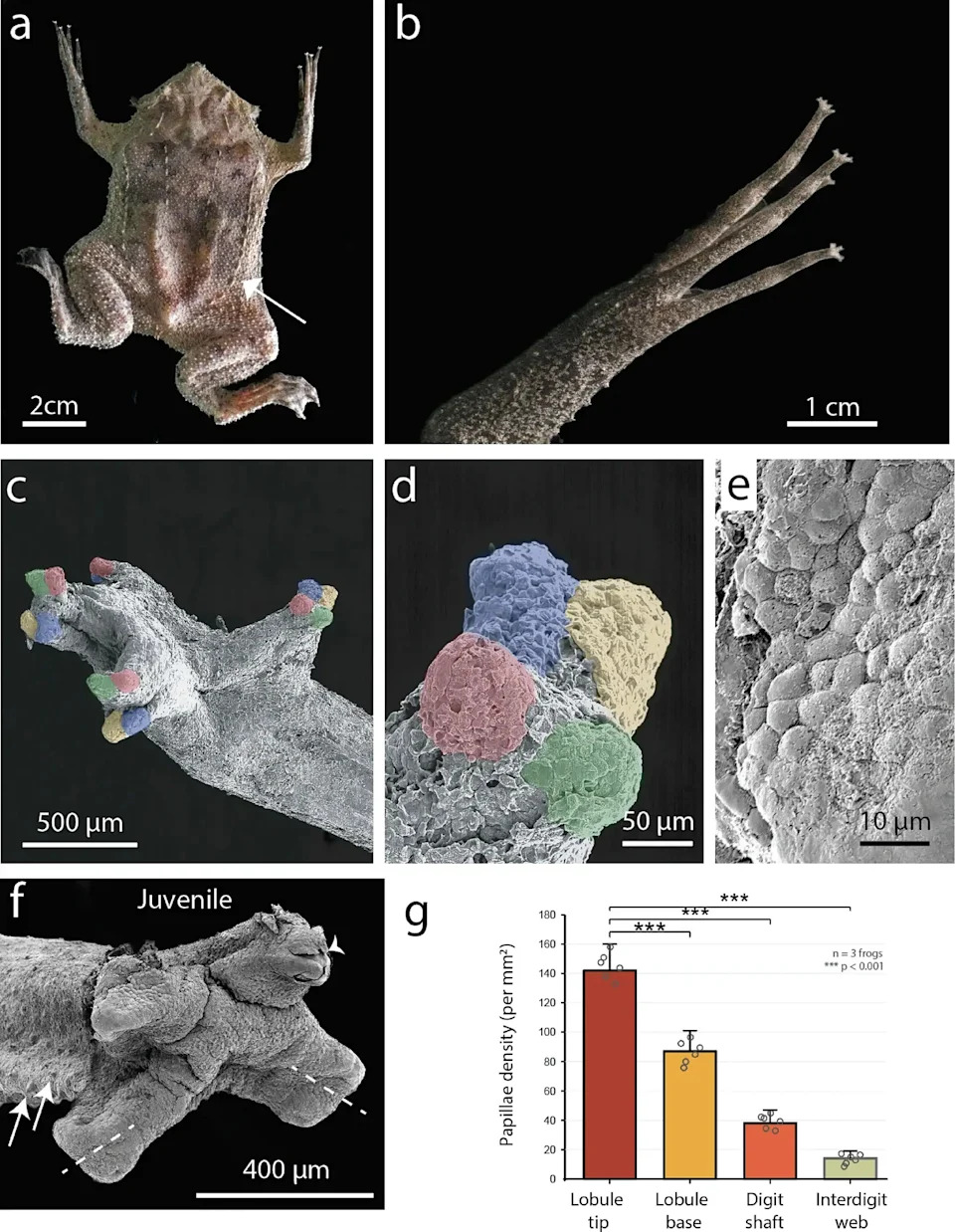
Above are illustrations of the Suriname toad, including details of its finger lobes and papillae.©Springer Nature Link –Original/License
Remarkable Finger Anatomy
Locally called the “star‑fingered toad,” Pipa pipa has highly unusual digits. Each of its four fingers splits into four lobes, and each of those lobes splits again into four smaller lobules — a repeating four‑by‑four pattern scientists call quadrification. That results in 16 lobes per finger and 128 lobes across all four fingers.
Sensory Specialization
Under the microscope the lobe tips are covered with dense papillae, making the skin at the tips about four times denser than skin farther down the finger. When probed with ultra‑fine calibrated filaments, the fingertip lobes responded to very light forces: their sensitivity nearly matches that of human fingertips and is roughly 70 times greater than the toad’s palm.
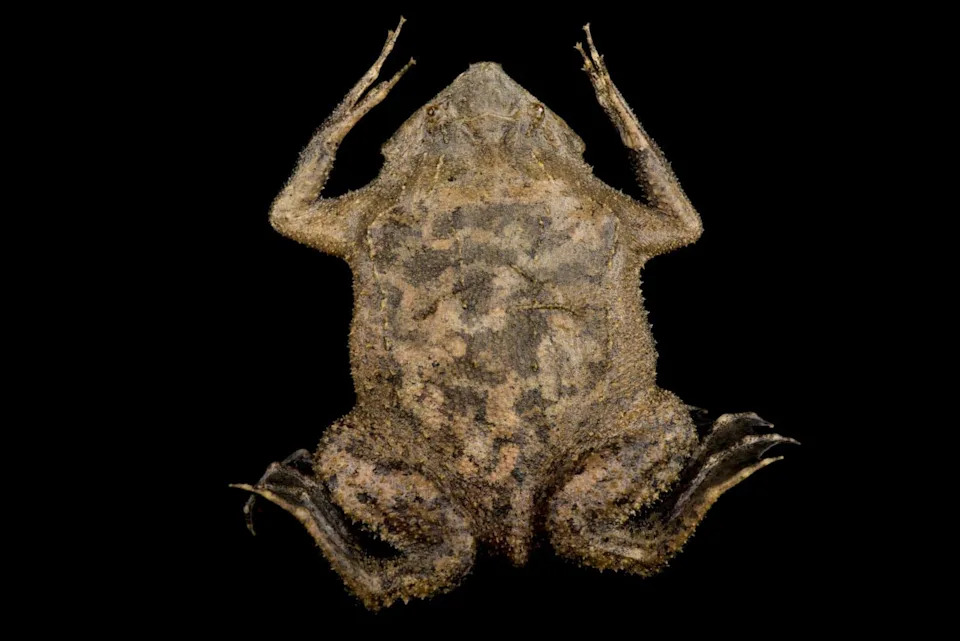
The Suriname toad,Pipa pipa, looks like a leaf or piece of driftwood when spotted on the river bottom.©reptiles4all/Shutterstock.com
"It immediately seemed to me like these lobes might be somewhat analogous to antennae that the frogs extend so they can feel the space around them," said Duncan Leitch, a corresponding author and UCLA assistant professor of integrative biology and physiology.
Brain Processing and Neural Investment
Although the lobes cover only about 8% of the forelimb surface, they account for more than 60% of the limb’s nerve connections. Tracing those nerves to the brain revealed an unexpectedly large processing area in the optic tectum — roughly four times larger than predicted for an animal this size. A similarly enlarged tactile processing area has been noted in mammals like the star‑nosed mole, but this is the first clear example reported in an amphibian.
Hunting Behavior: Touch‑Triggered Suction
Researchers filming strikes at 1,000 frames per second showed that the toads begin their suction stroke when prey is about 0.5 cm away — before any contact with the finger lobes and even in total darkness. To test whether water‑motion sensing (the lateral line) was required, the team chemically blocked that system; toads still captured fish in most trials, demonstrating that fingertip touch alone can reliably trigger the rapid suction strike. The whole capture sequence completes in under 0.1 seconds.
Study and Significance
These findings, published in the Journal of Comparative Physiology A, reveal a sophisticated tactile hunting system in an amphibian and suggest that highly specialized touch processing may be more widespread across animal lineages than previously thought.
Help us improve.