A full-grown humpback whale was spotted about 60 miles (97 km) inland on the Sacramento River, surprising anglers and prompting monitoring by the Sausalito-based Marine Mammal Center. The whale entered San Francisco Bay earlier and has been moving east through the Sacramento–San Joaquin Delta; its cetacean team plans to assess its condition. Identified in a photo catalog and seen 15 times over 24 years, the whale's sex is unknown. Officials ask the public to keep a respectful distance while experts determine whether the animal is simply passing through or needs help.
Humpback Whale Spotted 60 Miles Inland on Sacramento River — Marine Mammal Center To Monitor
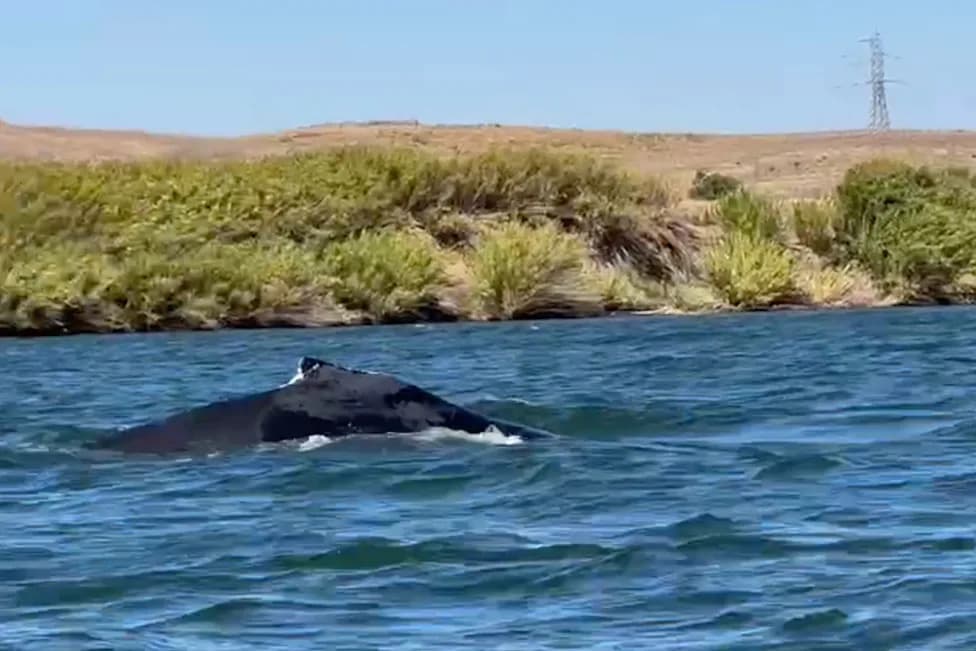
This image taken from video shows a humpback whale swimming in the Sacramento River on Sept. 16, 2026, near Rio Vista, Calif. (Denny Glover via AP)
A full-grown humpback whale was sighted about 60 miles (97 km) inland on the Sacramento River, surprising anglers and drawing attention from marine scientists.
Denny Glover, who was fishing for salmon and striped bass from a 21-foot (6.4-meter) boat, captured video of the whale as it surfaced on Wednesday. The vessel was shorter than half the length of the animal as it moved upriver after entering San Francisco Bay earlier in the week.
Glover recalled the moment: "One of the guys on the boat said, 'I see a whale.' He saw the spout. At first we thought it might be a dolphin or porpoise. Then we saw the spout again — there's no mistaking a whale spout."
Experts Step In To Assess The Whale
The Sausalito-based Marine Mammal Center said the whale has been traveling east through the Sacramento–San Joaquin Delta, California's largest river delta. Its cetacean team plans to assess and monitor the animal to determine its health and behavior.
"While it's unknown whether this whale is just passing through or if there is an underlying, unknown ailment, the best thing people can do is experience this adult whale's presence from a respectful distance," said Kathi George, the center's director of cetacean conservation biology.
The center identified the animal in its photo identification catalog. The whale has been documented 15 times over the past 24 years, with the most recent prior sighting off Baja California in February. Researchers have not confirmed the whale's sex.
The California Department of Fish and Wildlife and the National Oceanic and Atmospheric Administration declined to comment on the sighting this week.
Context And Precautions
This is not the first time humpbacks have ventured far inland. In 1985 a humpback nicknamed Humphrey spent several weeks near Rio Vista before returning to sea, and in 2007 a mother-calf pair known as Delta and Dawn remained in the Sacramento River Delta for nearly three weeks before heading back to the ocean.
Humpback whales are among the largest animals on Earth and can weigh up to about 80,000 pounds (roughly 35,000 kilograms). They are famous for breaching and for their complex songs. Scientists say freshwater is not the whale's natural habitat, but the animal in this case appeared to be moving steadily and not acting erratically.
Officials and rescue teams ask the public to avoid approaching or attempting to guide the whale. Boaters should give the animal ample space, minimize noise, and report any signs of distress to authorities so trained responders can intervene if necessary.
As of the last update, the whale was being monitored by the Marine Mammal Center and local agencies while experts try to determine whether it will continue upriver, turn back to sea on its own, or require assistance.
Help us improve.