JR East is piloting three mobile robotic rubbish bins at Tokyo's Shinjuku Station to reduce manual emptying and test commuter acceptance. Each unit is just over one metre tall and moves at about 20 cm/s while operating in the busy underground concourse. The trial runs through late November to assess safety, crowd navigation and whether passengers will use the devices. Early reactions have been positive, especially among tourists who photographed the robots.
Shinjuku Station Tests Mobile Robot Bins to Ease Cleaners’ Workload
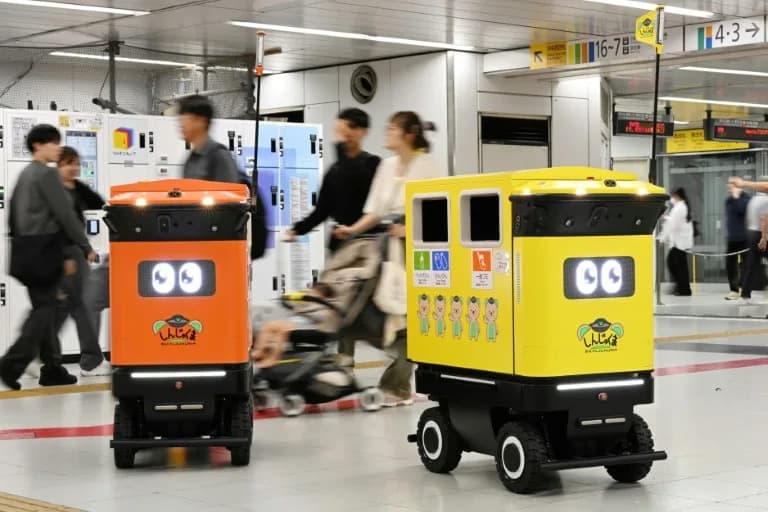
East Japan Railway is testing robot bins in a section of Shinjuku Station, among the world's busiest transport hubs (Toshifumi KITAMURA)
Tokyo's Shinjuku Station, recognised by Guinness World Records as the world's busiest rail hub, is piloting mobile robotic rubbish bins in a bid to reduce the manual workload of sanitation staff and test commuter acceptance.
Trial Overview
East Japan Railway Company (JR East) has deployed three autonomous waste-collection units in its section of the sprawling transport complex, which serves more than 2.7 million passengers daily. Each unit stands just over one metre tall and travels at a cautious 20 centimetres per second. In JR East's area of the station, bins are currently emptied by hand more than 10 times a day, and the number of fixed wastebaskets has been reduced in recent years for cleanliness and security reasons.
How the Robots Work
The robots are programmed to move slowly so commuters can deposit rubbish as they pass, and so the devices can stop immediately if needed. During the trial, the machines will collect waste in the underground concourse and deliver it to human crews for final disposal.
“We wanted to test how well something like this can operate automatically and safely in an environment like Shinjuku Station,” said Shinya Kawamichi, a JR East research official. He added that the company wants to measure both effectiveness and whether passengers will actually use the mobile bins.
Public Reaction and Purpose
The bulky, large-eyed robots have proved popular with visitors, many of whom stopped to take photographs. Some commuters said Japan's stations stay clean because people often take their trash home, while others welcomed the convenience of on-the-go disposal.
The trial runs through late November and will evaluate the robots ability to navigate dense crowds, their safety in busy conditions, and overall passenger acceptance as JR East considers broader applications for the technology.
Notable Facts
- Shinjuku Station handles over 2.7 million passengers daily.
- JR East deployed three robotic bins in its section of the station.
- Each robot is just over 1 metre tall and moves at 20 cm/s.
- JR East's area currently has only seven sets of bins and recycling boxes despite the station's size.
Help us improve.