The 2022 Hunga Tonga eruption produced a stratospheric plume in which satellites observed a sustained formaldehyde signal that implies active methane oxidation of about 900 ± 220 metric tons per day. TROPOMI tracked HCHO peaks near ~12 ppb at ~30 km altitude for at least ten days, inconsistent with a one‑time HCHO emission and pointing to in‑plume methane destruction. Researchers argue reactive chlorine generated from interactions among volcanic ash, seawater chloride and sunlight is the most plausible driver, but laboratory experiments and atmospheric modeling are needed to confirm the mechanism. The event also shows satellites can detect short‑lived oxidation products over oceans, which may help verify future methane‑removal efforts.
Hunga Tonga Plume Oxidized ~900 ± 220 t/day of Methane — Satellites Reveal Unusual Chlorine-Driven Chemistry
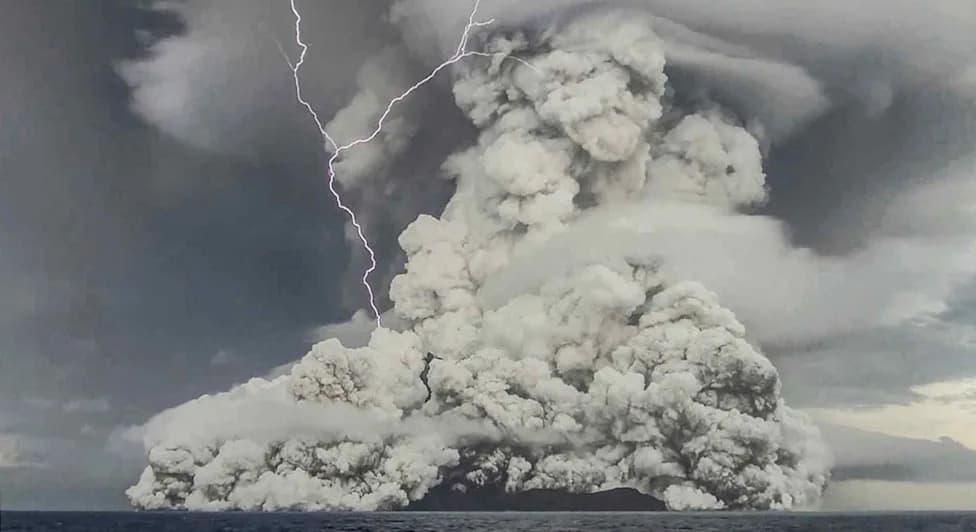
The Hunga Tonga–Hunga Ha'apai-volcanic eruption on 15 january 2022. Image taken from a video of the eruption. (CREDIT: Tonga Geological Services)
The 2022 Hunga Tonga–Hunga Ha'apai eruption produced a stratospheric plume that appears to have destroyed methane at an unprecedented rate. Satellite observations tracked a persistent formaldehyde (HCHO) signal that implies active methane oxidation of roughly 900 ± 220 metric tons per day inside the volcanic cloud, driven by unusually intense chemistry.
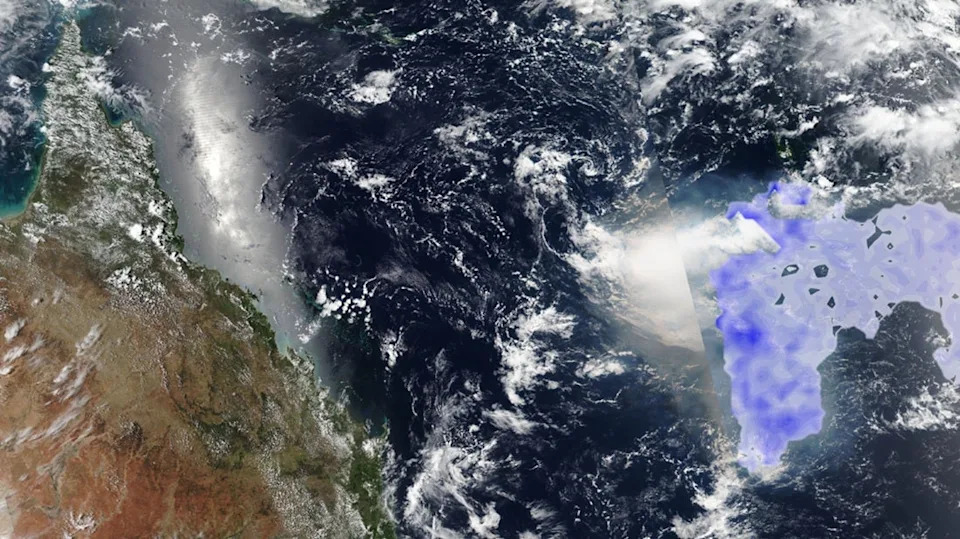
Satellite image using the VIIRS satellite on 16 January 2022, 13:30 UTC, showing in blue the cloud of formaldehyde measured by TROPOMI. To the left is the Australian coast of Queensland. (CREDIT: van Herpen et al. (2026))
What Satellites Saw
Instruments on the Sentinel‑5P satellite (TROPOMI) detected formaldehyde enhancements peaking near ~12 parts per billion (± ~10%) at about 30 km altitude and followed the elevated signal for at least ten days as the plume crossed the Pacific. That persistence was surprising because formaldehyde normally survives only a few hours under those conditions.
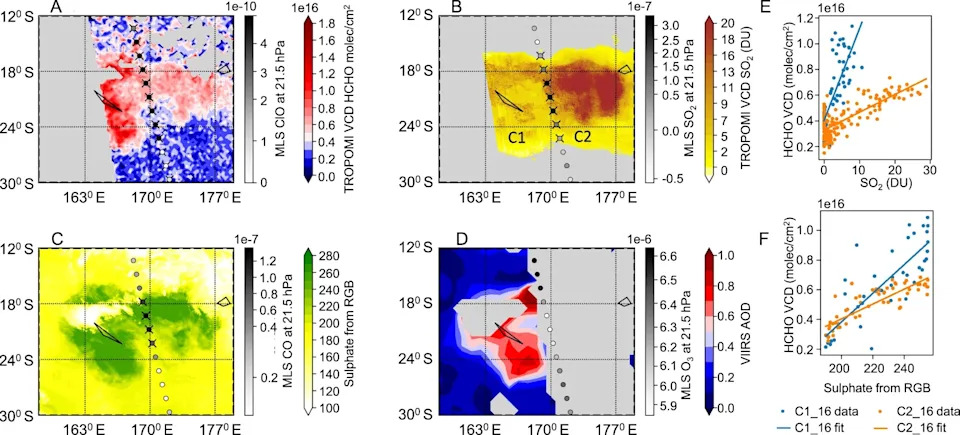
Correlation between HCHO, SO2, and aerosols within the Hunga Tonga-Hunga Ha'apai plume on 16 Jan 2022. (CREDIT: Nature)
How Methane Destruction Was Inferred
Formaldehyde is a short‑lived product of methane oxidation. The team calculated the plume was producing roughly 4.7 ± 1.1 million moles of HCHO per hour around midday on 16 January 2022, equivalent to about 75 ± 18 metric tons of CH4 oxidized per hour at that time. Integrating over daylight hours yields the headline estimate of ~900 ± 220 metric tons of methane destroyed per day.
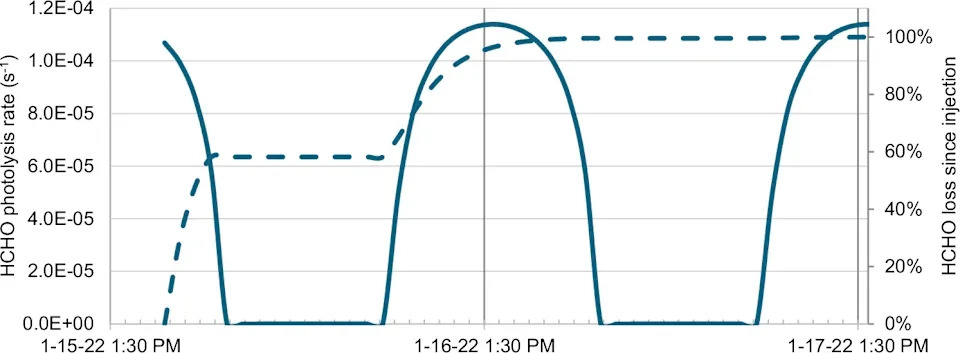
HCHO in-plume photolysis rate as a function of time, starting from the moment of the eruption. (CREDIT: Nature)
Which Oxidant Fits The Observations?
Hydroxyl radicals (OH) normally drive methane loss, but explaining these observations with OH alone would have required unrealistically high in‑plume methane (≈95 ppm) and a methane injection on the order of ≈2,300 gigagrams — amounts not supported by later satellite data. Instead, reactive chlorine provides a more consistent fit: the calculations suggest primary chlorine production on the order of ~2–5 gigagrams per day would sustain the inferred oxidation.
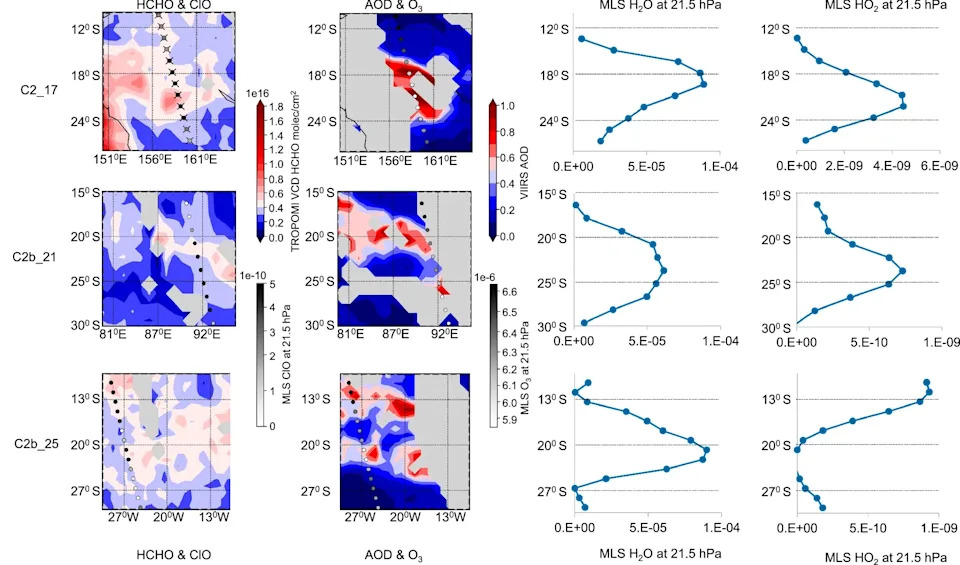
Comparison of several observed HCHO enhancements in vertical column density (VCD) with coincident simultaneous MLS v5 observations. (CREDIT: Nature)
Proposed Mechanism
The authors propose that the eruption’s exceptional conditions — an underwater blast that lofted large amounts of seawater, salt and fine volcanic ash high into the stratosphere — enabled iron‑chloride photochemistry on aerosol/ash surfaces. Sunlight acting on sulfate‑coated ash containing iron and chloride (from seawater) could release highly reactive chlorine atoms through catalytic cycles, accelerating methane oxidation. The plume reportedly reached roughly 55 km and carried an enormous mass of water (about 146 ± 5 teragrams).
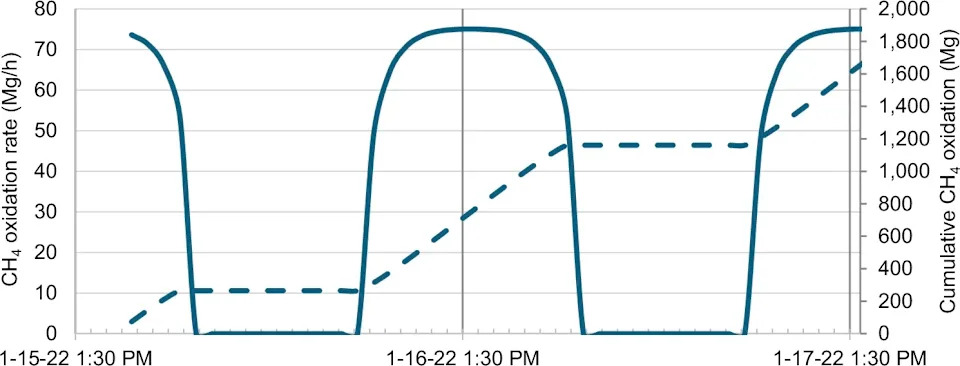
Quantification of total CH4 oxidation in the Hunga Tonga-Hunga Ha'apai (HHTH) plume. (CREDIT: Nature)
Why This Was Unusual
Hunga Tonga combined several exceptional factors — a submarine eruption, massive injection of seawater and salts, abundant fine ash, and relatively modest SO2 — that likely produced a rare chemical environment in the stratosphere. The proposed iron/cl− photochemistry has parallels with processes observed lower in the atmosphere (e.g., Saharan dust mixing with sea spray), but confirming that it can operate under stratospheric conditions requires laboratory experiments and detailed modeling.
Implications And Caveats
The event does not imply that most eruptions act as large methane sinks. Satellite retrievals have uncertainties (the team estimated ~±20% uncertainty from aerosol effects on HCHO retrievals), and other formaldehyde sources (for example, biomass burning) can complicate interpretation in other contexts. For Hunga Tonga, strong correlations among HCHO, SO2 and volcanic aerosols supported attribution to the plume.
Beyond volcano science, this case demonstrates that satellites can detect enhanced methane oxidation via short‑lived oxidation products over oceans — a capability that could be useful for verifying future methane‑removal experiments. The authors emphasize they are not advocating deliberate replication of volcanic chemistry; any attempt to alter atmospheric composition would require rigorous evaluation of effectiveness and unintended consequences.
Study: van Herpen et al., Nature Communications (2026). Observational uncertainties, proposed mechanisms, and broader context are discussed in the paper and supporting literature.
Help us improve.