A global survey of over 35,000 people in 34 countries finds growing trust in international institutions even as comfort with the United States and China as world leaders declines. Nearly 70% said the world has worsened over the past year and only 38% expect their national economies to improve in the next five years. Support for international cooperation rose to 57%, while Canada, Japan and Australia rank highest as preferred leaders. Trust in the WHO, U.N., World Bank, IMF, ICC and WTO also increased year over year.
Global Poll Finds Rising Trust in International Institutions, Waning Comfort With US and China as Leaders
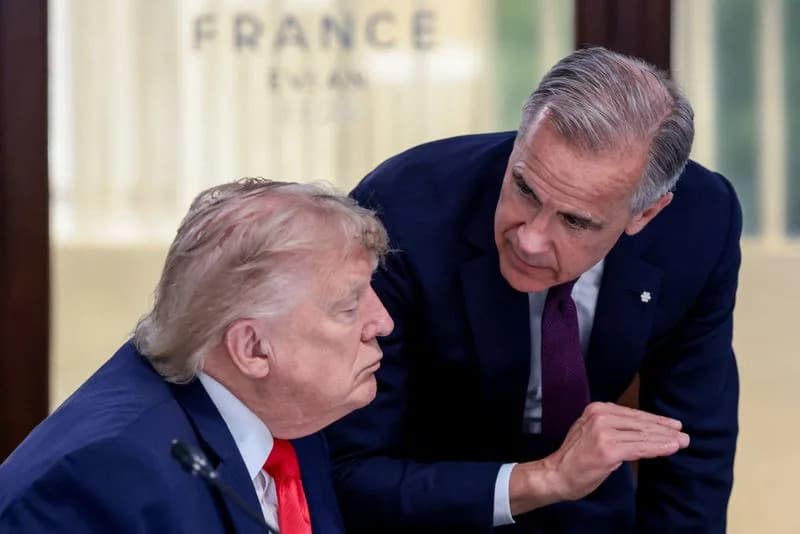
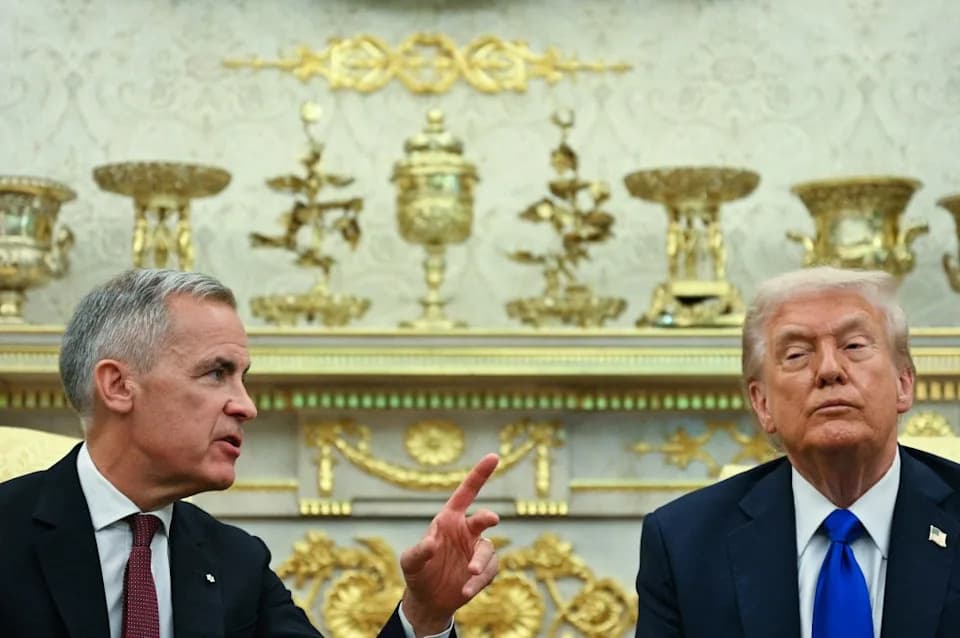
FILE PHOTO: U.S. President Donald Trump speaks with Canadian Prime Minister Mark Carney at a working lunch with leaders of G7 and the Middle East, in Evian-les-Bains, France, June 16, 2026. REUTERS/Evelyn Hockstein/Pool/File Photo
A global survey of more than 35,000 people across 34 countries, conducted July 21–August 5 and commissioned by the Rockefeller Foundation, shows growing confidence in international institutions even as public comfort with the United States and China leading the world has declined.
Key Findings
- Nearly 70% say the world has gotten worse over the past year.
- Only 38% expect their national economies to improve over the next five years.
- 57% support international cooperation on global challenges even if it requires compromising some national interests (up from 55% last year).
The survey reflects broad public pessimism about economic and security trends. Optimism fell sharply in several large economies: it dropped 26 percentage points in India to 50% and 16 points in China to 56% compared with the prior survey.
Respondents were generally uncomfortable with either the United States or China taking a leading global role. When asked if countries should work together without the participation of either of the world's two largest economies, 61% agreed.
Who Would People Prefer to Lead?
Countries and institutions that drew the highest comfort ratings for playing a leading role were: Canada (60%), Japan (58%), Australia (55%), the European Union (55%), Britain (54%) and the United Nations (52%). By contrast, comfort with the United States was 39%, China 37% and Russia 26%.
Trust in International Institutions Is Rising
Trust in global institutions improved across the board year over year: the World Health Organization rose to 69% (from 61%), the U.N. to 62% (from 58%), the World Bank to 55% (from 46%), the International Monetary Fund to 51% (from 43%), the International Criminal Court to 54% (from 48%) and the World Trade Organization to 57% (from 50%).
When respondents excluded assessments of their own country, 42% viewed Russia as a major threat, compared with 34% for the United States and 30% for China. Russia was the most-cited country of concern in 14 nations, especially across Europe; the United States was named the greatest threat in 15 countries, with the highest shares in Indonesia (73%), Brazil (59%), Mexico (58%) and Turkey (57%).
Eric Pelofsky, vice president of the Rockefeller Foundation, said the findings bolster the credibility of a 'middle powers' approach and reflect an erosion of U.S. global leadership: people are increasingly looking beyond Washington when discussing solutions to global problems.
Context and Methodology
The poll was released ahead of the United Nations General Assembly in New York and comes amid prolonged geopolitical tensions and disruptions to global energy markets that have affected growth and inflation. The online survey covered a wide mix of developing and advanced economies; comfort with China, for example, was 53% in developing countries versus 23% in wealthier nations, highlighting sharp regional differences in how major powers are perceived.
Note: The survey responses reflect public attitudes during the July–August field period and report year-over-year changes referenced by the Rockefeller Foundation.
Help us improve.