Women now outnumber men in tertiary enrollment in 130 countries, with a global average female advantage of 12%. Major economies with large gaps favoring women include Sweden (+40%), Brazil (+36%), the United States (+32%) and Australia (+31%), while Japan (-3%) and South Korea (-11%) are notable exceptions. These figures use gross enrollment ratios from World Bank and UNESCO data; women's lead in enrollment and completion has risen, but pay gaps persist — women aged 25–34 in OECD countries still earn about 17%–18% less than similarly educated men.
Mapped: Where Women Outnumber Men in College — Global Enrollment Gaps Explained
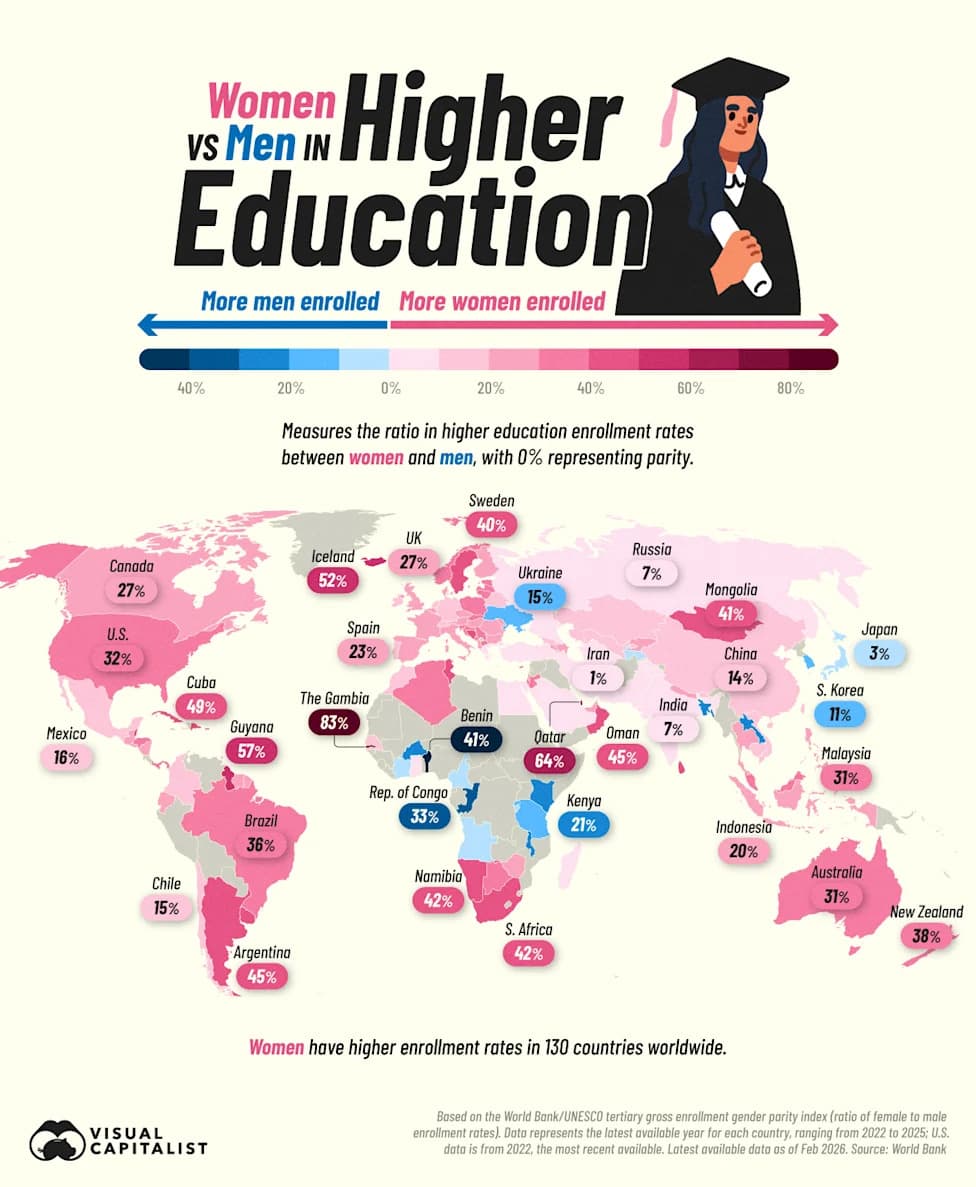
Map showing the ratio of femal to male higher education enrollment rates around the world.
Women now enroll in tertiary education at higher rates than men in 130 countries worldwide, according to the most recent figures from the World Bank and the UNESCO Institute for Statistics (data years range from 2022–2025). On average, the female tertiary enrollment rate is 12% higher than the male rate globally, but the gap varies widely by country and region.
Key Findings
Global average: +12% female advantage in gross tertiary enrollment.
Largest gaps favoring women: Gambia (+83%), Sint Maarten (+78%), and St. Vincent and the Grenadines (+68%).
Major economies with large female advantages: Sweden (+40%), Brazil (+36%), the United States (+32%), and Australia (+31%).
Countries where men lead: Benin (-41%), Republic of Congo (-33%), Malawi (-30%), and among advanced economies, South Korea (-11%) and Japan (-3%).
Regional Patterns and Notable Cases
East Asia shows a striking contrast: women lead in China (+14%), Hong Kong (+9%) and Singapore (+9%), while Japan and South Korea record higher male enrollment. In South Korea, mandatory military service for most able-bodied men can interrupt or delay university attendance, which affects gross enrollment ratios.
What the Numbers Measure
These figures use gross enrollment ratios, which count all students enrolled at the tertiary level regardless of age. That means differences can reflect not only enrollment decisions but also timing (when students enter) and duration (how long they stay in programs).
Attainment and Outcomes
The enrollment advantage mirrors attainment: across OECD countries in 2024, 55% of women aged 25–34 had completed tertiary education versus 42% of men. Women also have higher completion rates for bachelor’s programs. Yet this educational lead has not fully closed income gaps — among full-time, full-year workers aged 25–34 in OECD countries, women still earn about 17%–18% less than equally educated men.
Data Sources and Notes
Data come from the World Bank and the UNESCO Institute for Statistics; country records use the most recent year available (2022–2025). Positive values indicate higher female enrollment; negative values indicate higher male enrollment. Because gross enrollment can include out-of‑age-range students, interpret differences with that caveat in mind.
Implications
The widespread female advantage in tertiary enrollment and attainment signals important shifts in education access and gender dynamics across the globe. Still, persistent pay gaps and labor-market disparities show that higher education gains alone do not guarantee equal economic outcomes.
Full dataset: The complete country-by-country figures are available from the World Bank and UNESCO Institute for Statistics and underpin the rankings summarized above.
Help us improve.