The Apennine mountain chain in Italy shows simultaneous crustal shortening at its outer edge and extension behind the range. Tavani et al. propose lateral delamination — the lower crust and lithosphere peeling away along a migrating hinge — as the mechanism behind these contradictory signals. Integrated seismic, GPS, satellite and Moho data reveal a >500 km corridor of overlapping Moho and spatially varying seismic and geodetic patterns: ~4 mm/yr extension behind the hinge versus ~2 mm/yr contraction at the front. The model explains uplift and rebound behind the hinge while acknowledging remaining uncertainties in slab geometry and mantle dynamics.
Italy’s Crust Is ‘Unzipping’: Migrating Delamination May Explain the Apennines’ Paradox
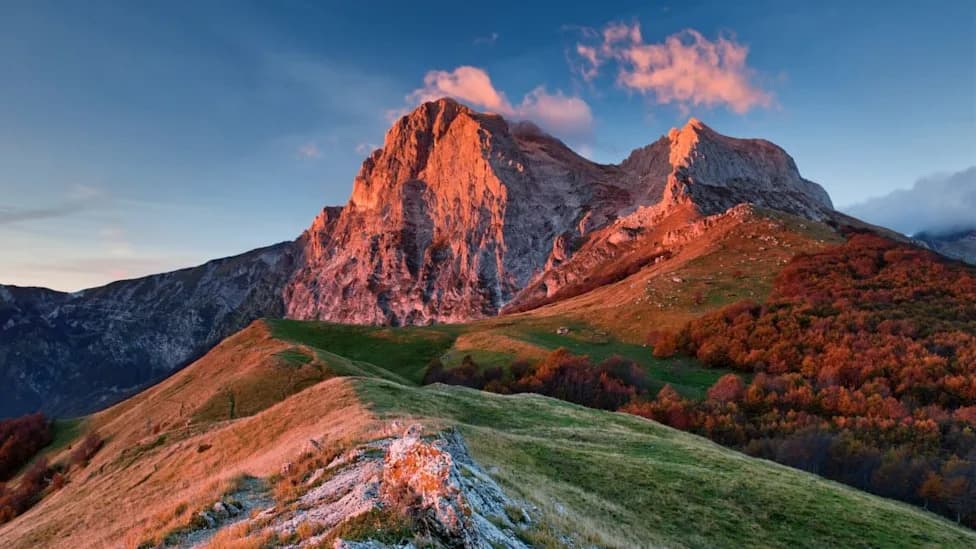
The contradictory geology of the Apennines has long puzzled scientists. (Paolo Corsetti/Moment/Getty Images)
Deep beneath Italy, slow but powerful forces in Earth’s interior are reshaping the landscape in ways that have long puzzled geologists. In the Apennine mountain belt, measurements show the crust is being stretched inboard while simultaneously compressed at the chain’s outer edge. A new study led by Stefano Tavani (University of Florence) suggests these contradictory surface signals result from lateral delamination — a peeling away of the lower crust and lithosphere along a migrating hinge beneath the peninsula.
What the Researchers Did
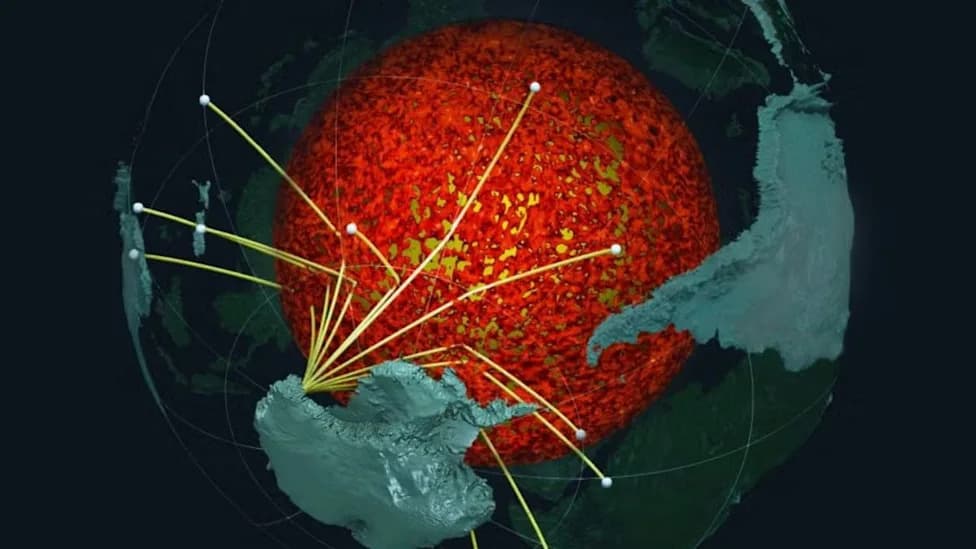
Tavani and colleagues combined decades of earthquake catalogs, GPS velocity fields, satellite radar observations and maps of the Mohorovičić discontinuity (the Moho) to construct a comprehensive view of crustal and mantle structure beneath the Apennines. Their integrated analysis reveals a corridor longer than 500 kilometres where the Moho on the Tyrrhenian side overlaps the Moho on the Adriatic side — interpreted as a double Moho marking the delamination hinge.

YouTube Thumbnail
Key Observations
Seismicity clusters around this migrating hinge. Earthquake focal mechanisms and GPS rates show a clear spatial pattern: behind the hinge, deformation is predominantly extensional (the crust is rebounding and stretching); ahead of the hinge, earthquakes and surface motions indicate compression and subsidence.
Quantitatively, the team reports roughly 4 mm/yr of extension across the belt and about 2 mm/yr of contraction toward the outer front. The Apennines themselves extend roughly 1,200 km along Italy and, during an earlier phase (≈10–2 million years ago), experienced on the order of 100 km of shortening that coincided with extension in the Tyrrhenian back-arc.
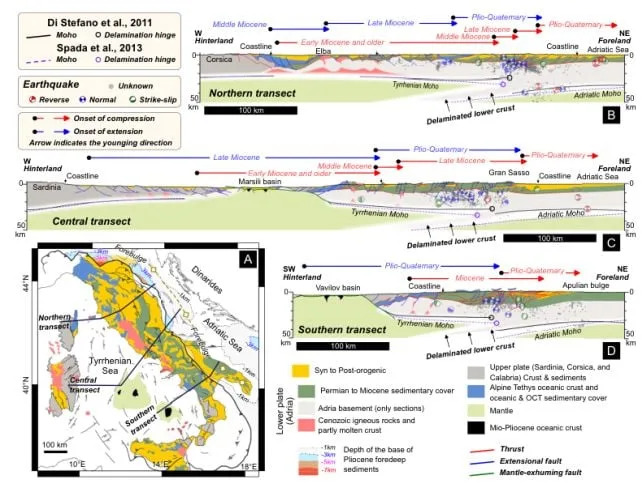
Cross-sections through the northern, central, and southern Apennines show the overlapping Tyrrhenian and Adriatic Moho and the delaminated lower crust beneath the mountain range. (Tavani et al.,Commun. Earth Environ.2026)
How Delamination Explains the Paradox
Delamination occurs when dense lower crust and attached lithospheric mantle detach and sink into the mantle. The authors argue that this detachment is not uniform but focused at a laterally migrating hinge. Ahead of the hinge the lower layers remain attached to a sinking slab and exert a downward load, producing compression and subsidence; when the hinge passes and those lower layers peel away, that load is released and the remaining crust unbends and rebounds, producing extension behind the hinge.
Limitations and Next Steps
The proposed model is intentionally simplified. Key uncertainties remain, especially regarding the precise geometry of the slab and mantle flow beneath the Apennines. The authors call for more sophisticated geodynamic modeling and denser geophysical observations to resolve remaining questions and test whether lateral delamination can fully account for the observed deformation.

Subscribe to ScienceAlert's free fact-checked newsletter
Why It Matters
If confirmed, the Apennines would offer a rare, geodetically constrained example of a laterally migrating delamination hinge operating on human-observable timescales. The finding helps reconcile how contraction and extension can coexist in convergent mountain belts and improves our understanding of crust–mantle interactions that shape surface topography and seismic hazards.
Study: Tavani et al., Communications Earth & Environment (2026).
Help us improve.