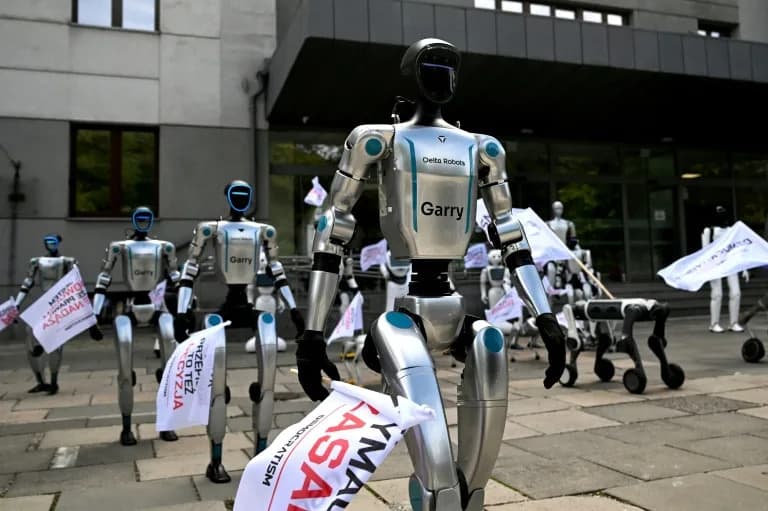
Roughly 30 robots supplied by Delta Robots paraded outside Poland’s Ministry of Digital Affairs on September 7, 2026, calling for clearer rules on artificial intelligence. The demonstration was organised by Grzegorz Kuliś, who also runs Delta Robots and recruitment firm Weegree, creating a deliberate tension between industry and advocacy. Poland has already set up KRiBSI to implement the EU AI Act domestically, and Digital Affairs Minister Krzysztof Gawkowski met the organisers. The stunt highlighted both the urgency of regulation and questions about motive and public messaging.
Thirty Robots Paraded Outside Poland’s Digital Ministry to Demand AI Rules — and the Organizer Built Them

Image: Sergei GAPON
On September 7, 2026, roughly 30 humanoid and quadruped robots circled Warsaw’s Ministry of Digital Affairs, waving flags while loudspeakers broadcast calls for regulation such as “Defend workplaces,” “Time for rules,” and “Don't wait, regulate.” The machines were supplied by Opole-based Delta Robots and the demonstration was organised by Grzegorz Kuliś — who also leads the activist group Democratism, serves as a Delta Robots executive, and runs recruitment agency Weegree.
Irony With Purpose
The event was deliberately theatrical: chants and statements were pre-recorded and played through speakers, and an Agibot A3 humanoid later answered reporters with a scripted line that highlighted the organisers’ point — that the technology is already real. That layered irony — industry-built robots urging regulation of their own sector — turned the stunt into both a product showcase and a policy message.
What Organisers Said
Kuliś told Euronews: “If we don't react now, we may soon have a problem,” framing Democratism as pro-accountability rather than anti-technology. He argued regulations should act as a “shield protecting workers” and said he hopes the initiative will spread internationally. Observers noted that the organiser’s multiple roles (robot vendor, recruiter, activist) complicate how the action is interpreted: is it genuine labour advocacy, savvy marketing, or both?
Policy Context
The timing matters. Poland is among the first EU member states to operationalize the EU AI Act domestically, creating KRiBSI (the Commission for the Development and Security of Artificial Intelligence) — a single national authority empowered to supervise AI deployments, run regulatory sandboxes, and impose penalties. Digital Affairs Minister Krzysztof Gawkowski came out to meet organisers and warned that “uncontrolled AI models, implemented into humanoids that will also keep evolving as robotisation moves forward, are a major problem,” stressing that “human beings come first.”
Why It Resonated
The spectacle worked because it wove together two truths: automation is advancing rapidly, and some people closest to the technology are calling for guardrails. The machines did not autonomously generate messages — humans programmed the demonstration — but using robots to demand regulation created a striking visual argument about urgency, transparency and the stakes for workers.
Bottom line: Whether Warsaw’s robot march becomes a template for public AI advocacy or a highly photogenic product tour will depend on whether governments treat the underlying regulatory concerns seriously rather than dismissing the messenger.
Help us improve.