New York City converted two basketball courts at the South Jamaica Houses in Queens into below-grade retention basins called Water Square to capture stormwater during flash floods. Each court can hold up to 330,000 gallons and routes water through pipes and bio‑retention basins for gradual infiltration. The $5 million drainage system—inspired by projects in Copenhagen and Rotterdam—keeps the courts usable for recreation when dry and complements broader city resilience efforts, including a $43 million Lower Manhattan flood initiative.
New York Turns Basketball Courts Into ‘Water Squares’ That Soak Up Flash Floods
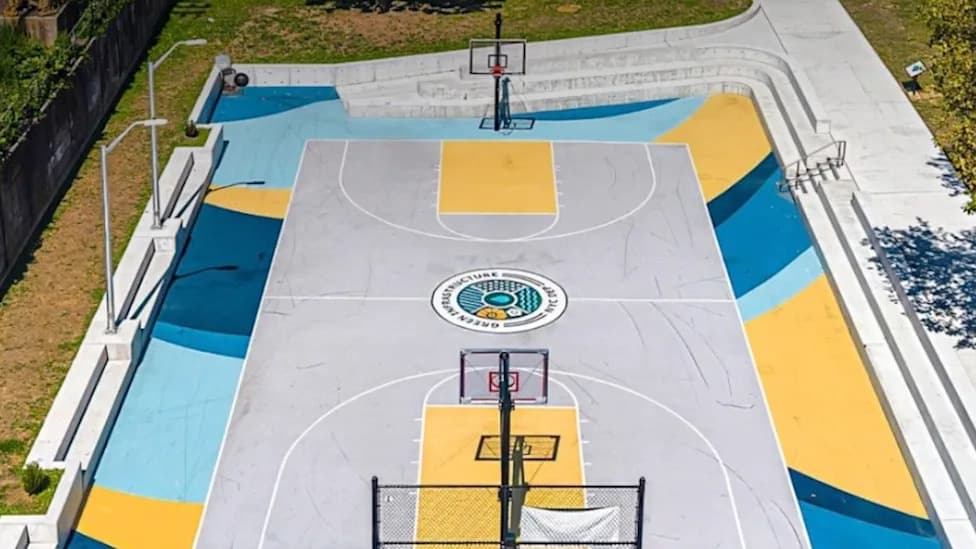
Photo Credit: Grain Collective
New York City is piloting an innovative approach to flash flooding by redesigning two basketball courts in Queens so they can temporarily hold large volumes of stormwater.
Known as Water Square, the project at the South Jamaica Houses public-housing complex sinks two courts below street level so they act as temporary retention basins during heavy storms while remaining usable community space when dry.
How It Works
Each court can store up to 330,000 gallons of water — roughly half the volume of an Olympic-size pool — according to Grain Collective, one of the firms involved. Stormwater is routed through underground piping, filtered through bio-retention basins, and then slowly allowed to infiltrate back into the ground rather than overwhelming the city sewer system.
Design, Cost and Community Focus
Grain Collective collaborated with Marc Wouters Studios and engineers from Hazen and Sawyer to build a roughly $5 million drainage system beneath Water Square. Designers said they took inspiration from multifunctional public-space projects in Copenhagen and Rotterdam.
"[The court] becomes like a sponge, which basically holds the water as much as it can," said Runit Chhaya, a principal at Grain Collective. "It helps in not putting stress on the city storm system during a flood event."
Beyond flood control, the three-foot-deep courts are intentionally multifunctional: when dry they host basketball games, movie nights, farmers markets and other community activities so the space remains useful year-round.
Why It Matters
New York's aging sewer infrastructure can be overwhelmed by increasingly intense, less predictable storms fueled by climate change, leaving streets and nearby homes vulnerable to flooding. Localized solutions like Water Square complement larger citywide resilience investments and pilot practical, visible benefits for neighborhoods that have historically been underserved.
City officials have also approved larger resilience spending for flood-prone areas, including a separate $43 million initiative to address flooding in Lower Manhattan, underscoring a multi-layered approach to urban flood management.
Community engagement was central to the project: designers said working with residents builds stewardship and increases support for future climate-adaptive investments in neighborhoods that need them most.
Help us improve.