A randomized crossover trial in Spain found that 42 middle‑aged adults who ate 35 g of tomato paste daily for three months showed improved selective attention and a small gain in associative memory, with blood lycopene levels rising markedly. A subgroup of 14 participants had resting‑state fMRI changes in frontoparietal, auditory, and dorsal attention networks, but imaging was underpowered and used a more permissive statistical threshold. The trial was unblinded and the authors call for larger, longer, blinded studies to confirm clinical relevance.
Daily Tomato Paste for 3 Months Linked to Small Cognitive Gains and Brain Connectivity Changes in Small Trial
(yipengge/iStock/Getty Images Plus)
A small randomized crossover trial in Spain found that daily intake of tomato paste was associated with modest cognitive benefits and tentative changes in brain connectivity in healthy, middle‑aged adults.
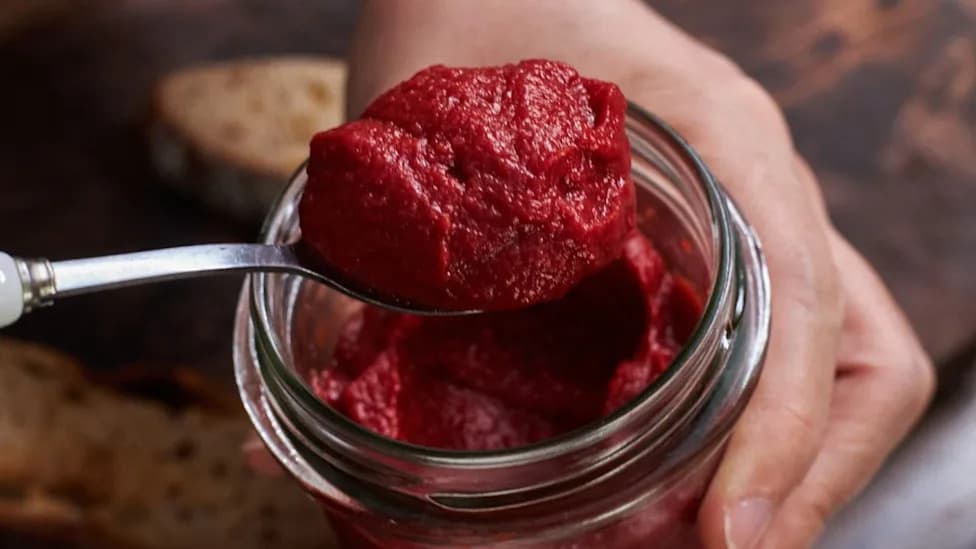
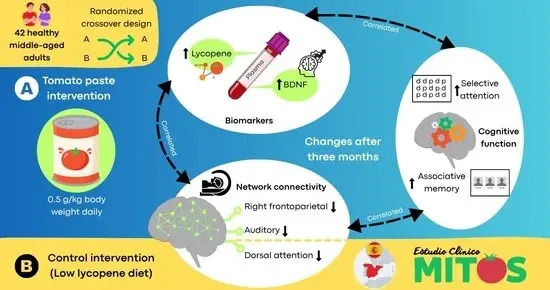
The study, led by Ricardo López‑Solís (University of Barcelona) and published in Antioxidants (2026), assigned 42 participants to two three‑month diet phases separated by a one‑month washout. In one phase participants consumed 35 g of tomato paste per day; in the other they followed a low‑lycopene diet. The trial used a crossover design so each participant served as their own control.
(López-Solís et al.,Antioxidants, 2026)
Key Findings
On standard cognitive tests, the tomato‑paste phase produced improved selective attention and a small gain in associative memory. Blood measurements confirmed a marked rise in circulating lycopene during the tomato phase and a borderline increase in brain‑derived neurotrophic factor (BDNF), a protein linked to neural plasticity.
A smaller subgroup of 14 participants underwent resting‑state fMRI. Imaging results suggested reduced connectivity in the right frontoparietal and auditory networks after the high‑lycopene diet, while the low‑tomato condition showed reduced connectivity in dorsal attention networks. The authors interpreted these patterns as a possible functional reorganization that could reflect greater neural efficiency, but they emphasized that the neuroimaging analysis was preliminary.
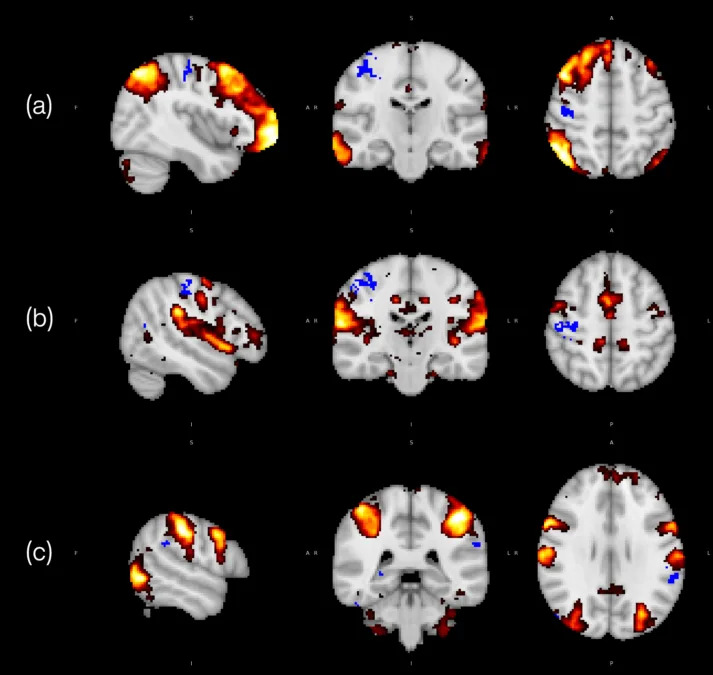
Functional connectivity patterns after tomato and control interventions (uncorrected p < 0.005). Clusters displaying reduced connectivity are shown in blue; red-yellow represents the functional network in which the differences were detected. (a) Right frontoparietal network. (b) Auditory network. (c) Dorsal attention network. (López-Solís et al.,Antioxidants, 2026)
Important Limitations
Interpretation should be cautious because:
- The neuroimaging subgroup was small (n=14) and statistically underpowered.
- Investigators applied a more permissive statistical threshold for the imaging results than originally planned, increasing the chance of false positives.
- The trial was unblinded: both participants and researchers knew who was on the tomato paste diet, which could influence motivation or test performance.
- Tomatoes contain many bioactive compounds, so effects cannot yet be attributed to lycopene alone.
Context And Practical Takeaway
These findings align with prior small studies that reported modest cognitive benefits from carotenoid‑rich tomato supplements in older adults. However, no study has established a causal, long‑term clinical benefit of tomato or lycopene intake for brain health. The authors call for larger, longer, blinded trials to determine whether the observed blood, cognitive, and connectivity changes persist and have meaningful effects.

Subscribe to ScienceAlert's free fact-checked newsletter
From a dietary perspective, tomatoes are nutrient‑rich and cooking can increase lycopene bioavailability, so tomato paste or sauce remains a reasonable, low‑cost addition to a balanced diet. But current evidence does not yet justify specific medical recommendations for preventing cognitive decline.
"To our knowledge, this is the first clinical trial to link changes in the antioxidant lycopene with alterations in functional brain connectivity," the authors write, while noting the exploratory nature of the imaging results.
Study: López‑Solís et al., Antioxidants, 2026.
Help us improve.