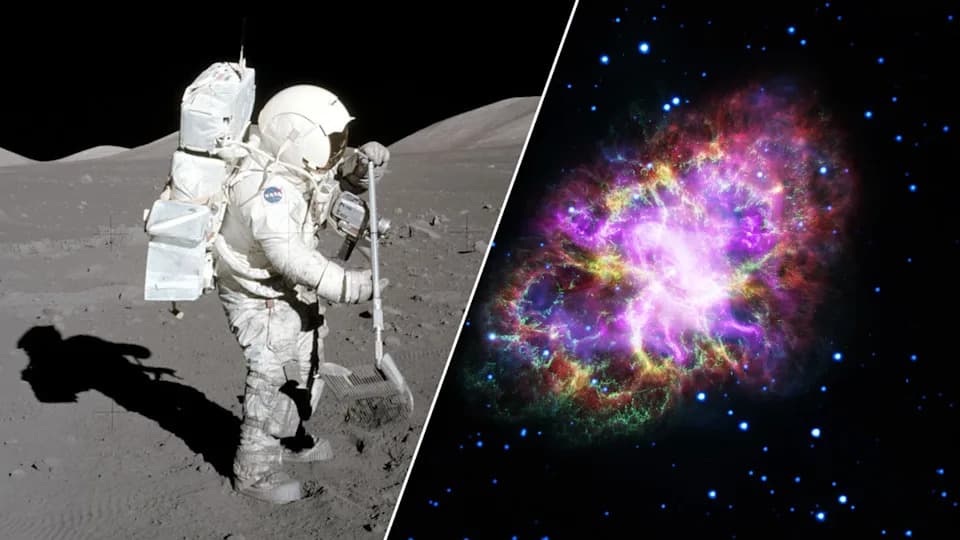
The Moon’s airless, geologically stable surface could preserve microscopic traces of extraterrestrial technology. Researchers at the SETI Institute and Birkbeck College propose excavating about one cubic metre of lunar regolith and screening it with machine vision, spectroscopy, micro‑tomography, and isotopic analysis. Models suggest micron-scale "Arkhipov" (accidental) and "Bracewell" (deliberate) particles could survive 0.1–1 billion years in transit and travel thousands of light‑years. A null result would place a quantitative limit (~0.09 Earth‑mass equivalent) on galactic dispersal of manufactured particulate; a confirmed grain would be a landmark discovery.
Could Moon Dust Hide Alien Micro‑Debris? Scientists Propose a One‑Cubic‑Metre Search
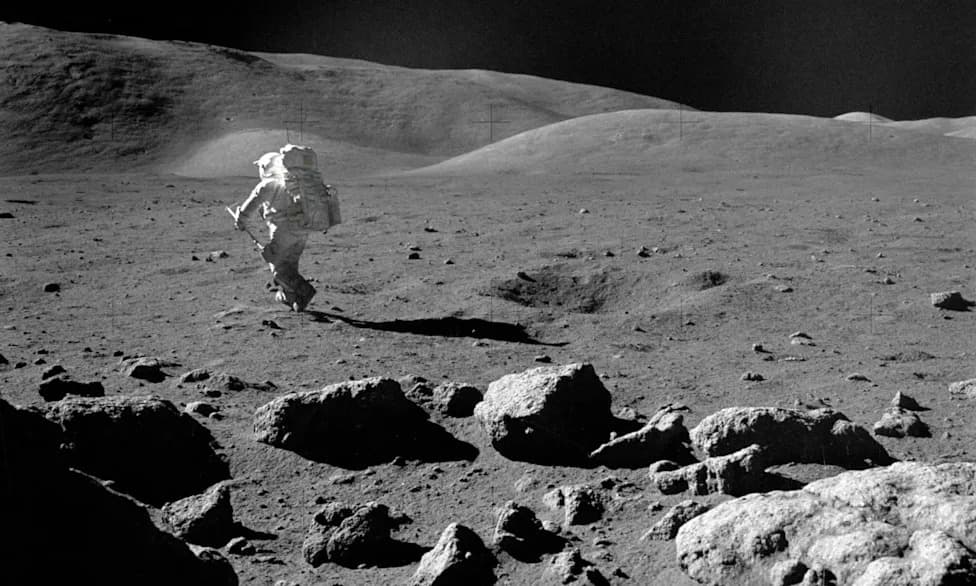
Image: NASA
For roughly four billion years the Moon has behaved like a pristine archive: no weather to erase records, no plate tectonics to recycle crust, and a surface that steadily accumulates material delivered from across space. Researchers at the SETI Institute and Birkbeck College argue that this long-term preservation makes the lunar regolith a promising place to search for microscopic traces of extraterrestrial technology.
What the researchers propose
In a preprint submitted to the International Journal of Astrobiology, lead author Lewis J. Pinault and colleagues present quantitative models and a concrete experimental plan: excavate roughly one cubic metre of lunar regolith and screen it for grains that are inconsistent with natural lunar geology.
Key hypotheses and terminology
The team models how micron-scale particles produced by alien infrastructure might travel across the galaxy. Driven by stellar winds and radiation pressure, these tiny grains could survive transit times on the order of 0.1 to 1 billion years and travel thousands of light-years. The authors name two conceptual classes of particles:
- Arkhipov particles — accidental, microscopic detritus analogous to microplastics shed from large spacecraft or infrastructure;
- Bracewell particles — deliberately engineered microscopic probes or messengers, named after Ronald Bracewell’s proposal for autonomous alien probes.
Planned search workflow
The proposed, methodical retrieval and analysis process is designed to minimize false positives and contamination:
- Excavate ~1 cubic metre of regolith from a carefully selected, low-contamination site.
- Screen recovered grains for metals, alloys, ceramics or synthetic compounds atypical for lunar geology.
- Use machine-vision systems to flag grains with anomalous shapes, textures, or impact morphologies.
- Subject flagged candidates to high-resolution spectroscopy, micro-tomography, and isotopic analysis.
SETI scientist Sofia Sheikh describes the approach as “a creative and worthwhile avenue,” especially timely as NASA’s Artemis program returns hardware and new sample-return capabilities to the Moon.
Why a null result still matters
Finding nothing would not be a failure. Pinault’s models quantify what ‘‘no detections’’ would imply: observing zero artificial grains in a one-cubic-metre sample would rule out scenarios in which civilizations typically disperse more than roughly 0.09 Earth-mass equivalent of manufactured particulate over galactic history. That converts a previously vague aspect of the Fermi paradox into a measurable constraint.
Critics note the needle‑in‑a‑haystack nature of the search. Apollo samples have been studied in great detail without signs of technology — a fact emphasized by Penn State’s Jason Wright, who calls the preprint “impressive” and “extremely thorough.” Any candidate discovery would require exhaustive vetting for contamination from past human missions and rigorous comparison with known aerospace materials and isotopic baselines.
Upside: profound scientific payoff
Co‑author Ian Crawford stresses the stakes: confirming even a single artificial grain would be a landmark discovery, implying either a higher prevalence of technological civilizations than conservative models predict or that at least one civilization intentionally targeted our inner Solar System. Whether the search returns an empty result or a verified candidate, the outcome would significantly refine our understanding of technosignatures in the galaxy.
With Artemis and other lunar initiatives under way, adding a modest technosignature-focused sampling or instrument package could be relatively low cost compared with the potential scientific return. The Moon may be humanity’s long-term attic — and it may still hold surprises.
Help us improve.