The Times Square standoff involving Pamela Cisneros highlighted why Tasers do not always incapacitate suspects. Experts point to probe placement, insulating clothing, intoxication and body composition—with fat conducting electricity less effectively than muscle—as key factors. Authorities confirmed Cisneros had prior mental-health contacts; after multiple failed Taser attempts, officers fired and she was later pronounced dead at Bellevue Hospital.
Why Tasers Sometimes Fail: Probe Placement, Clothing and Body Composition in the Times Square Case
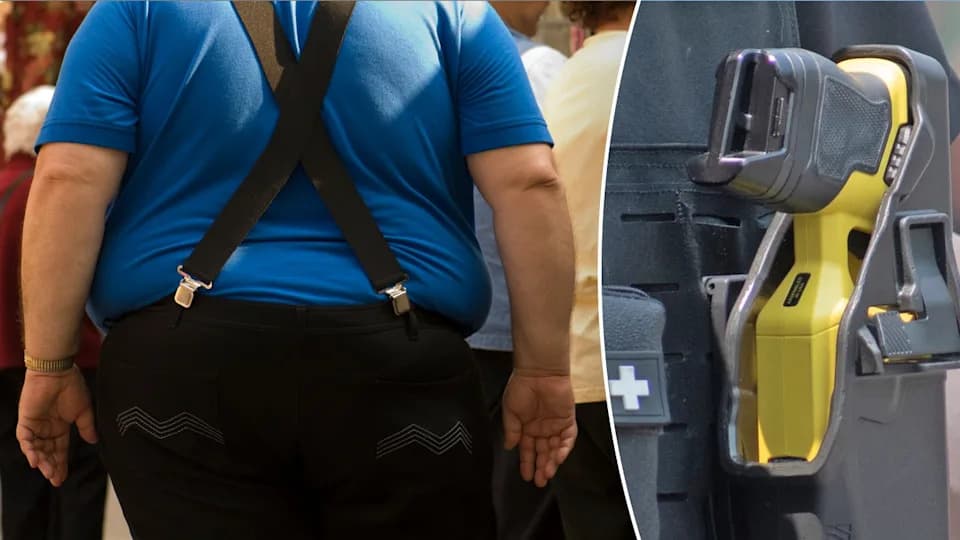
The recent incident on Times Square sparked broader questions about why Tasers sometimes fail and whether obesity or body composition can impede their effectiveness.
Multiple Taser deployments failed to stop 49-year-old Pamela Cisneros during a roughly four-minute standoff in Times Square after she allegedly stabbed two people. The attack left a 32-year-old woman dead and a 68-year-old man wounded. When Taser discharges did not subdue Cisneros, two officers fired their service weapons; Cisneros was taken to Bellevue Hospital and later pronounced dead.
How Tasers Are Supposed To Work
According to the manufacturer Axon, a standard Taser fires two small barbed probes that remain connected to the device by insulated, conductive wires. Electrical pulses travel along the wires into the body to trigger involuntary muscle contractions. For neuromuscular incapacitation (NMI) to be most effective, Axon says the two probes should make contact at least 12 inches (30 cm) apart.
Common Reasons Tasers Can Fail
Retired police sergeant Steve Keller identified several frequent causes of Taser ineffectiveness: heavy or insulating clothing, poor probe placement, the subject’s intoxication or drug use, and inadequate electrical connectivity between probes. Any of these factors can prevent the device from completing the circuit needed to produce a disabling neuromuscular effect.
Body Composition Matters
Experts explain that muscle conducts electricity much better than fat. Dr. Marc Siegel, a medical analyst, noted that "Tasers are much more effective for muscle than fat because muscle conducts electricity much better, and the Taser delivers a high voltage." A thick layer of adipose tissue can make it harder for both probes to achieve an effective conductive path, reducing the device’s incapacitating effect even if the subject feels the shock.
Probe Placement And Clothing
Officers are trained to aim for large muscle groups (for example, the back and thighs) and to consider clothing and distance when deploying a Taser. If one probe embeds in the target and the other lands on an insulating surface—such as a thick jacket—or misses entirely, the circuit may be incomplete and the device may not incapacitate the subject.
"If one probe hits the person and the other probe misses, the Taser will not work," Keller told reporters, adding that probe spacing and clothing are frequent culprits.
Mental State And Intoxication
Beyond physical factors, a subject’s mental state or drug intoxication can influence their responsiveness to a Taser. New York City Police Commissioner Jessica Tisch said the suspect had documented mental-health contacts with the NYPD in 2018 and 2019.
Case Notes And Outreach
The Times Square incident has prompted renewed public discussion about the limitations of conducted-energy weapons in real-world confrontations. Fox News Digital reported experts’ assessments and contacted Axon, the NYPD and advocacy organizations for comment.
Takeaway: Tasers can be effective tools for subduing suspects, but their success depends on probe placement, adequate spacing, clothing, body composition and the subject’s condition. Understanding those limits is important for both officers and the public when evaluating use-of-force events.
Help us improve.