Archaeologists reopened a burial mound in Norway and found traces of a roughly 50-foot vessel that may date to the Viking era. The team recovered rivets, birch bark and exceptionally preserved plant remains that reveal original vegetation. Evidence suggests the ship burial may sit atop an older Bronze Age mound; new samples are being taken to refine dating and clarify changing burial practices.
Traces of a 50-Foot Ship Found in Reopened Norwegian Burial Mound — Possible Viking-Era Burial
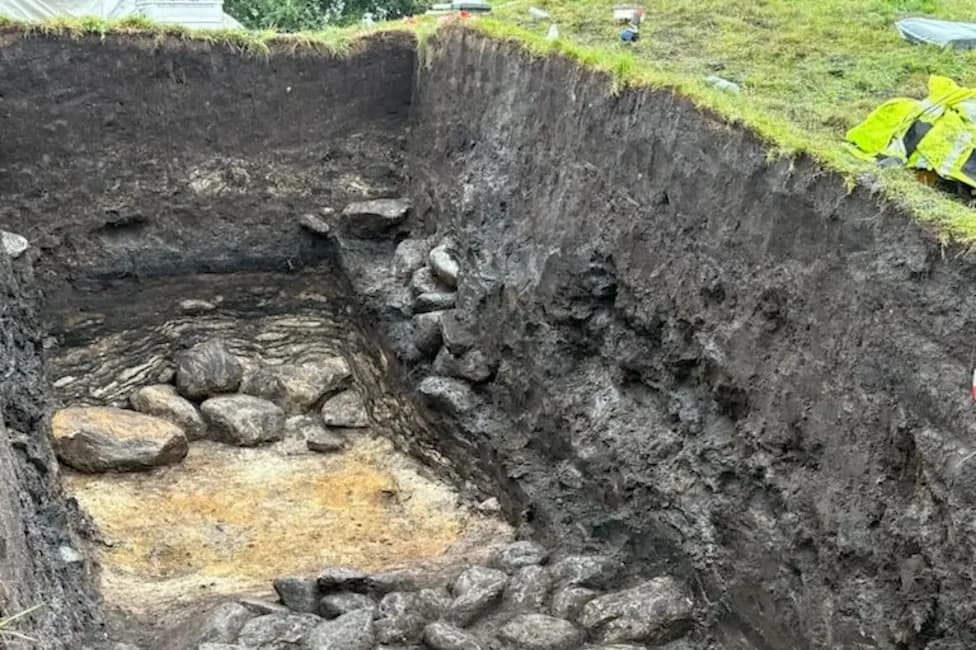
Photo Credit: Marie Ødegaard / University of Stavanger
Archaeologists in Norway have reopened a long-neglected burial mound and uncovered traces of a roughly 50-foot vessel that may date to the Viking period. Researchers from the University of Stavanger returned this year to a mound first investigated in 1902 and extended a trench originally cut by Haakon Shetelig to probe deeper into the monument without fully dismantling it.
What the Team Found
Although much of the timber is fragile or degraded, the excavation has already yielded important clues: one or two rivets likely from the ship, fragments of wood that may be related to other phases of use, and a layer of birch bark that could reveal construction and reuse methods. Remarkably, preserved plant remains — including blueberry and heather — were recovered, offering direct evidence of the vegetation present when the mound was built.
"It was so well preserved that I could see blueberry plants and heather that were growing there when they built the mound in the Viking age," said Marie Ødegaard of the University of Stavanger. "The plants even still had leaves on them."
Context and Dating
Researchers suspect the ship burial was placed atop an older Bronze Age mound, indicating the location held ritual or social significance long before the vessel was interred. Earlier studies dated the finds to before the Viking Age, while more recent analyses suggest a date near 864. The excavation team is collecting samples for refined radiocarbon and material analyses to narrow the chronology and better understand changing burial practices in northern Europe.
Conservation and Purpose
The dig was commissioned by the Norwegian Directorate for Cultural Heritage in cooperation with Rogaland County Municipality. Archaeologists are deliberately leaving most of the mound undisturbed while they assess the condition of preserved wood, metal and organic materials. The project also contributes to wider efforts tied to proposals for listing additional Viking sites on the UNESCO World Heritage List.
Although the ship appears to be in poor condition overall, the combination of structural clues, artefacts and exceptional organic preservation makes this a rare opportunity to reconstruct not just a vessel but the landscape, materials and rituals associated with burial in the region.
Help us improve.