AI Can Analyze Data — It Can't Originate Care. A medical student recalls a supervising physician's simple, compassionate question that revealed a patient's fear after her sister's stage 4 colon cancer diagnosis. The essay argues that great clinicians "define the input" by noticing hesitation, unsaid clues, and subtle signs—skills AI cannot originate. It calls for AI to be used as an adjunct and for medical training to emphasize curiosity, observation, communication, and empathy.
What AI Can’t Do in Medicine: The Human 'Feel' That Guides Care
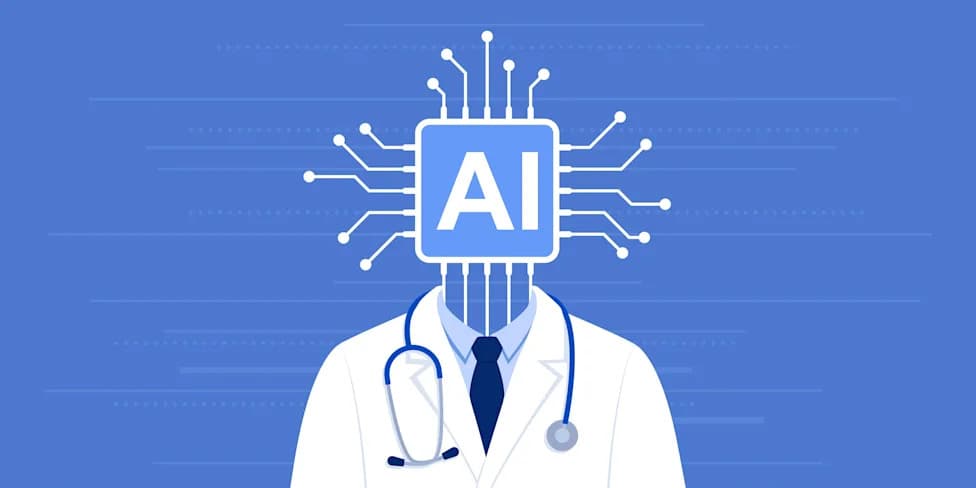
—elenabs—Getty Images
I was an early medical student at the University of Miami when I saw a patient in a community primary care clinic. With some pride I told my supervising physician, "Abdominal pain with constipation — I think it's irritable bowel syndrome."
We entered the exam room together. He asked many of the same questions I had: When did the pain start? Where is it? I expected him to confirm my assessment. Instead, after his last question he paused and looked at her face. For the first time I noticed she wasn't meeting our gaze; she was staring at the floor.
"We've known each other for a long time," he said gently. "You seem worried. Can you share what you're thinking?"
She was quiet at first. When she finally looked up, she said, "My sister was just diagnosed with stage 4 colon cancer. I'm afraid I might have it too." We spent the next 15 minutes talking about how she was coping, her fears about future screening, and why, in our judgment, irritable bowel syndrome remained the most likely cause of her symptoms. By the end of the visit her face had relaxed. I realized I had missed how terrified she was, and I felt ashamed. "What kind of doctor will I be if I miss that?" I wondered.
Learning To "Get A Feel"
Afterward my supervising physician said something I never forgot: "You learn how to look. When you care, you get a feel for it." That lesson has stayed with me as artificial intelligence has entered clinical practice—at my residency program at Johns Hopkins Hospital and beyond. I have seen AI scribes in clinics, symptom-to-differential chatbots, and electronic tools that summarize a hospital course. These technologies are powerful, but they can't feel.
Why AI Can't Replace the Initial Human Attention
AI excels at processing presented information—symptoms, labs, images, and even facial expressions. It reasons from the inputs it receives. What AI cannot do is decide, beforehand, what deserves attention when no explicit data exist. Great clinicians "define the input": they notice a half-second hesitation before an answer, pitting in a nailbed, or a subtle change in heart sounds compared with a prior visit. Those observations arise from full attention, curiosity, relationship building, and context—qualities that lead clinicians to ask the questions an algorithm would never think to ask.
Ironically, many health systems push clinicians toward the workflows where AI performs best: documenting, checking boxes, and following protocols. That environment risks eroding the chance for physicians to practice the nuanced observation and curiosity that distinguish human care. If training and systems reduce clinical encounters to discrete data points, AI-driven outputs may well match human outputs—but the patient experience will be diminished and, at times, ineffective.
How to Integrate AI Without Losing What Matters
We should embrace AI's ability to improve accuracy and efficiency while recognizing its limits. AI must be positioned as an adjunct—a modern stethoscope—not a substitute for the clinician's presence. Healthcare workers should shape how medical AI is designed and deployed so it does not entrench checkbox medicine or create AI-equivalent clinicians who follow protocols without empathy or curiosity.
Medical education must be reimagined for an AI era: teach learners to define the input by cultivating curiosity, careful observation, expert communication, and physical-exam mastery. Recruitment should favor people drawn to service, connection, and trust-building—attributes that have defined great physicians for centuries.
Years later I remember little about the specifics of that patient's abdominal pain. What I recall vividly is the moment she looked up after the question my younger self hadn't thought to ask. AI will get better at detecting disease; whether medicine gets better at recognizing patients depends on whether future clinicians still learn to look—and to feel.
Help us improve.