Big Tech’s AI expansion is driving rising emissions as companies scale energy-hungry data centers. Climate Power’s tracker ranks eight leading AI firms by data-center cleanliness: xAI is the dirtiest (6/100) while Amazon ranks cleanest among the eight (68/100). However, Amazon, Microsoft and Google together emitted roughly 19 million metric tonnes CO2e last year — about one-third of France’s emissions — showing that average cleanliness does not eliminate large total footprints. Greater transparency, grid decarbonization and limits on behind-the-meter gas are needed to rein in the sector’s climate impact.
Ranked: Which Big Tech Firms Are Driving AI’s Rising Carbon Footprint?
Major technology companies that once promised aggressive decarbonization are now seeing emissions climb as they massively expand energy-intensive data centers to power artificial intelligence. While some firms invest in low-carbon projects, others are building highly polluting infrastructure — often in parallel with public climate pledges.
Amazon’s Texas Plant and the Broader AI Emissions Problem
Amazon is planning a gas-fired power plant in Texas that, if built as permitted, could emit roughly 33 million tons of carbon dioxide a year — more than any single power plant in the United States, according to reporting by The New York Times. Amazon continues to publicly reaffirm its climate commitments even as critics point to the gap between its pledges and some of its projects.
"The world looks different now than when we co-founded The Climate Pledge," Amazon spokeswoman Margaret Callahan told The New York Times. "However, our commitment hasn't changed."
How The Firms Compare: Climate Power’s Tracker
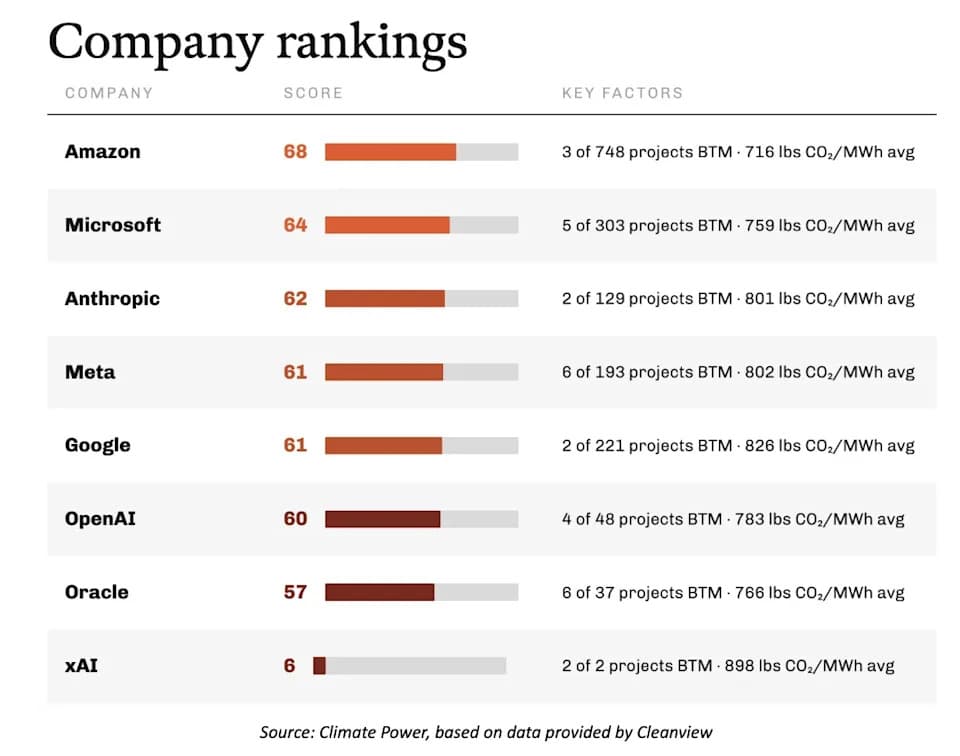
Climate Power’s Data Center Air Pollution Tracker ranks eight leading AI-focused companies based on two factors: whether data centers burn gas behind the meter (BTM) on-site and the relative cleanliness of the local electrical grid. Scores run from 0 (very dirty) to 100 (entirely clean).
As of data compiled on August 13, Elon Musk’s xAI ranks worst with a score of 6 because its projects are gas-powered BTM, averaging about 898 pounds of CO2 per megawatt-hour. By contrast, Amazon scores highest among the eight firms with 68 points. The full ranking (dirtiest to cleanest) is: xAI (6), Oracle (57), OpenAI (60), Meta (61), Google (61), Anthropic (62), Microsoft (64), and Amazon (68).
Big Averages Can Mask Huge Totals
These per-project cleanliness scores do not reflect total emissions volumes. Amazon, Microsoft and Google may operate comparatively cleaner projects on average, but they also run many more large-scale data centers. Together, those three companies emitted roughly 19 million metric tonnes of CO2e in the last financial year — about one-third of France’s annual emissions — illustrating that better averages do not eliminate large aggregate footprints.
"Claims by Microsoft, Amazon and Google about their clouds being ecologically friendly and sustainable are a marketing strategy," said Cecilia Rikap, an economics professor at University College London. She warned that migrating services to cloud providers can shift and obscure emissions that would otherwise be visible on customers' books.
Transparency, Accountability and Policy
Analysts and advocates say the sector’s opacity and inconsistent reporting practices may cause us to significantly underestimate actual emissions. As AI demand grows, policymakers, investors and the public will need clearer disclosure standards, stronger grid decarbonization, and limits on behind-the-meter fossil fuel use to ensure that AI’s benefits do not come at an unacceptable climate cost.
Sources: The New York Times; Climate Power Data Center Air Pollution Tracker; The Guardian.
Help us improve.