Costa Rica extradited alleged drug boss Gilbert Bell Fernández ("Macho Coca") and associate Gabriel Lozano Bonilla ("Compadre") to New York to face U.S. federal charges. Bell Fernández, listed on the U.S. Treasury sanctions list since 2023, is accused of violent, large-scale cocaine trafficking linked to the Gulf Clan. Lozano Bonilla is also accused of facilitating liquid cocaine shipments to Europe and Asia. The transfer follows a 2025 constitutional reform that enabled extraditions and forms part of Costa Rica's broader crackdown on organized crime.
Costa Rica Extradites Notorious Trafficker "Macho Coca" and Associate to U.S. Federal Courts
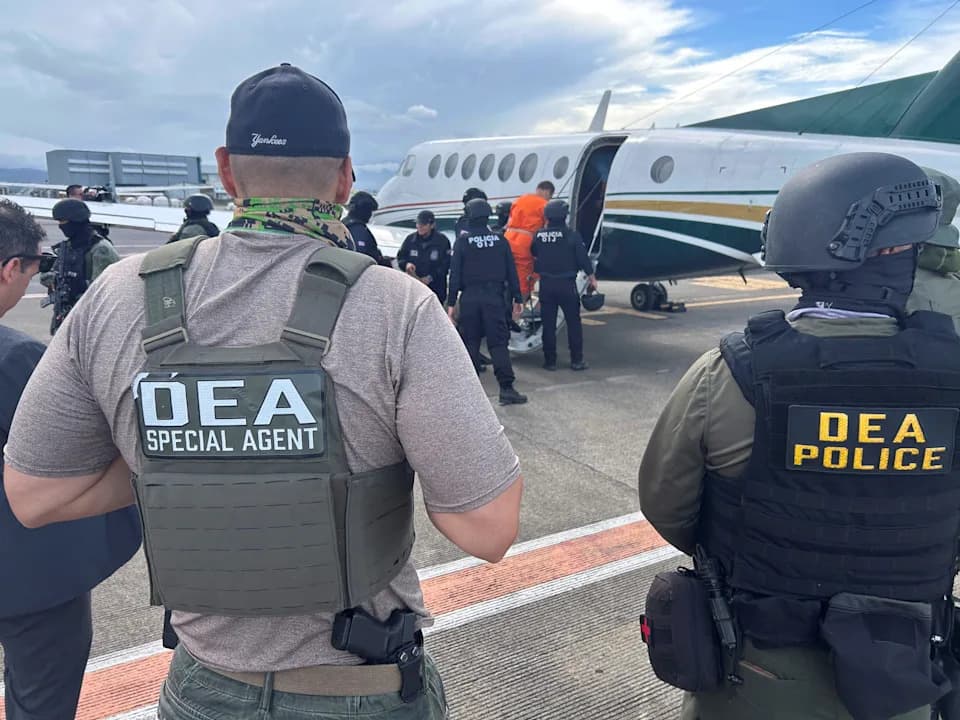
U.S. Drug Enforcement Administration agents observe alleged drug traffickers Gabriel Lozano (not pictured) and Gilbert Bell Fernandez as Costa Rican security forces escort them aboard a plane for extradition to the United States, in Alajuela, Costa Rica, August 13, 2026. / Credit: Ministerio de Seguridad Publica/Handout via REUTERS
San José authorities extradited one of Costa Rica's most prominent alleged drug traffickers and an associate to the United States on Thursday to face federal charges, officials said.
Gilbert Bell Fernández, a 63-year-old Costa Rican businessman widely known by the alias "Macho Coca," and Colombian national Gabriel Lozano Bonilla, nicknamed "Compadre," were flown from Juan Santamaría International Airport northwest of San José to New York under heavy security.
Allegations and Links
The U.S. Treasury Department lists Bell Fernández as one of Costa Rica's major drug traffickers, noting both the volume of drugs he is alleged to move and the violence with which he reportedly operates. He was added to the U.S. sanctions list in 2023.
Costa Rica's Attorney General Carlo Díaz said authorities and the U.S. Drug Enforcement Administration link the men to the Gulf Clan. U.S. prosecutors accuse both defendants of participating in cocaine shipments to the United States for the Colombian cartel Washington has designated a Foreign Terrorist Organization.
"I thank the United States for taking me out of this country. They are saving my life," Bell Fernández said, claiming he had been mistreated while in Costa Rican custody.
Lozano Bonilla, a naturalized Costa Rican, is also accused of involvement in shipments of liquid cocaine destined for markets in Europe and Asia.
Security and Political Context
Local media reported that both men were escorted to the airport wearing bulletproof vests and helmets and were closely guarded by security personnel during the transfer.
The extradition comes amid a tougher stance on organized crime by Costa Rica's new right-leaning president, Laura Fernández, who pledged during her May inauguration to take a "firm hand" against trafficking networks. Observers note the move also follows a constitutional reform adopted in 2025 that restored or expanded the government's authority to extradite suspects to face foreign prosecutions.
Why It Matters
Costa Rica, a nation of about 5.2 million people long seen as a stable democracy in Central America, has in recent years become an important logistics hub for regional drug trafficking. That shift has contributed to an increase in violent turf battles and a rising homicide rate. Last month authorities captured the country's most-wanted fugitive, known as "Diablo," who faced U.S. charges and carried a $500,000 bounty.
Since the 2025 reform, Costa Rica has extradited several high-profile suspects to the United States, including former security minister and judge Celso Gamboa and alleged associate Edwin López Vega (alias "Pecho de Rata"). Gamboa was indicted by the U.S. Justice Department on July 9, 2025, on charges of conspiring with international traffickers to manufacture and transport large quantities of cocaine.
U.S. authorities will now pursue federal charges in New York. The extraditions highlight increasing international cooperation to disrupt drug networks that operate across borders and the political will in Costa Rica to pursue more aggressive measures against organized crime.
Help us improve.