The University of Michigan will pilot a pass-or-no-credit grading system for first-semester LSA students to reduce transition-related stress and address student mental health. Officials cite findings from the 2024–2025 Healthy Minds Study showing declines in severe depression and suicidal ideation. The move joins similar measures at other selective institutions and comes amid broader debates over grade inflation and uneven academic preparation in STEM.
University of Michigan Pilots Pass/No-Credit For LSA First-Year Students To Ease Mental-Health Strain
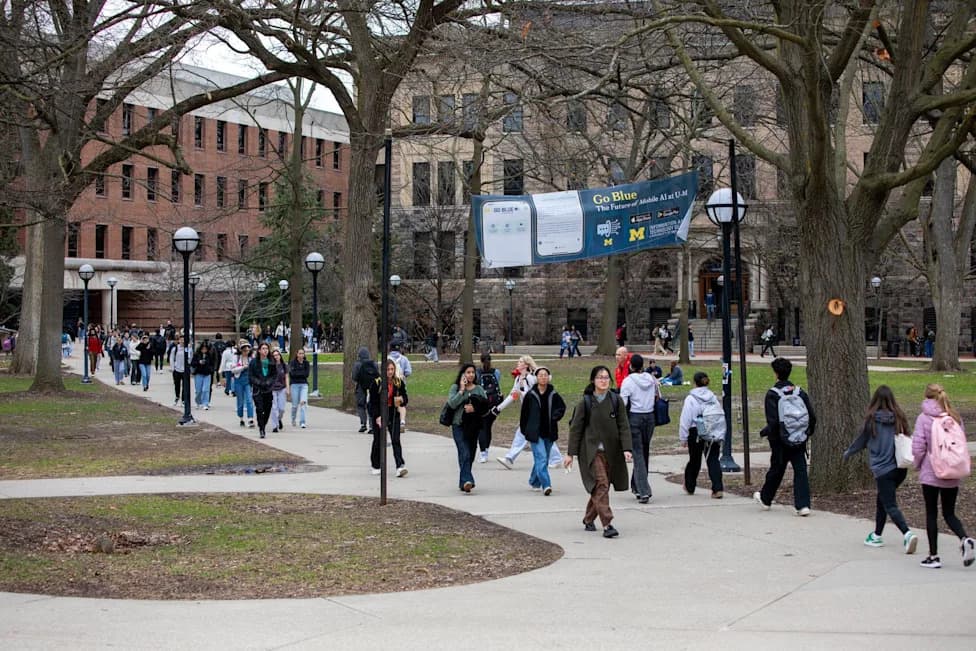
University of Michigan students walk on campus on 3 April 2025 in Ann Arbor, Michigan.Photograph: Bill Pugliano/Getty Images
The University of Michigan will replace letter grades with a pass-or-no-credit grading system for first-semester students in the College of Literature, Science, and the Arts (LSA). The university says the change is intended to ease students' transition to college, reduce competition, and address growing mental-health concerns among young adults.
What the Pilot Entails
Under the pilot, transcripts for affected students will list 'pass' or 'no credit' rather than letter grades. The policy applies only to the first semester for incoming LSA students; officials have framed it as a temporary "on-ramp" that gives new undergraduates space to adjust to college-level expectations without the immediate pressure of traditional grades.
Why the University Cited the Change
University leaders pointed to recent mental-health data and broader debates about grading and preparedness. The 2024–2025 Healthy Minds Study — a multi-campus survey covering 135 U.S. colleges and universities — reported declines in serious mental-health symptoms among students: symptoms of severe depression fell to 18% (from 23% in 2022) and reported suicidal ideation fell to 11% (from 15%).
'Removing letter grades for the first semester has the potential to not only address the alarming rates of stress, depression and anxiety among our students, but to deliver on our core promise as a liberal arts and sciences college,' said Rosario Ceballo, dean of the University of Michigan.
'This program would provide LSA students with a smooth on-ramp as they accelerate from high school into a rigorous college education; a chance to refine their academic skills and build early momentum,' said Timothy McKay, LSA associate dean for undergraduate education.
Context: National Trends and Concerns
Michigan's pilot follows similar moves at several selective institutions. The Wall Street Journal reported comparable initiatives at the California Institute of Technology, Swarthmore College, Wellesley College, and the Massachusetts Institute of Technology. At the same time, universities continue to grapple with related issues: Harvard faculty recently voted to cap A grades at roughly 20% to counter grade inflation.
Separately, math and science faculty across the University of California system have warned of uneven academic preparation. Professors at UC Berkeley reported 'severe preparation deficits' in first-semester calculus and urged regents to reconsider college-entrance exam policies. Data from UC San Diego indicate that the share of students needing remedial math before precalculus rose to 8.5% in 2025 from 0.5% in 2020, prompting instructors to sometimes reteach middle-school material alongside college topics.
'Grades have lost their value as an indication of quality or excellence,' said Kenneth Lowande, a former University of Michigan political-science professor, expressing skepticism that a single-semester grading pause will restore grading's long-term meaning.
Possible Implications
Proponents argue the pilot could reduce early-term stress and encourage collaborative learning. Critics worry about unintended effects on student motivation, the meaning of transcripts, and preparedness for rigorous majors. The university has positioned the change as an experimental, limited step to help new students acclimate — with outcomes to be evaluated before any broader adoption.
What Comes Next: The university will monitor academic outcomes, student well-being metrics, and feedback from faculty and advisors to determine whether the pilot should continue, expand, or be modified.
Help us improve.