Researchers are developing vaccines to prevent Lynch syndrome–related colorectal cancer by training the immune system to target novel proteins produced by mutation-prone cells. In a 45-person trial, a Nouscom vaccine boosted T-cell responses and was associated with fewer precancerous lesions and no advanced polyps after one year. Oxford/Moderna and ImmunityBio are testing related approaches, and a larger MD Anderson trial is expected to start next year. Larger studies are needed before vaccines could replace current surveillance practices.
Early Vaccines Aim To Prevent Lynch Syndrome–Related Colon Cancer — Promising Early Results
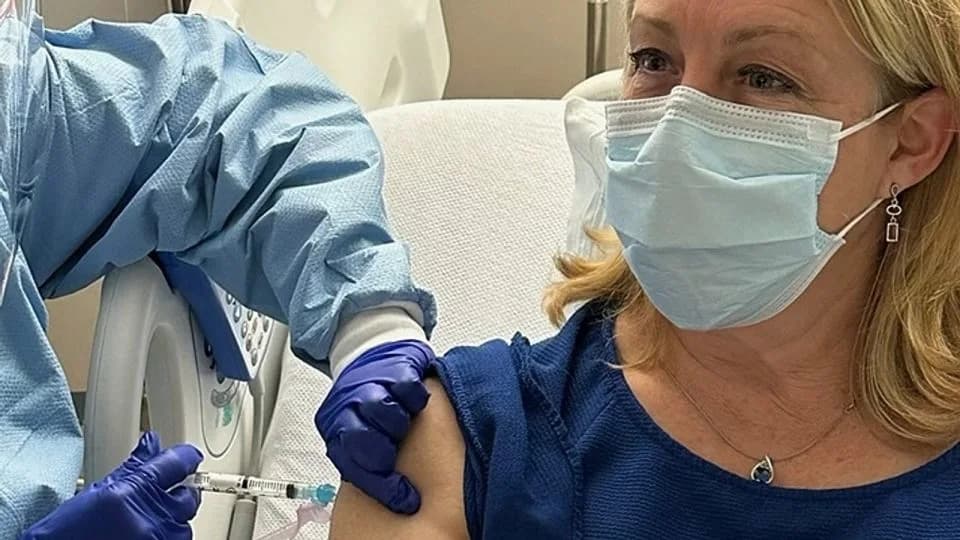
Dr. Stacy Norton receives a trial vaccine for Lynch syndrome at the MD Anderson Cancer Center Infusion Center in Houston on April 11, 2023. - Dr. Stacy Norton/AP
Researchers are testing vaccines that train the immune system to intercept early, Lynch syndrome–driven colorectal cancers before tumors form. Early results from a small trial are encouraging, and larger studies are planned.
Patient Story: Dr. Stacy Norton, an obstetrician-gynecologist in Houston, volunteered for a clinical trial after a family history of aggressive, early-onset cancers. Norton carries a Lynch syndrome mutation and has already survived another Lynch-related cancer. In the Nouscom vaccine study she joined, her colonoscopies were polyp-free one and two years after vaccination.
What Is Lynch Syndrome?
Lynch syndrome is an inherited defect in mismatch-repair genes — the DNA "spellcheckers" — that allows mutations to accumulate, greatly increasing the risk of colorectal cancer and several other cancers (including endometrial, ovarian, stomach, pancreatic and some brain and skin tumors). The condition affects roughly 1 in 279 people; depending on the specific faulty gene, a carrier's lifetime colorectal cancer risk can approach 80%.
How The Vaccines Work
Unlike vaccines that prevent viral infections, these experimental vaccines teach the immune system to recognize abnormal proteins produced by cells that have acquired many mutations due to mismatch-repair failure. That enables T cells to identify and attack early, precancerous cells.
Early Trial Results
The Nouscom vaccine tested at MD Anderson — led by Dr. Eduardo Vilar-Sanchez — targets 209 recurrent abnormalities found in Lynch-associated precancers. In a first-step study of 45 Lynch carriers, the shot stimulated tumor-targeting T-cell responses and, after one year, colonoscopies showed fewer precancerous lesions and no advanced polyps. The team published their findings in Nature Medicine.
A subgroup of participants received a booster a year later; additional booster data are expected in the coming months. Based on the early results, MD Anderson expects to launch a larger trial early next year.
Other Approaches Under Way
Oxford University is beginning early testing of a similar concept using an mRNA vaccine developed by Moderna, while California-based ImmunityBio is running a slightly larger trial testing its Tri-Ad5 vaccine against placebo. Each candidate flags different sets of cancer-related markers.
What This Means For Patients
These vaccine approaches are promising but still experimental. Larger trials are needed to confirm benefits, safety and durability. For now, people with Lynch syndrome should continue recommended surveillance — typically yearly colonoscopies — and discuss genetic testing and preventive options with their healthcare providers.
Context And Screening Guidance
About 158,000 people in the U.S. are diagnosed with colorectal cancer each year, most over age 50, though diagnoses in younger adults have been increasing. For average-risk individuals, current U.S. guidelines recommend routine colorectal screening beginning at age 45. Seek medical evaluation at any age for symptoms such as blood in the stool, persistent changes in bowel habits, unexplained weight loss, or abdominal pain.
Bottom Line: Early vaccine trials to prevent Lynch syndrome–related colon cancer show promise by stimulating T-cell responses and reducing precancerous growths in a small study. Ongoing and larger trials will determine whether these vaccines can become a safe, effective complement — or alternative — to frequent surveillance for high-risk individuals.
Help us improve.