Israel on Trial is Judge Roy K. Altman's forensic legal review of six widespread accusations against Israel. Using historical, archaeological, genealogical, and legal evidence, Altman evaluates claims that Jews are colonists, that Israel's founding was illegitimate, that it blocked Palestinian statehood, that Gaza was an occupied "open-air prison," that Israel practices apartheid, and that it committed genocide. He concludes that many of these charges do not withstand careful legal and factual scrutiny and offers the book as a practical, evidence-based rebuttal to common misconceptions.
Israel on Trial: Judge Roy K. Altman's Forensic Legal Examination of Six Major Accusations

The author subjects the six major allegations against Israel to scrupulous analysis. (photo credit: Sasun Bughdaryan/Unsplash)
Roy K. Altman, a Columbia University graduate who served as a federal prosecutor and later became a United States District Judge for the Southern District of Florida, applies decades of courtroom practice to a charged contemporary debate in his new book, Israel on Trial: Examining the History, the Evidence, and the Law.
Method and Purpose
Altman subjects six widely circulated accusations against Israel to the same legal methodology judges, juries, and lawyers have used for centuries: careful weighing of evidence, attention to definitions, and rigorous application of rules of proof. Drawing on historical, archaeological, genealogical, and legal sources, he sets out the evidence for and against each claim and tests whether the assertions stand up to forensic scrutiny.
Six Allegations Examined
1. Jews as Colonists
Altman begins with a working definition of "colonist" — an outsider with no historical, linguistic, cultural, or religious ties to the land being seized — and argues that Jews do not fit that definition. He documents a continuous Jewish presence in the Land of Israel long before the rise of Islam, centuries before the Roman designation "Palaestina," and well prior to the Arab Muslim conquests in the seventh century.
2. Illegitimacy of Israel’s Founding
Rejecting the claim that biblical texts are Israel’s sole source of legitimacy, Altman invokes the Montevideo Convention (1933) criteria for statehood: a permanent population, defined territory, effective government, and capacity to conduct foreign relations. He contends that Israel met these criteria at its declaration of independence in May 1948.
3. Preventing Palestinian Statehood
Altman reviews six occasions when Israel — or the international community with Israeli acquiescence — offered frameworks for Palestinian statehood. He argues these offers were rejected or undermined by Palestinian leaders’ maximal territorial demands and political disagreements, and he documents the diplomatic history that shaped those outcomes.
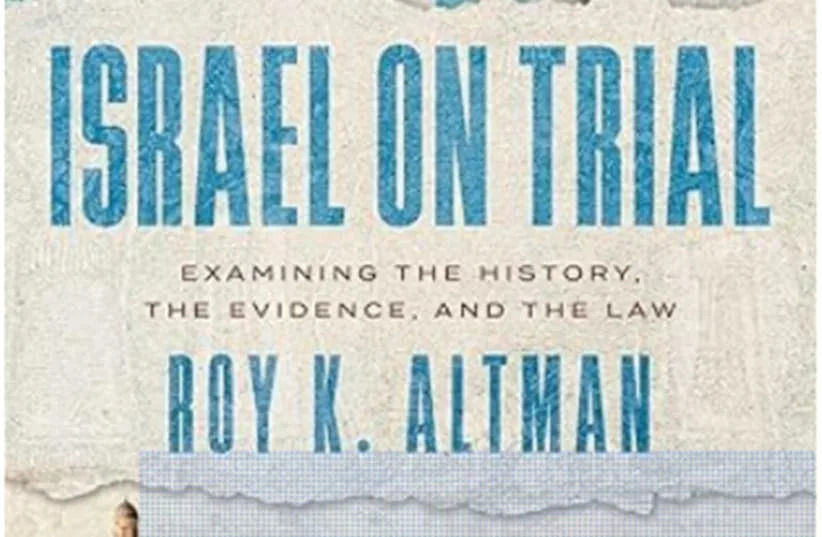
Israel on Trial: Examining the History, the Evidence, and the Law, by Roy. K. Altman. (credit: Advantage Books)
4. Gaza: Occupation, "Open-Air Prison" or Concentration Camp
Addressing claims that Gaza was an occupied territory turned into an "open-air prison" or concentration camp as of October 7, 2023, Altman analyzes historical facts and the ordinary meanings of those loaded terms. He argues the available evidence does not support those characterizations when measured against legal and historical definitions.
5. Apartheid Allegations
Altman examines the status of Arab citizens within Israel — who constitute roughly 20% of the population — and notes the legal rights they hold under Israeli law. He also highlights a logical tension in some claims of "apartheid": many organizations that label Israel as such also recognize a separate Palestinian state, raising the question whether withholding Israeli citizenship from citizens of another recognized polity can be equated with practicing apartheid under international law.
6. Genocide Charges
Altman acknowledges the tragedy of civilian deaths in conflict, but emphasizes that the legal test for genocide requires specific intent to destroy, in whole or in part, a protected group. He argues the evidence does not establish that the State of Israel possessed the requisite intent to commit genocide in Gaza.
Audience and Impact
The book is pitched both to people seeking evidence-based rebuttals to prevalent narratives about Israel and to individuals—especially Jews—confronting hostile or ill-informed claims in daily life. Altman aims to provide a compact, legally oriented toolkit for responding to frequently repeated allegations.
"The question in a genocide case isn't whether innocent civilians have died in Gaza. They unquestionably have — just as they have in every war that's ever been fought. The essence of genocide is a specific intent to destroy the victim group's existence." — Roy K. Altman (paraphrased)
Recommendation: Israel on Trial is presented as a timely, evidence-driven resource for readers who want a forensic legal perspective on contested claims about Israel. Those seeking a concise, courtroom-style rebuttal of common accusations will find Altman's arguments structured and accessible.
Book Details: Israel on Trial: Examining the History, the Evidence, and the Law, by Roy K. Altman. 304 pages; $32. Advantage Books.
Help us improve.