FDA Approved First U.S. mRNA Flu Vaccine: On August 5, 2026 the FDA cleared mFLUSIVA, the first mRNA influenza vaccine licensed in the United States, a year after HHS canceled about $500 million in mRNA projects. mFLUSIVA outperformed a standard-dose shot by 26.6% in a ~40,700-person Phase 3 trial and can be reformulated in 2–3 months versus ~6 months for egg-based vaccines. Side effects at the injection site were more common, and access may be limited until the CDC advisory panel resumes and insurers set coverage rules.
Why Flu Shots Have Been Hard to Improve — And How mRNA Could Change That
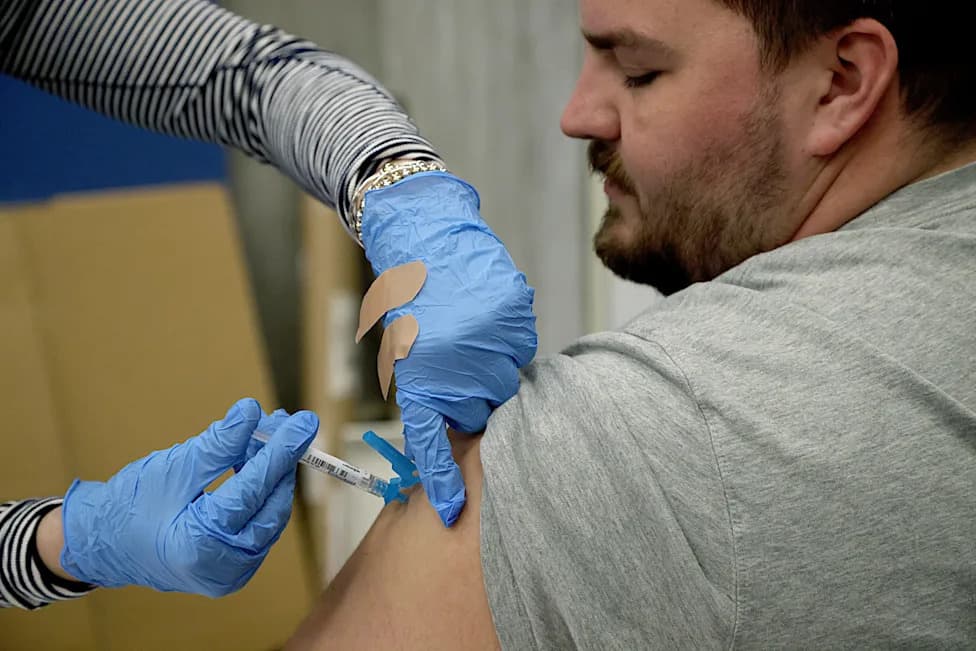
A man in a gray T-shirt gets a shot in his shoulder from a blue-gloved health worker.
On August 5, 2025, the U.S. Department of Health and Human Services unexpectedly halted 22 mRNA vaccine projects valued at roughly $500 million and announced it would stop funding the mRNA platform that produced the Covid vaccines. Health Secretary Robert F. Kennedy Jr., a longtime skeptic of some vaccine technologies, said available data showed these products did not protect well against upper respiratory infections such as Covid and influenza. That claim clashed with published Phase 3 results from Moderna, but the funding cuts went ahead.
Exactly one year later, on August 5, 2026, the Food and Drug Administration approved mFLUSIVA — the first mRNA influenza vaccine licensed in the United States. The matching dates are coincidental: the approval occurred on the anniversary because the FDA met a self-imposed review deadline set earlier this year after an initial refusal to file Moderna’s application was reversed.
Why This Matters
Seasonal influenza rarely captures sustained public attention — fewer than half of U.S. adults got a flu shot last season — yet the stakes are high. The 2024–25 flu season caused an estimated 51 million illnesses, 710,000 hospitalizations, and 45,000 deaths. Beyond acute illness, influenza raises short-term cardiovascular risks: in the week after a confirmed infection the chance of heart attack can climb substantially.
Eggs, Timing, and Why Flu Shots Lag Behind
Since the 1940s, most flu vaccines have been produced in fertilized chicken eggs. The process is time-consuming and agricultural in nature: eggs are inoculated and incubated for nine to 12 days, then manufacturers and public-health bodies spend months preparing and standardizing reagents. From strain selection to finished product typically takes about six months — which is why the strains chosen each February must anticipate the viruses that will circulate in November.
That delay matters because influenza mutates continually. H3N2, in particular, drifts quickly. Growing virus in eggs also forces the virus to adapt to egg cells, creating “egg-adaptive” mutations that can change the surface proteins a vaccine targets. Between 2011 and 2020, egg-adaptive changes caused more vaccine mismatch than natural viral drift.
How mRNA Changes the Equation
mRNA vaccines bypass eggs entirely. They deliver a short strand of genetic instructions so recipients’ cells produce the viral surface protein directly. Updating a vaccine for a new strain requires editing the genetic sequence rather than growing a new virus. Moderna told the FDA advisory panel it can move from strain selection to finished vaccine in about two to three months instead of six — allowing later strain picks and faster responses to late-emerging variants.
In a Phase 3 trial of roughly 40,700 participants, mFLUSIVA reduced influenza cases by 26.6% compared with a standard-dose shot; an exploratory analysis showed a 33.7% advantage against cases that led to a medical visit. This is a meaningful improvement, though it does not eliminate flu.
Trade-Offs and Access
mFLUSIVA was associated with more local reactions: about two-thirds of recipients reported injection-site pain versus roughly 30% with the comparator vaccine. Most side effects resolved within a day or two, but in a country where concern about side effects is a common reason to decline vaccination, tolerability is important for uptake.
Approval does not guarantee broad access. The CDC’s vaccine advisory committee has been effectively paused by a federal court order, leaving no formal recommendation in place and meaning insurers are not yet required to cover mFLUSIVA without cost sharing. The $500 million in funding that was canceled last year has not been restored, and some trials and programs are proceeding with international or philanthropic support rather than U.S. government backing.
Broader Implications for the mRNA Platform
Last year’s funding decision conflated questions about specific respiratory applications with the underlying mRNA platform. Meanwhile, progress continued across diverse areas that use the same basic chemistry — short genetic sequences delivered in lipid nanoparticles. Recent examples include improved recurrence-free survival in melanoma with a personalized mRNA therapy; promising long-term outcomes in a subset of pancreatic cancer patients treated with tailored mRNA vaccines; and successful delivery of a gene-editing therapeutic as mRNA for a patient with a rare genetic disorder.
Those advances illustrate that the platform’s value extends well beyond a single application. Some of the most realistic routes to a universal or broadly protective influenza vaccine also run through mRNA technology — and platforms tend to improve as they are used.
What Comes Next
The most hopeful reading of recent events is straightforward: independent experts appointed under the current administration reviewed the evidence and unanimously concluded that mFLUSIVA’s benefits outweigh its risks. The more pessimistic interpretation is that policy reversals required public pressure and leadership changes. Either way, for many people the practical outcome is simple — this fall some Americans will be offered a flu vaccine designed from sequence data rather than grown in an egg, and for most it will be a step forward.
Bottom line: mRNA influenza vaccines promise faster updates and improved strain matching, and mFLUSIVA offers a meaningful improvement over standard-dose shots — but side effects and access barriers remain.
Help us improve.