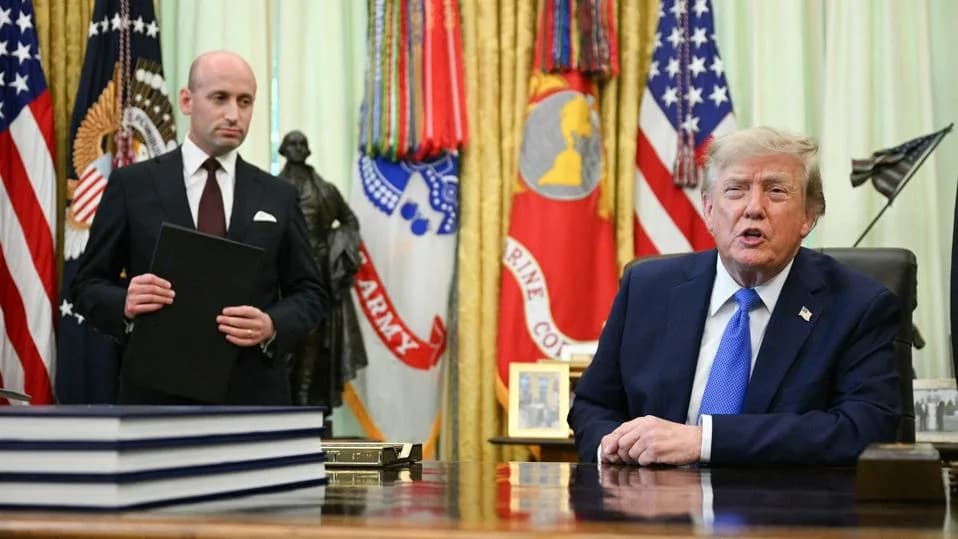
President Donald Trump on Thursday signed an executive order that attempts to narrow birthright citizenship, roughly two months after the Supreme Court struck down an earlier order on the same topic in the case described in the administration’s papers as Trump v. Barbara. The new order purports to identify categories of children born in the United States who, the White House says, do not fall within the rule of birthright citizenship announced by the Court in June.
Background: The Fourteenth Amendment And Precedent
The Fourteenth Amendment declares that "all persons born or naturalized in the United States, and subject to the jurisdiction thereof, are citizens of the United States." For about 150 years, the prevailing judicial and scholarly interpretation has been that nearly everyone born on U.S. soil is a citizen at birth, with narrow historical exceptions such as the children of accredited foreign diplomats. The Supreme Court reaffirmed the general rule in United States v. Wong Kim Ark (1898).
Earlier this year, Mr. Trump issued an executive order that sought to deny U.S. citizenship to children born to temporary visa holders or undocumented immigrants. In Trump v. Barbara, the Supreme Court invalidated that order as unconstitutional. Chief Justice John Roberts wrote for the majority that the children at issue "satisfy both elements of the Citizenship Clause: they are 'born … in the United States' and 'subject to the jurisdiction thereof.'" In short, the Court concluded: "Under the Constitution, they are citizens at birth."
What The New Order Does
The new order seeks to carve out additional categories of exclusion and directs agencies to implement rules that would refuse to recognize citizenship at birth for children in specified circumstances, including:
- Children with at least one parent who is a foreign government employee — stretching from accredited ambassadors to various foreign officials and some international-organization staff.
- Children whose parents "engage in a commercial transaction" to arrange a birth in the United States — language aimed at "birth tourism" and certain surrogacy arrangements.
- Children born in territories or territorial waters where federal statute does not already confer citizenship — language that may implicate rare maritime or territorial-law exceptions.
- Children of parents designated as "alien enemies," including members of groups labeled as Foreign Terrorist Organizations or Specially Designated Global Terrorists.
The order also instructs agencies to identify other categories "non-exhaustively," which signals an intent to allow further administrative exclusions over time.
Legal Problems And Practical Concerns
Legal scholars and many of the justices in Barbara stressed that the established exceptions to birthright citizenship are narrow. Roberts’s opinion emphasized the "broad reach and narrow exceptions" of the Citizenship Clause, and Justice Brett Kavanaugh — who concurred in part — wrote separately to clarify limits on creating new exceptions. Nothing in the majority’s opinion invited the executive branch to invent additional categories of exclusion.
Some specific issues with the order:
- Diplomatic And Consular Immunity: The longstanding diplomatic exception (accredited ambassadors and similar officials with full immunity) is well established. But the order expands coverage to many foreign employees who do not enjoy full diplomatic immunity and remain "subject to the jurisdiction" of U.S. law — a change that conflicts with the Court’s reasoning in Barbara.
- Broad, Vague Terms: Phrases such as "commercial transaction to ensure the mother is present" could sweep in innocuous travel or ordinary purchases and create absurd results (for example, routine flight purchases by expectant parents).
- Surrogacy: The order attempts to address surrogacy arrangements without clear statutory guidance and leaves key questions unanswered about which parentage scenarios it would cover.
- Territorial And Maritime Exceptions: References to territories and territorial waters resurrect arcane doctrines (including older maritime concepts noted in Wong Kim Ark) and touch on the unresolved status of places like American Samoa, where people are generally U.S. nationals rather than citizens.
- "Alien Enemy" Provision: Excluding children based on a parent’s designation as a member of a terrorist organization is constitutionally suspect. Designations are administrative and do not strip a person of the protections of being "subject to the jurisdiction" of the United States.
Importantly, the order cites no clear statutory authority empowering the president to refuse to recognize citizenship for children who otherwise meet the constitutional standard. White House claims that the president may rely on "commander in chief" powers or on unspecified executive authority to make these exclusions are widely viewed as legally unfounded. Under the Constitution, Congress — not the president — is charged with setting "rules for naturalization."
Likely Legal Response
The order’s sweeping language and lack of clear statutory support make immediate litigation likely. Critics argue the administration effectively asks courts to accept new exceptions to the Citizenship Clause that the Supreme Court has not authorized. Given the Court’s recent decision and its emphasis on narrow exceptions, challengers are expected to seek injunctive relief quickly.
Conclusion
The administration’s new executive order repackages prior arguments and adds broader, more ambiguous categories for exclusion. Those changes increase the likelihood of rapid legal challenge. If the order's framing is an attempt to achieve by administration action what the Court rejected, it confronts both textual constitutional limits and well-established precedent that favor broad birthright citizenship.