At Hiroshima’s annual Peace Declaration on August 6, Mayor Kazumi Matsui renewed calls to abolish nuclear weapons while criticizing reliance on deterrence. Defense Minister Shinjiro Koizumi has urged an open debate about whether nuclear arms should factor into Japan’s defense planning — a conversation that would challenge the postwar "Three Non-Nuclear Principles." Prime Minister Sanae Takaichi has suggested the U.S. nuclear umbrella could apply in emergencies, and about 21% of Japanese respondents favor reconsidering the ban amid concerns about Russia, China and North Korea.
Hiroshima's Plea and a National Debate: Is Japan Rethinking Its Ban on Nuclear Weapons?
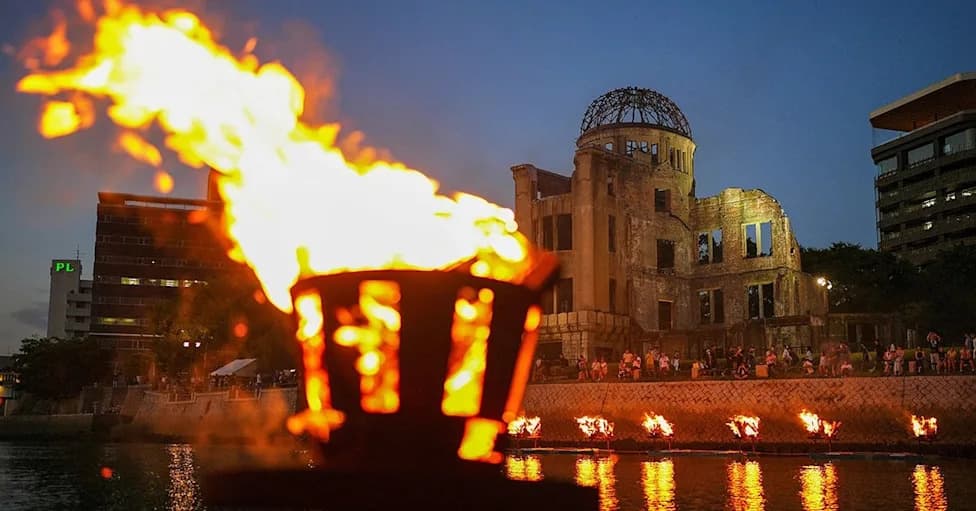
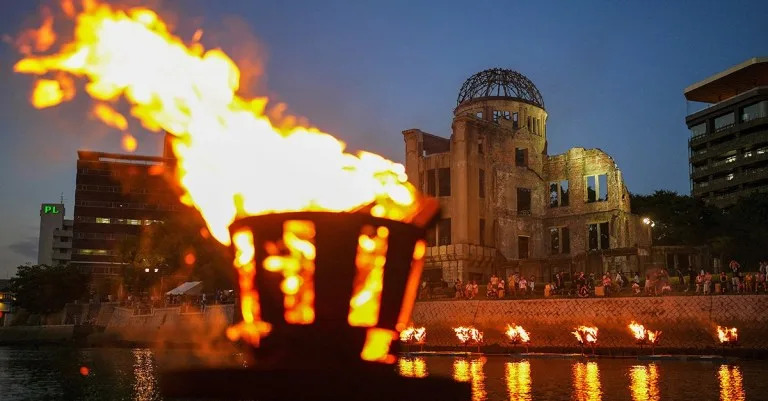
Ceremonial fires are lit in front of the Atomic Bomb Dome to remember the victims on the eve of the 81st anniversary of the world's first atomic bomb attack, in Hiroshima on August 5, 2026. (JIJI Press/AFP via Getty Images)
Every year at 8:15 a.m. on August 6, the mayor of Hiroshima reads a Peace Declaration to mark the moment the city was struck by an atomic bomb in 1945. In 2026, Mayor Kazumi Matsui followed that solemn ritual: after a minute of silence he urged the world to abolish nuclear weapons and prayed for lasting peace. Yet his speech carried an unusually sharp edge, reflecting a growing domestic debate in Japan over its postwar non-nuclear posture.
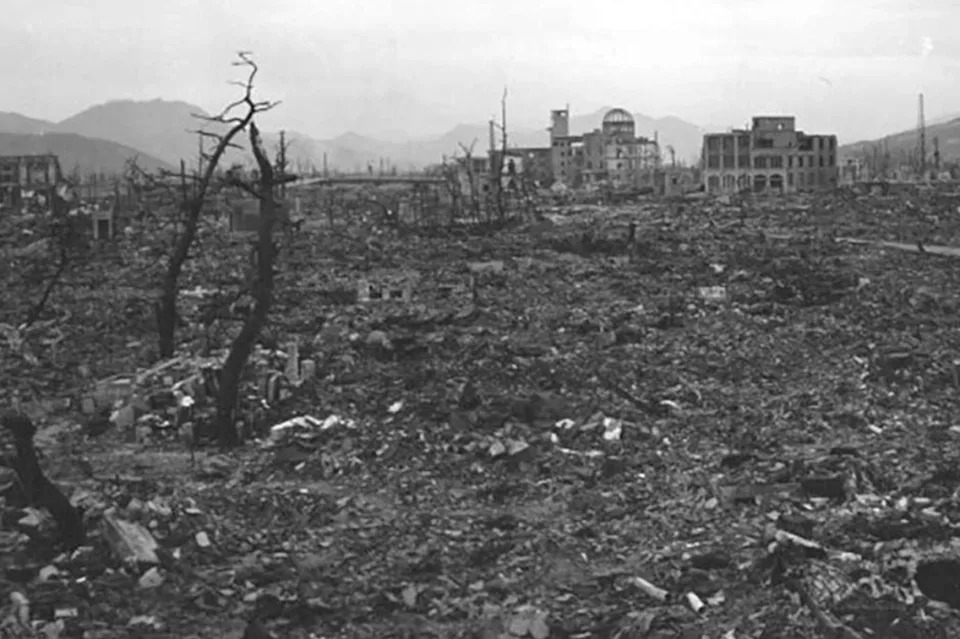
Downtown Hiroshima with the dome of the Prefectural Industrial Promotion Hall in the distance. It is now called the Atomic Bomb Dome, and is part of the Hiroshima Peace Memorial. (National Archives)
What changed
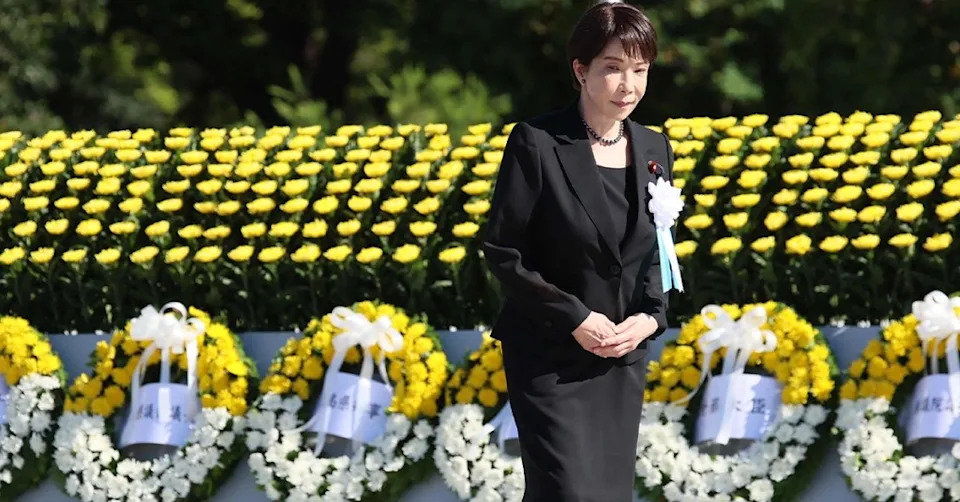
Japanese Prime Minister Sanae Takaichi looks on during a memorial at the Peace Memorial Ceremony, on the 81st anniversary of the dropping of the atomic bomb.(JIJI Press/AFP via Getty Images)
Japanese Defense Minister Shinjiro Koizumi has publicly called for an open discussion about whether nuclear arms should be considered in Japan’s defense planning. Such a debate — if it led to policy change — would reverse the country’s long-standing "Three Non-Nuclear Principles," under which Japan does not produce, possess or permit the introduction of foreign nuclear weapons on its territory. Koizumi stopped short of proposing an official policy reversal, but his comments illustrate how much the security conversation has shifted in recent years.
japan nuclear weapons atomic bomb dome getty
Symbolism and memory
columbia class submarine navy
Hiroshima’s Peace Declaration is deliberately symbolic. The date commemorates the U.S. atomic bombing on August 6, 1945, and the time — 8:15 a.m. — marks the detonation. Survivors of the "Little Boy" attack still attend the annual ceremony at Peace Memorial Park, where the Prefectural Industrial Promotion Hall (now the Atomic Bomb Dome) stands as a powerful reminder of wartime devastation.
tsa military lane check
“We still see military invasions using nuclear weapons as tools of intimidation as well as other imperious actions by major powers in violation of international law,” Matsui said. “The responsibility for this failure lies with political leaders who place blame on others to justify their own behavior.”
Political signals
USS Somers mutiny
Prime Minister Sanae Takaichi attended the ceremony. While Takaichi’s administration has publicly asserted adherence to the Three Non-Nuclear Principles, the prime minister has raised eyebrows with prior comments and writings. In her 2024 book Kokuryoku Kenkyu ("National Strength Research") she argued that Japan should be covered by a U.S. nuclear umbrella in an emergency — a formulation that could imply hosting allied nuclear weapons on Japanese soil or in nearby waters under certain circumstances.
brrrrt act a-10
Opinion remains divided in Japan: polling shows roughly 21% of respondents favor revisiting the ban on allowing foreign nuclear weapons. Supporters of debate often cite Russia’s invasion of Ukraine, China’s posture toward Taiwan, and North Korea’s missile and nuclear development as drivers that make Japan’s security environment more precarious than in past decades.
Why it matters
Reopening the discussion about nuclear weapons would mark a major shift in Japan’s postwar identity and security policy. Allowing the introduction of foreign nuclear weapons or seeking a more explicit U.S. nuclear guarantee would have domestic political consequences and raise regional and global diplomatic implications. At the same time, Hiroshima and Nagasaki’s annual memorials — on August 6 and 9, respectively — continue to anchor national memory and anti-nuclear sentiment, even as strategic debates evolve.
Looking ahead
The debate is likely to intensify as Tokyo balances public memory and legal commitments against shifting regional threats. Whether discussion leads to policy change remains uncertain, but the fact that senior officials are publicly airing the possibility shows how Japan’s security conversation is being reframed.
Help us improve.