The largest study of sibling birth order to date, using insurance records for more than 10.3 million U.S. children, screened 569 diseases and identified 150 with different rates by birth order. First-borns had higher rates of allergies and several neuropsychiatric diagnoses (including autism and ADHD), while second-borns were more often diagnosed with digestive conditions, migraines, shingles and substance abuse problems. The effects were generally modest, robust across within-family and between-family comparisons, and likely reflect a mix of immunological, physiological and social mechanisms; further research is needed to explore causality.
Massive Study of 10.3 Million Siblings Finds Birth Order Linked to ADHD, Autism and Hundreds of Conditions
(AvailableLight/iStock/Getty Images Plus)
When a new sibling joins a household, everyday routines change: another chair at the table, less room on the couch and a new voice in family decisions. A large new analysis suggests these family dynamics may also be linked to long-term health patterns.
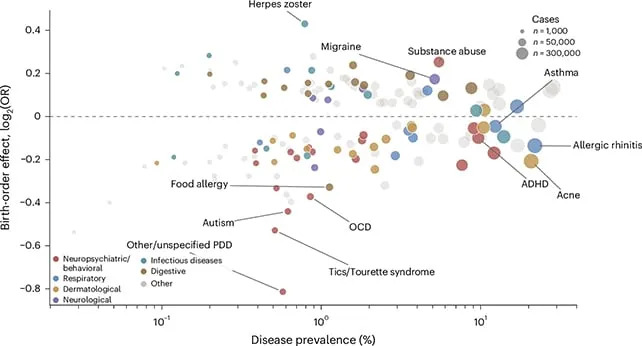
150 diseases were statistically more likely for first-borns or second-borns. (Kramer et al.,Nat. Health, 2026)
What the Study Did
Researchers from the University of Chicago and Columbia University analyzed health insurance records for more than 10.3 million U.S. children who each had one sibling. Using these data, they screened 569 distinct diseases and built a "disease atlas" to test whether a child’s ordinal position (first-born versus second-born) was associated with different risks of diagnosis.

YouTube Thumbnail
Main Findings
The team found 150 diseases with statistically different rates depending on birth order. First-born children showed higher rates of allergies and a cluster of neuropsychiatric conditions, including autism spectrum disorder, attention-deficit/hyperactivity disorder (ADHD), Tourette's syndrome and obsessive-compulsive disorder (OCD). Second-born children were more likely to develop digestive disorders, migraines, shingles and problems related to substance abuse.

Subscribe to ScienceAlert's free fact-checked newsletter
Methods to Reduce Confounding
To limit confounding by family-level factors (for example, pets, household income or regional differences), investigators compared outcomes both within families (first-born versus second-born siblings in the same household) and between families (first-borns versus second-borns across different households). The consistency between these designs, plus validation controls and robustness checks, increased confidence that observed differences relate to birth order itself rather than simple household-level differences.
Modifiers and Limitations
Some associations varied with sibling age gap: a larger gap increased the first-born's likelihood of an autism diagnosis but reduced the chance that the first-born had allergies their later-born sibling did not. The authors emphasize that effect sizes are generally modest. Important potential confounders remain, such as parental age (first-borns typically have younger parents than later-borns) and other unmeasured social or environmental factors. The study is observational and cannot establish causation.
"Birth order appears associated with widespread, albeit generally modest, differences in disease risk across many clinical domains," the authors write, noting a likely mixture of physiological, immunological and social mechanisms.
Why It Matters
This is the largest study to date examining birth-order associations across the medical phenome. It expands prior work — such as findings that later-born children may gain microbial exposure from older siblings — by demonstrating many more modest but consistent associations between ordinal position and diagnosis risk. The authors call for targeted follow-up studies to probe causal pathways and to separate social from biological contributors.
Publication: Kramer et al., Nature Health, 2026.
Help us improve.