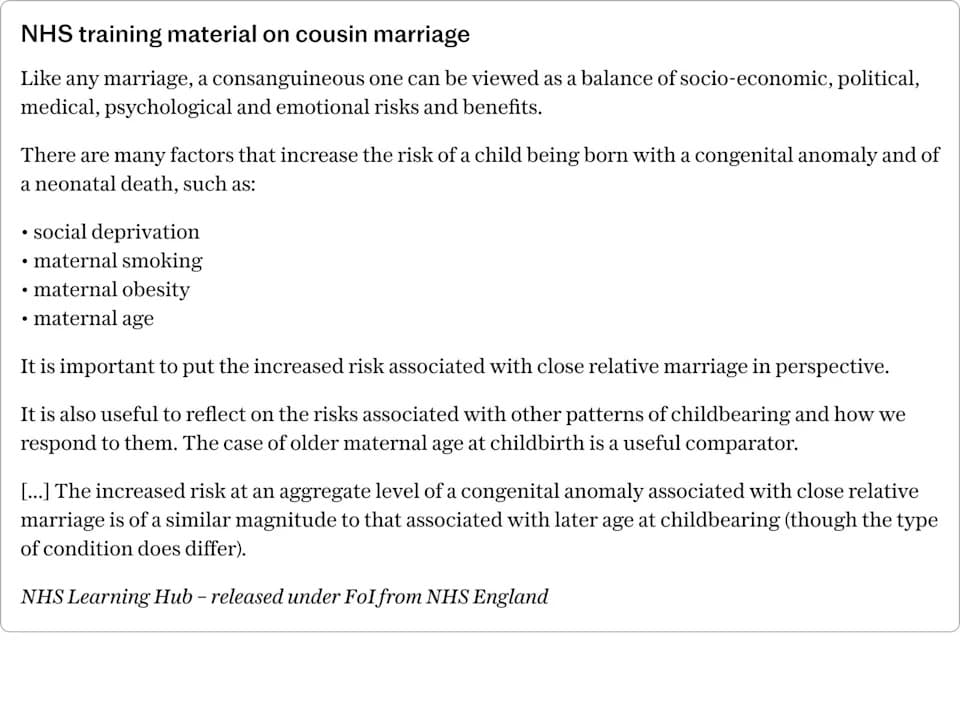
The NHS issued e-learning for health staff that characterised the increased genetic risks from cousin unions as often "exaggerated" and comparable to other risk factors such as older maternal age, smoking, obesity and deprivation. Three of five modules published in October 2022 were withdrawn in October 2025 after public backlash, while two remain online to guide sensitive questioning and genomic referrals. The training cited evidence including the Born in Bradford study (≈6% vs ≈3% congenital anomalies in first-cousin versus unrelated parents) and prompted strong political criticism.
NHS E-Learning Said Cousin-Child Risks Were 'Exaggerated' — Controversial Modules Withdrawn After Backlash
Cousin marriage is 'like any other', midwives taught
The NHS produced e-learning modules for midwives, nurses, GPs and genetic counsellors that described the health risks of consanguinity — when close relatives conceive a child together — as often "exaggerated" and urged staff to put those risks in perspective alongside other recognised factors.
First published in October 2022 and used across the NHS in England, the materials compared the increased risk from cousin unions with other established risk factors such as older maternal age, maternal smoking, obesity and social deprivation. Three of five modules were withdrawn in October 2025 after public criticism; two training courses remain online, offering guidance on how to raise the topic sensitively and when to refer couples to genomic services.
What the Training Said
The now-deleted modules described consanguinity as having been "stigmatised" and suggested the "level of increased risk had often been exaggerated". One session was headed "benefits of marrying within the family" and warned that attempts to discourage the practice could be "inappropriate, alienating and ineffective." The materials also noted that the practice is most common among — but not exclusive to — groups identifying as British Pakistani or Pakistani, and described many such unions as arranged rather than forced.
Clinical Guidance And Referral Criteria
Remaining guidance advises clinicians to ask sensitive screening questions such as: "Is there any possibility you could be related?" and "Do you have any older relatives in common?" Staff are reminded that relatedness is not limited to first cousins and that more distant relationships should be discussed. Urgent referral criteria listed include a family history of genetic conditions, previous pregnancy losses, or a child already affected by a genetic disorder.

Richard Holden, the Conservative MP, has been a long-standing campaigner for a ban on cousin marriage - Ian Forsyth/Getty Images
Evidence Cited
The training cited research including the NHS "Born in Bradford" study, which reported congenital anomalies in about 6 in 100 babies born to first cousins compared with 3 in 100 among unrelated parents. The materials also noted other established risk statistics: roughly 4.5% of children born to mothers aged 40 and over have a congenital anomaly such as Down's syndrome; maternal obesity is linked to elevated risks of heart and neural-tube defects; and smoking or living in deprivation increases risks of low birth weight, heart defects and infant mortality.
NHS Response: An NHS spokesman said the comparison between consanguinity and risks linked to maternal age, obesity and deprivation "reflected the academic evidence" but confirmed the disputed modules had been removed and were no longer in use. The spokesman added: "The evidence is clear that having closely related parents can increase the risk of inheriting certain genetic conditions, and the NHS is fully committed to ensuring that more families can access the information and support they need."
Political And Community Reaction
Politicians and campaigners criticised the guidance. Wes Streeting, who publicly condemned the advice, said the materials "should never have been published" and that the NHS should have apologised. Richard Holden MP, a long-standing campaigner for a ban on cousin marriage, argued that the guidance minimised "well-established genetic, societal and clan-focused risks" and urged the NHS to provide clear, factual information to patients.
Campaigners and critics have also highlighted wider social concerns, noting that in some communities arranged cousin unions can be used to restrict women's freedoms — a point the training addressed by saying arranged does not automatically imply coercion.
Couples referred to genetics services are offered counselling and, where appropriate, testing to assess the likelihood a child will inherit a genetic disorder and to inform reproductive decision-making.
Help us improve.