New research in fruit flies finds that memories that seem forgotten can persist as silent neural traces and be recovered when contextual cues from the original experience are recreated. Neural recordings show separate neuronal populations for active, behavior‑driving traces and for latent, silent traces. Recovery can restore accurate memories but can also yield false memories through distinct pathways, suggesting a flexible — though fallible — dual‑state memory system.
Forgotten Memories Can Linger Silently — and Be Reconstructed, Fruit‑Fly Study Shows

(Jorg Greuel/Getty Images)
Some memories that appear to be lost may survive in a hidden form inside the brain and can be brought back by the right reminders, new research in fruit flies suggests. A team led by Wenbin Yang, Benedetta Zattera and Miguel Pavão‑Delgado at the Friedrich Miescher Institute reports that memories which are unrecoverable by ordinary recall can persist as a "silent" neural trace and be revived when contextual cues match the original experience.

YouTube Thumbnail
The researchers trained Drosophila melanogaster to associate a specific odor with a mild electric shock, producing conditioned avoidance of that scent. After roughly 24 hours the flies no longer avoided the odor, behaviorally appearing to have forgotten the association. However, returning flies to the original training chamber with matching texture and lighting — not just the odor alone — restored avoidance behavior.
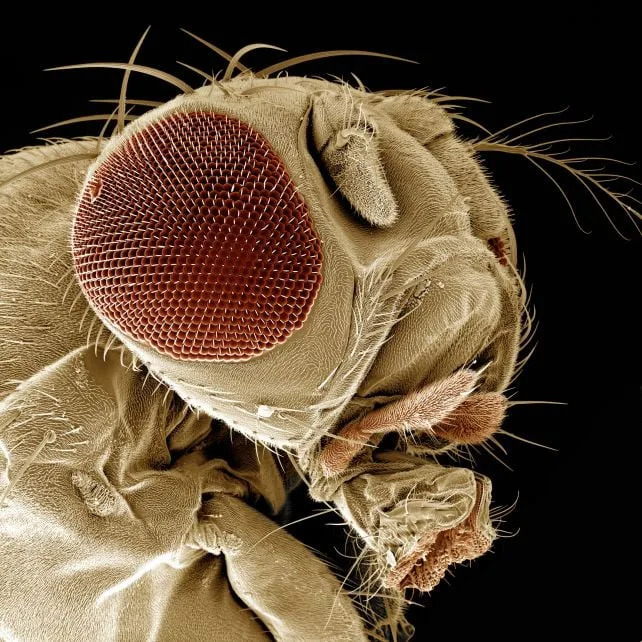
Fruit flies may be tiny, but they share many of the same molecular machinery involved in learning and memory, making them one of neuroscience's favorite model organisms. (David Spears FRPS FRMS/Corbis Documentary/Getty Images)
Hidden Traces and Context‑Dependent Recovery
To understand what changed in the brain, the team recorded activity from neural circuits known to support memory in flies. They observed that the neural pattern that directly drove avoidance gradually faded as behavioral recall declined. At the same time, an alternative activity pattern emerged in a separate neuronal population that does not normally influence immediate behavior. The authors describe this second pattern as a "silent memory trace."
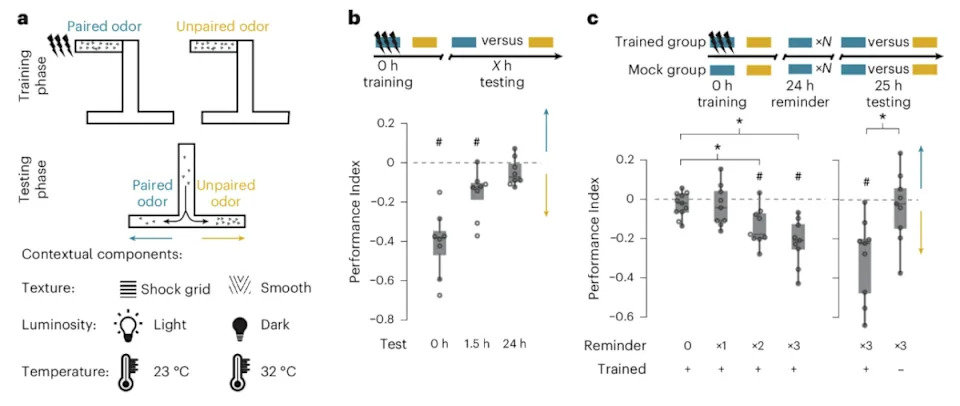
Flies were exposed to odors associated (or not) with an electric shock and different conditions as part of experimental training (a). The memory trace that drives learned avoidance behavior gradually decayed over 24 hours (b). Repeated reminders recovered forgotten memory in trained (+) but not mock-trained (-) flies (c). (Yang et al.,Nat. Neurosci., 2026)
When the full set of contextual cues was presented, activity shifted back into neurons that mediate avoidance and the memory influenced behavior again. Based on these results, the authors propose a dual‑state model in which memories are represented both as an active, behavior‑driving trace and as a latent, silent trace that can be reinstated under appropriate conditions.

Subscribe to ScienceAlert's free fact-checked newsletter
Reconstruction Can Produce False Memories
The recovery process was not always faithful. During training the flies were also exposed to a second, harmless odor that was never paired with shock. If that harmless odor was later used as the reminder within the training context, flies began to avoid it as though it predicted shock — effectively forming a false memory. Neural recordings indicated that accurate recovery and false reconstruction recruited different pathways, suggesting distinct mechanisms for faithful recall versus erroneous rebuilding of past events.
Implications, Limits, And Next Steps
The authors suggest the silent/active memory system could be adaptive: keeping a backup trace may prevent permanent loss and let the animal flexibly prioritize retrieval based on recent experience. But reconstruction carries a risk of distortion, which may sometimes produce false memories.
Important caveats apply: this work was done in fruit flies, which share conserved molecular mechanisms of learning with other animals, but the exact circuits and processes in mammals and humans remain to be tested. Future studies will need to determine the molecular and circuit‑level mechanisms that create and switch between silent and active states and to test whether similar processes operate in mammals.
Publication: The findings are reported in Nature Neuroscience. The study identifies a neural substrate for silent memory traces, shows that context‑rich reminders can restore inaccessible memories, and demonstrates that recovery can sometimes produce inaccurate recollections via distinct neural pathways.
Help us improve.