Researchers at the University of Tokyo made a photonic crystal from a 13‑sided 'einstein' (Smith hat) tile and observed a distinctive pinwheel diffraction pattern with stable Bragg peaks, demonstrating quasicrystalline long‑range order. Because the hat tile lacks mirror symmetry, the scattering showed chirality and a measurable dependence on circular polarization. The team aims to integrate this aperiodic pattern inside photonic chips to control light for optical communications and computing.
Scientists Build Photonic Crystal From 13‑Sided 'Einstein' Tile That Twists Light
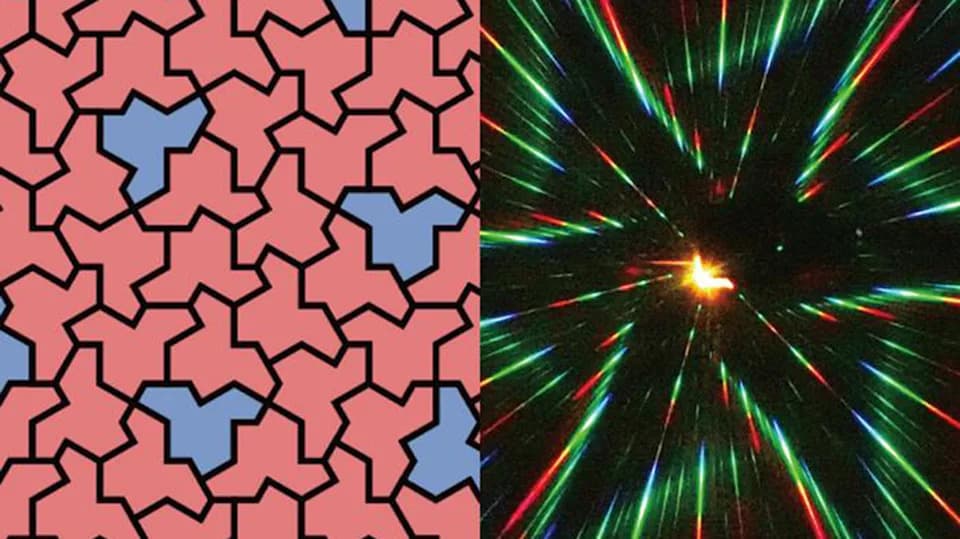
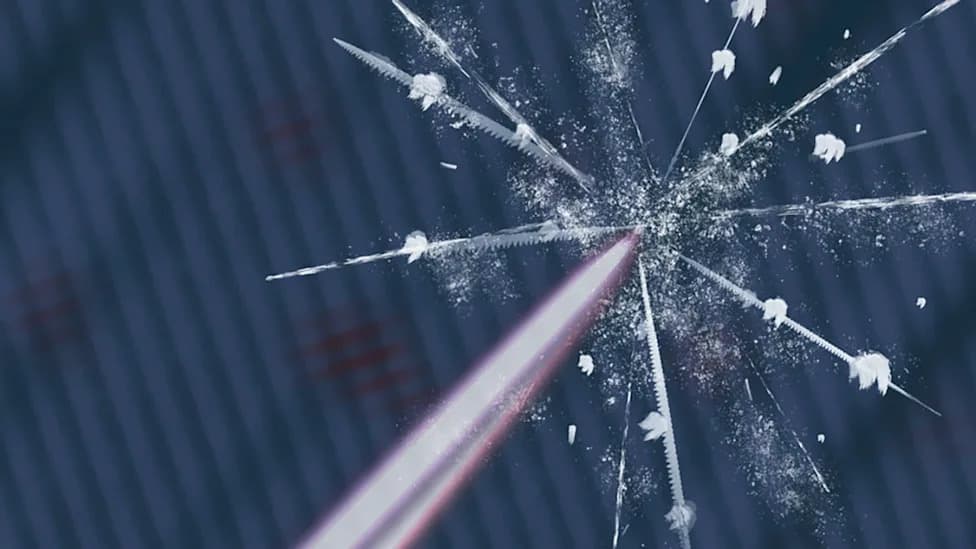
Researchers from The University of Tokyo demonstrated unique optical behavior from a long-sought aperiodic pattern. The pattern, nicknamed the 'einstein' (left) can fill a surface infinitely without repeating. | Credit: Institute of Industrial Science, The University of Tokyo
Physicists at the University of Tokyo have fabricated a photonic crystal using a never‑repeating 13‑sided tile — the so‑called 'einstein' or 'Smith hat' — and discovered it scatters light in ways ordinary crystals cannot.
A New Kind of Photonic Lattice
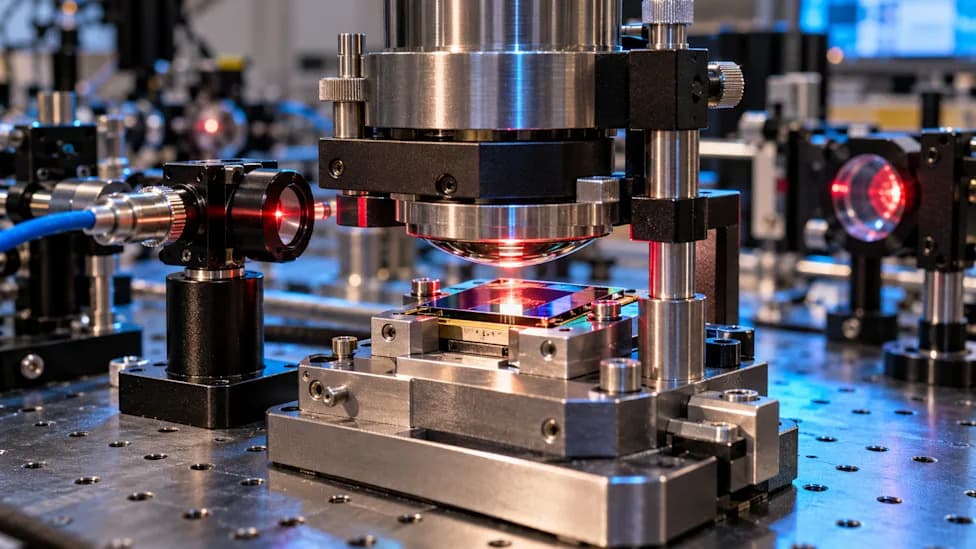
Reported July 29 in Nature Communications, the experiment replaces the usual periodic grid of a photonic crystal with an aperiodic layout derived from the hat tile. The research team used electron‑beam lithography and etching to pattern hundreds of thousands of nanoscale holes into a thin film of silicon nitride so the holes followed the hat‑tile arrangement. Each hole was roughly 100 nanometres in radius — about 500 times thinner than a human hair — and the pattern covered a chip roughly half a millimetre across, about the width of a pencil tip.
Pinwheel Diffraction and Quasicrystalline Order
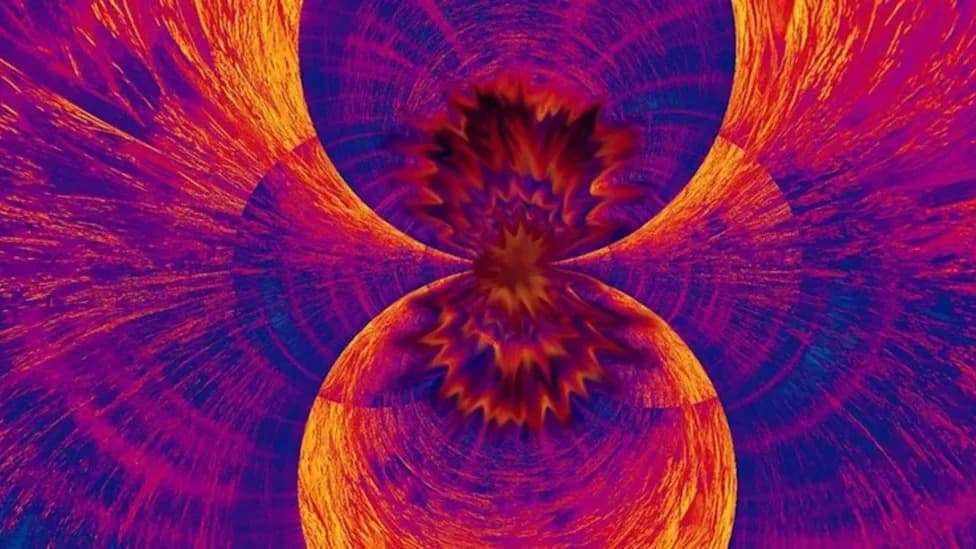
When the team illuminated the chip with a laser, the light diffracted into a swirling, pinwheel‑like scattering pattern. That diffraction image contained distinct bright spots known as Bragg peaks, and those peaks remained in the same positions no matter where on the chip the laser struck. This positional stability indicates long‑range, deterministic order without periodic repetition — the hallmark of a quasicrystal, whose internal pattern is ordered but nonrepeating.
Chirality and Polarization Dependence
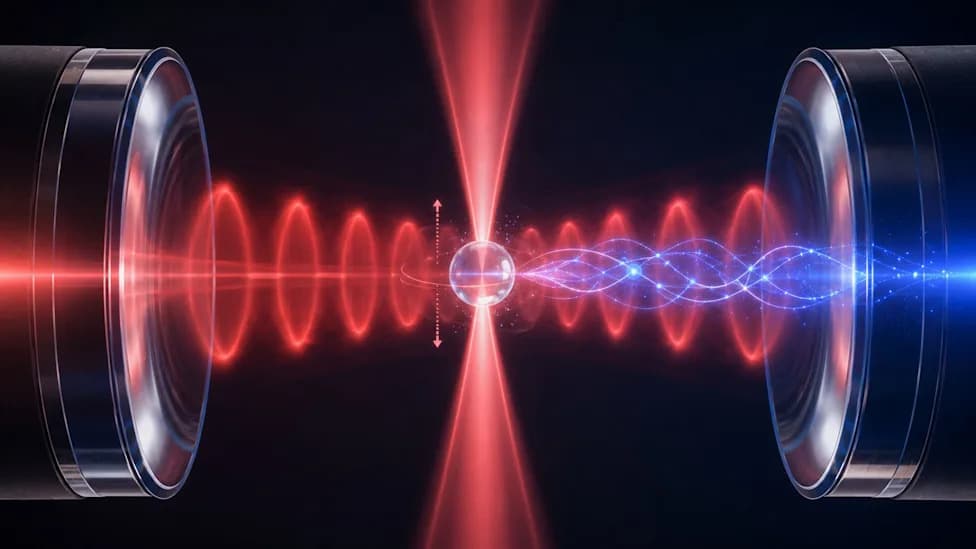
The hat tile itself lacks mirror symmetry — think left hand versus right hand — so the scattering pattern exhibited the same asymmetry, a property called chirality. That chirality produced the study's most surprising result: a measurable dependence of scattering on the circular polarization of incoming light. Circular polarization describes light whose electric field rotates clockwise or counterclockwise as it travels; the team observed subtle but reproducible differences in how clockwise and counterclockwise spinning light scattered from the chip. By contrast, ordinary quasicrystals that possess mirror symmetry cannot produce this effect.
'I decided to include it in our photonic crystal structure,' said Yuto Moritake, an experimental physicist at the University of Tokyo, describing how the hat tile inspired the project. He added that the circular‑polarization dependence was not something he initially expected to find.
Origins of the 'Einstein' Tile
The hat tile — a 13‑sided shape discovered in 2023 by David Smith and collaborators and nicknamed the 'Smith hat' — solves a decades‑old problem in tiling theory known as the 'einstein' problem. That puzzle asked whether a single tile could cover a flat surface without creating a repeating pattern. The name 'einstein' is a pun on the German phrase 'ein Stein' (one stone) and is unrelated to Albert Einstein.
Potential Applications and Next Steps
Going beyond surface scattering, Moritake and colleagues plan to embed the hat‑tile pattern into waveguides and other structures to control light traveling inside photonic chips. If the aperiodic layout and its inherent chirality can be harnessed on‑chip, they may enable new devices for optical communications, sensors, and optical computing that exploit polarization sensitivity and nonperiodic order.
This experiment demonstrates that substituting a single never‑repeating tile for conventional periodic lattices can produce novel optical responses in nanofabricated photonic structures, opening fresh avenues for devices that leverage quasicrystalline order and chirality at the chip scale.
Help us improve.