Theridion himalayana, a newly described spider from Uttarakhand, sports smile‑like abdominal markings and has been nicknamed the Himalayan Happy‑Face Spider. Fieldwork (Apr 2023–Oct 2024) yielded 61 specimens and revealed 32 color morphs grouped into five categories, with color patterns strongly associated with sex. Genetic data show an 8.5% divergence from Hawaii’s lookalike, indicating independent evolution. The tiny, non‑aggressive spiders live on leaf undersides and may be vulnerable to habitat disturbance.
Himalayan ‘Happy‑Face’ Spider Discovered: Theridion himalayana Unearthed in Uttarakhand
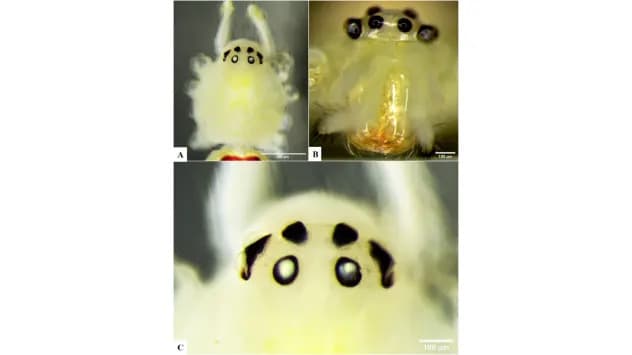
A. Cephalothorax of female holotype of T. himalayana sp. nov.; B. Showing the eye, chelicera and the fangs; C. Showing the eyes of the female. (Image credit: Ashirwad Tripathy and Devi Priyadarshini, Evolutionary Systematics)
Scientists have described a striking new spider species in the western Himalayas whose abdominal markings resemble a tiny smiling face. Published in the journal Evolutionary Systematics, the species has been named Theridion himalayana and is commonly called the Himalayan “Happy‑Face” Spider.
Field teams led by Ashirwad Tripathy and Devi Priyadarshini conducted surveys from April 2023 through October 2024 and collected 61 specimens across three sites in Uttarakhand, India. The spiders were most often found on the undersides of large leaves in Himalayan moist temperate deciduous forest, where their inverted webs—long silk strands running parallel to the leaf surface—are difficult to detect.
Color Diversity and Sexual Differences
Researchers documented remarkable variation in abdominal patterning: 32 distinct color variants ("morphs") were recorded and grouped into five principal categories. The study found a strong association between color pattern and sex, with males and females showing different predominant morphs. The authors say more research is needed to determine whether these differences are driven by genetics, ecology, sexual selection or developmental factors.
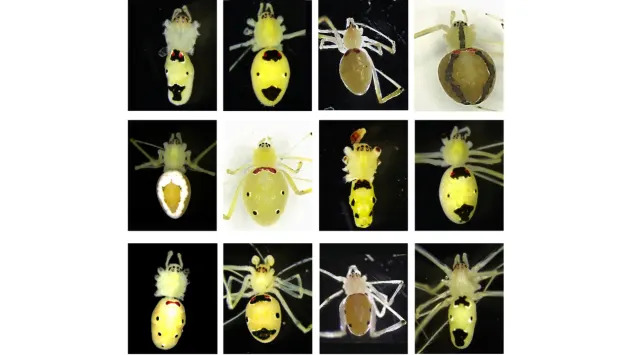
Collage showing morphs of some of the males and females in the population with different polymorphic patterns on abdomen. (Image credit: Ashirwad Tripathy and Devi Priyadarshini, Evolutionary Systematics)
Evolutionary Relationship
Although the Himalayan spider’s markings recall the famous Happy‑Face Spider of Hawaii, genetic analysis revealed an 8.5% sequence divergence between T. himalayana and the Hawaiian lookalike. That level of divergence supports the conclusion that the two species are not closely related and that their similar “smile” patterns evolved independently (a case of convergent evolution).
Size, Behavior and Habitat
The new species is very small: females measure about 2.94 mm in body length and males about 2.23 mm. Observers described the spiders as non‑aggressive and slow‑moving; individuals did not exhibit dramatic escape tactics such as jumping away or feigning death.
Specimens were recorded on a variety of broad‑leaved plants. One frequently observed host was ginger lily (Hedychium coronarium), a plant also associated with Hawaii’s Happy‑Face Spider—raising the intriguing possibility that this plant provides a favorable microhabitat for both species.
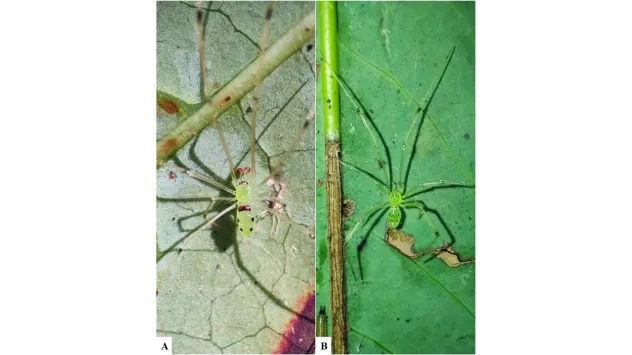
Habitus of live male (A) and female (B) Theridion himalayana sp. nov. (Image credit: Ashirwad Tripathy and Devi Priyadarshini, Evolutionary Systematics)
Conservation Concerns
Populations were observed near the National Highway close to Kedarnath Wildlife Sanctuary, exposing them to tourist traffic, construction and other human disturbances. "If the habitat gets further disturbed due to human activities, the spiders may lose their niche and microhabitat, which they occupy amidst vegetation," the authors warn. Because these spiders live almost exclusively on leaf undersides of certain broad‑leaved plants, they are vulnerable to vegetation changes caused by disease, land‑use change or deforestation.
"If the habitat gets further disturbed due to human activities, the spiders may lose their niche and microhabitat, which they occupy amidst vegetation," — Ashirwad Tripathy and Devi Priyadarshini.
Why It Matters
Studying Theridion himalayana can shed light on how a single species maintains extensive color and pattern diversity and how similar markings can evolve independently in geographically separated lineages. Continued field surveys, ecological study and genetic work will help clarify the drivers of polymorphism and inform conservation needs.
Image credits: Ashirwad Tripathy and Devi Priyadarshini, Evolutionary Systematics
Help us improve.