Verdict: False. Social posts claiming the CDC admitted COVID-19 vaccines are the "largest carcinogenic exposure in history" misrepresent the evidence. A CDC-hosted slide highlighted cancers occurring after vaccination only as a temporal association, not proof of causation. Two cited studies reported associations but have substantial limitations—one is under editorial investigation and both need longer follow-up and more rigorous analyses. Experts and the study authors conclude there is no established causal link.
Fact Check: CDC Did Not Say COVID-19 Vaccines Are The “Largest Carcinogenic Exposure In History”
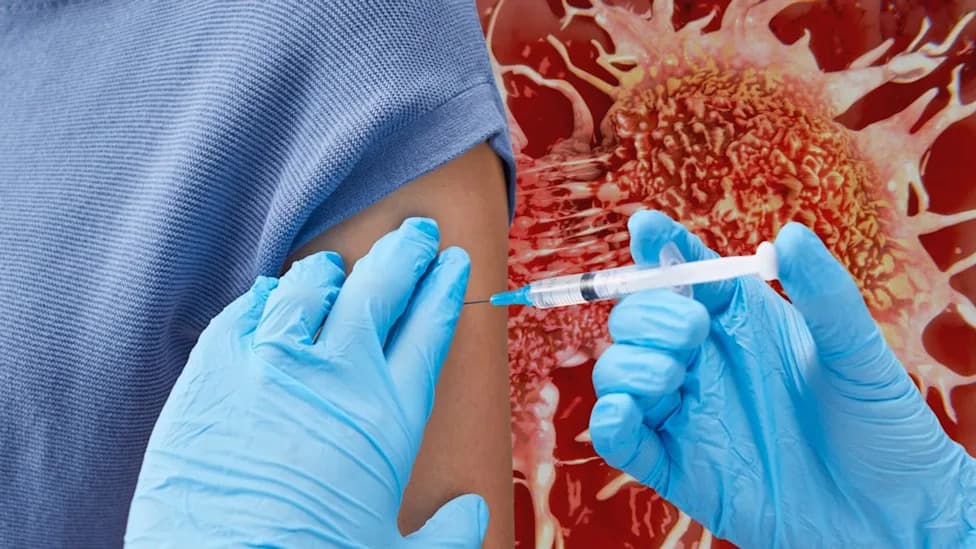
selvanegra and Aflo via Canva, illustrated by Snopes
Rumors circulated in mid-2026 claiming the U.S. Centers for Disease Control and Prevention (CDC) had "admitted" that COVID-19 vaccines are the "largest carcinogenic exposure in history." Those claims cited a CDC-hosted slide deck and two peer-reviewed studies as evidence. A careful review of the materials, however, shows no CDC statement or peer-reviewed paper that proves vaccination causes cancer.
What The Slide Deck Actually Said
The slide presentation by Wafik El-Deiry (Brown University) and Charlotte Kuperwasser (Tufts University) listed several cases of aggressive cancers diagnosed after COVID-19 vaccination and explicitly used the term temporal association to describe the timing. For example:
Cancers have been reported in mRNA vaccinated individuals in temporal association to immunization.
That language denotes timing (the cancers were diagnosed after vaccination) but does not demonstrate causation. The slide did not present evidence proving vaccines caused those cancers, nor did it contain an official CDC declaration that vaccines are a major carcinogenic exposure.
What The Studies Show And Their Limitations
Two peer-reviewed items commonly cited in social posts were:
- A September 2025 cohort letter in Biomarker Research analyzing health records for roughly 8.4 million people in South Korea, which reported statistical associations between COVID-19 vaccination and higher incidence of several cancers.
- A March 2025 EXCLI Journal study of 296,015 residents of Pescara province, Italy, which reported small increases in some cancer diagnoses after vaccination (signals strongest for colorectal, breast and bladder cancers).
Neither paper established a causal link. The South Korean letter has an editorial notice added by the journal in October 2025 saying concerns had been raised and that the editors were investigating. Independent commentaries have flagged major methodological concerns, including:
- Different start dates assigned to vaccinated vs. unvaccinated groups, which can bias incidence comparisons.
- Insufficient adjustment for prior SARS-CoV-2 infection (which some research suggests might itself have oncogenic effects), tobacco and alcohol use, family history, and genetic risk factors.
- Failure to address surveillance bias: people who pursue vaccination may also be more likely to get routine screenings, increasing the chance of detecting cancers.
The Italian study adjusted for prior infection, age, sex and some comorbidities, making it stronger in certain respects, but its authors acknowledged limitations: missing data on smoking, preventive-care behavior and other important confounders that could affect observed cancer rates.
Expert Reviews And Authors' Conclusions
A January 2026 review by El-Deiry and Kuperwasser examined both studies and explicitly stated that neither provides causal evidence linking COVID-19 vaccines to cancer. They and other independent researchers called for longer follow-up, molecular correlation, and re-analyses using target-trial frameworks with robust sensitivity checks to separate true biological effects from health-system or behavioral confounders.
Conclusion
Social posts that claim the CDC admitted COVID-19 vaccines are the "largest carcinogenic exposure in history" misrepresent the available evidence. The slide deck noted temporal associations but did not claim causation, the large South Korean analysis is under editorial scrutiny, and the Italian study had important data gaps. On balance, the evidence cited in these posts shows associations with substantial limitations—not proof that vaccination causes cancer. The rumor is false.
Selected Sources
- Kim HJ, et al. "1-Year Risks of Cancers Associated With COVID-19 Vaccination: A Large Population-Based Cohort Study in South Korea." Biomarker Research, Sept. 2025.
- Martellucci CA, et al. "COVID-19 Vaccination, All-Cause Mortality, and Hospitalization for Cancer: 30-Month Cohort Study in an Italian Province." EXCLI Journal, Mar. 2025.
- Locquet M, et al. "Commentary: 1-Year Risks of Cancers Associated With COVID-19 Vaccination." Frontiers in Public Health, Mar. 2026.
- El-Deiry WS, Kuperwasser C. "COVID Vaccination and Post-Infection Cancer Signals: Evaluating Patterns and Potential Biological Mechanisms." Oncotarget, Jan. 2026.
- Jahankhani K, et al. "Possible Cancer-Causing Capacity of COVID-19: Is SARS-CoV-2 an Oncogenic Agent?" Biochimie et Biophysica, Oct. 2023.
Help us improve.